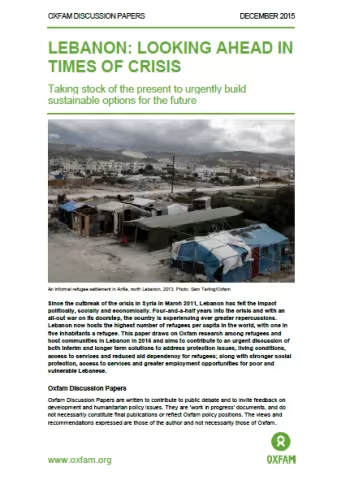
Considerable analysis has been undertaken to date on the challenges and impacts on and of Syrian refugees in Lebanon – including by Oxfam – but the bulk of this analysis is seen through the lens of the wider Syria crisis and often fails to take into consideration Lebanon itsel
In Lebanon, the question of hosting and ensuring protection for Syrian refugees in light of the government stance against the erection of camps has created many deliberations concerning different proposed and implemented shelter options and solutions. UN-Habitat, in partnership with the American University of Beirut’s (AUB) Issam Fares Institute for Public Policy and International Affairs (IFI), initiated a research study in July 2014 to address solutions for hosting and ensuring protection for refugees specifically on the subject of erecting camps to address the Syrian crisis. The study...
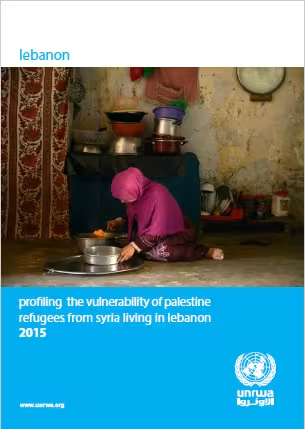
The “Profiling vulnerability of Palestine refugees from Syria living in Lebanon” report is a multi-sectorial analysis of the vulnerability experienced by the Palestine Refugees from Syria [PRS] according to the following sectors: economic; education; food-security; health; protection; non-food items; shelter and water, sanitation and hygiene. It provides information on the living conditions of PRS to inform decision-making on programmatic activities. The survey is based on the VASyR [Vulnerability Assessment of Syrian Refugees in Lebanon] and adapted for UNRWA’s specific context. Data was...
Since 2011, Lebanon has seen a huge influx of refugees fleeing the violence in Syria and currently hosts the biggest number of Syrian refugees in the world.
This paper was prepared by the Economic and Social Commission for Western Asia (ESCWA) as a background paper contributing to the Arab Sustainable Development Report. It focuses on gender equality as a core element to achieve sustainable development.
The Swiss Agency for Development and Cooperation (SDC) is pleased to share with you the report:
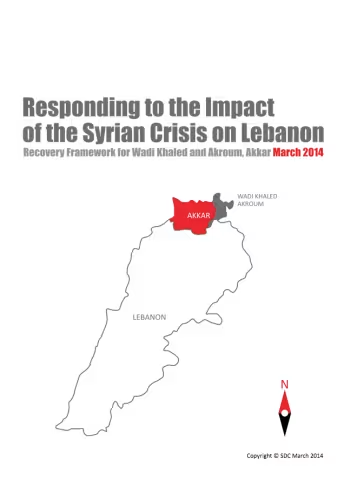
“Responding to the Impact of the Syrian Crisis on Lebanon: Recovery Framework for Wadi Khaled and Akroum, Akkar”, March 2014.
SDC facilitated a process to shed light on the impact of the Syria crisis at the national level but also on the local level. The formulation of a recovery framework for Wadi Khaled and Akroum is a process that can be replicated for other affected regions of Lebanon.
The findings and recommendations are based on consultations (between October 2013 and January 2014) with...
تسعى هذه الدراسة الى ما يعبّر عنه عنوانها: إثبات وجود تراتب اجتماعي في لبنان يقوم على المواقع المتفاوتة لسكانه من الاقتصاد والموارد والدخل والثروة وعلاقات الإنتاج والملكية. بعبارة أخرى، نريد منها إعادة الاعتبار لمفهوم الطبقة في إنتاج المعارف عن المجتمع والسلطة في لبنان
Over three years after it began, the Syria crisis continues to weigh extremely heavily upon Lebanon. Around a quarter of its population is now made up of refugees, whose needs remain dire even as the resources available to address them appear to be shrinking.
تسعى هذه السلسة إلى أن تكون مدماكا في بنيان الذاكرة الجمعية السورية في زمن الأزمة الكبرى التي تعصف بها . السلسلة مفتوحة أمام الجميع دون أي تمييز في الميول السياسية أو الإيديولوجية .
The continuing unrest in Syria is resulting in a growing influx of Syrian refugees to Lebanon. The United Nations High Commissioner for Refugees has registered over 57,000 Syrian refugees in Lebanon (September 7, 2012) while many refugees are awaiting registration.
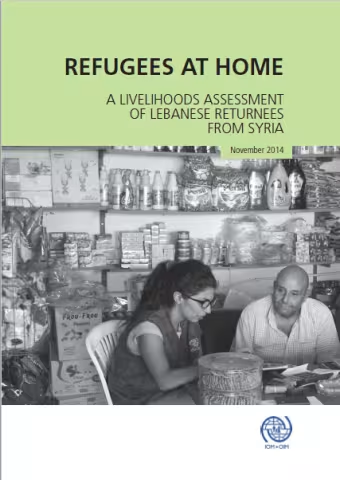
Since March 2012, several towns and villages in the North, the Bekaa and the South started receiving Lebanese families who fled Syria, against the backdrop of sectarian conflicts. Most of those families left their hometown decades ago and got Syrian citizenship.
This report is the result of 4 months of field data collection from April to August 2013 carried out in the Informal Tented Settlements (ITS) of the two districts of Zgharta and Minieh-Dennieh by SOLIDARITÉS INTERNATIONAL’s (SI) outreach workers.
The purpose of the needs assessment conducted in the Bekaa area is to identify the needs of Syrian refugees (SR), in terms of food, non food items (NFIs), shelter, water and education.
Swiss Solidar undertook a multi-sectoral needs assessment in August 2013 to assess the humanitarian needs of Syrian refugees residing in Nabatieh and Jezzine Districts in Southern Lebanon.1 Prior to undertaking its field assessment, Solidar undertook a detailed documentation r