تجاوز إلى المحتوى الرئيسي

موارد

Theme
Displaying 41 - 60 of 107
National
Publishing Date
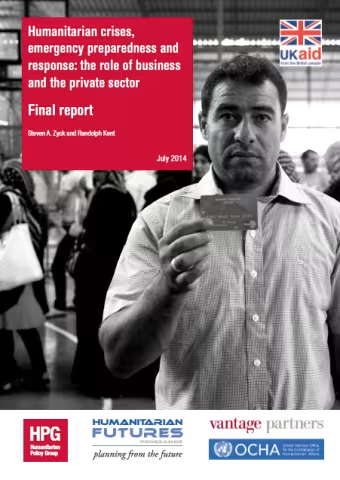
The private sector has long been a major contributor to humanitarian action. At the community level, businesses frequently use their materials and resources to aid people affected by crises. As local markets recover and supply chains are repaired, crisis-affected people are once again able to access basic goods and, in some cases, resume livelihoods. Large national, regional and multinational firms are also closely involved in supporting humanitarian objectives, whether indirectly, by resuming operations in crisis affected areas, or directly, by providing cash and in kind donations of goods or...
National
Publishing Date
The humanitarian aid system is growing and expanding, and so surely its capacity to meet these challenges should also be growing. Yet despite the enormous resources, in the more complex, less high-profile and difficult contexts, MSF teams in the field have seen that humanitarian responses to displacement emergencies have not occurred in a timely and effective way. This is especially the case in conflict areas. These observations have prompted MSF to conduct this review, to better understand how the humanitarian system is responding to acute displacement emergencies. The review is based on...
National
Publishing Date
Integrity’s research highlights that the truces agreed in several locations across Syria in the early months of 2014 do not represent the localised beginnings of a peacebuilding process. These agreements—and the negotiation and implementation processes that delivered them—were not built upon good practice and were significantly undermined by a lack of political will for peace from the outset. For opposition stakeholders, the truce agreements were a reaction to extreme levels of civilian suffering and a military capacity weakened by lengthy, government-enforced sieges. In all areas researched...
National
Publishing Date
This report is this first of a three-part series focusing on the current status and lessons learned relating to transitional justice and policing initiatives in opposition-controlled Syria. • Part I focuses on the effects of the departure of judicial and security elements of the Syrian state has had on conditions on the ground currently and on the nascent justice institutions that have emerged in this void (including levels of institutionalisation, Islamic law, and the legal systems currently being debated and trialed in some areas). • Part II examines the variety of institutions and...
National
Publishing Date
The growing influx of Syrian refugees to Lebanon has strained its socio-economic fabric, piling pressure on employment opportunities, housing, trade, and infrastructure capacities (basic services). Tensions between Syrian refugees and their Lebanese host communities have led to intercommunity clashes, and it thus becomes imperative to identify the indicators of social instability and ways to reduce them. A research project initiated by Save the Children (SC) and in association with faculty at AUB assessed the social psychological dimensions of Syrians and Lebanese relations in the Bekaa, Sahel...
National
Publishing Date
This report examines the role of gender in Lebanese security perceptions, Lebanese perceptions of security institutions, as well as gender dynamics within security institut
National
Publishing Date
This paper discusses the risk of a renewed civil strife in Lebanon as a result of the Syrian Crisis. It argues that the security situation inside Lebanon could deteriorate due to three interrelated spillover effects stemming from Syria’s ongoing civil war.
National
Publishing Date
India shifted to the side of US primacy in 2004, but since then its foreign policy has shifted once more to the middle. Sitting with a senior Indian diplomat, I mentioned that India seemed to be caught between two stools, US primacy and regionalism. “That’s an apt image,” he said, “except we have not fallen between the stools.” Things are more fraught now, and less clear. Talk of the peace pipeline and of linkages with Iran returned to the agenda after 2004. As US power enters a period of decline as a result of economic trials and two expensive and inconclusive wars, the moment of regionalism...
National
Publishing Date

Research Study | June 2013
Irish Peacekeeping in the United Nations Interim Force in Lebanon (UNIFIL) A Historical, Political, and Socio-Cultural Study by Rita Sakr
This study explores Irish peacekeeping within UNIFIL, since 1978 through the expanded UNIFIL after its formation in the aftermath of the 2006 Lebanon war, from historical, social, political, and cultural perspectives. The methodological approach relies mainly on interviews with a number of retired and active members of the Irish Defence Forces, academics, and journalists as well as primary and secondary sources including military...

National
Publishing Date
The continuing unrest in Syria is resulting in a growing influx of Syrian refugees to Lebanon. The United Nations High Commissioner for Refugees has registered over 57,000 Syrian refugees in Lebanon (September 7, 2012) while many refugees are awaiting registration.
National
Publishing Date
This report constitutes the final publication of the outcomes of the program "Development in Lebanon: Poverty Eradication, Gender Equity and Youth Participation; the Role of NGOs Civil Society and Other Actors".
National
Publishing Date

Research Report | January 2013
Lawfare and Armed Conflict: Comparing Israeli and US Targeted Killing Policies and Challenges Against Them by Lisa Hajjar
The term lawfare, an amalgamation of “law” and “warfare,” is used in reference to various kinds of legal challenges to state policies and practices in the realm of national security. Unsurprisingly, it has a negative connotation among those who oppose efforts to legally constrain state prerogatives, to fetter the discretion of officials in their pursuit of national security goals, and to pursue accountability for violations. This article...

National
Publishing Date
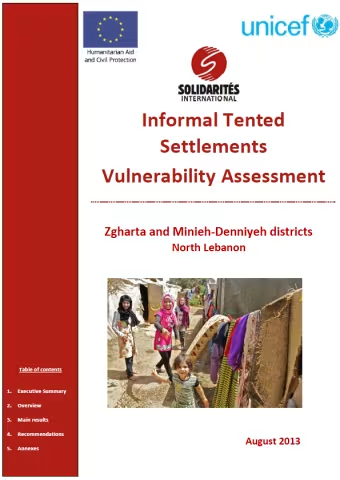
The purpose of the needs assessment conducted in the Bekaa area is to identify the needs of Syrian refugees (SR), in terms of food, non food items (NFIs), shelter, water and education.
National
Publishing Date
This operational guidance note is anchored on the principles of universal health care for all persons of concern fleeing the ongoing conflict in Syria and in need of international protection in Lebanon.