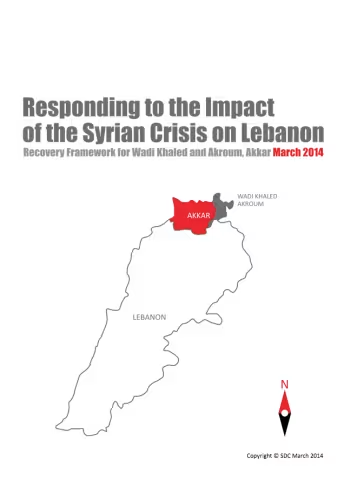
The Swiss Agency for Development and Cooperation (SDC) is pleased to share with you the report:
“Responding to the Impact of the Syrian Crisis on Lebanon: Recovery Framework for Wadi Khaled and Akroum, Akkar”, March 2014.
SDC facilitated a process to shed light on the impact of the Syria crisis at the national level but also on the local level. The formulation of a recovery framework for Wadi Khaled and Akroum is a process that can be replicated for other affected regions of Lebanon.
The findings and recommendations are based on consultations (between October 2013 and January 2014) with...
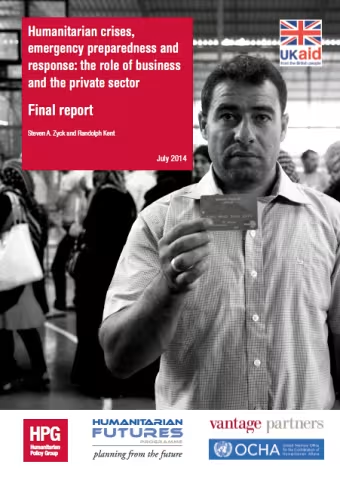
The private sector has long been a major contributor to humanitarian action. At the community level, businesses frequently use their materials and resources to aid people affected by crises. As local markets recover and supply chains are repaired, crisis-affected people are once again able to access basic goods and, in some cases, resume livelihoods. Large national, regional and multinational firms are also closely involved in supporting humanitarian objectives, whether indirectly, by resuming operations in crisis affected areas, or directly, by providing cash and in kind donations of goods or...
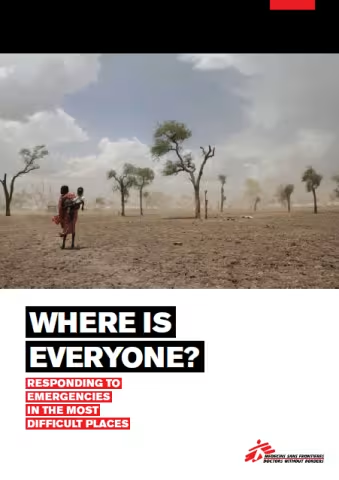
The humanitarian aid system is growing and expanding, and so surely its capacity to meet these challenges should also be growing.
Yet despite the enormous resources, in the more complex, less high-profile and difficult contexts, MSF teams in the field have seen that humanitarian responses to displacement emergencies have not occurred in a timely and effective way. This is especially the case in conflict areas.
These observations have prompted MSF to conduct this review, to better understand how the humanitarian system is responding to acute displacement emergencies. The review is based on...
This report is this first of a three-part series focusing on the current status and lessons learned relating to transitional justice and policing initiatives in opposition-controlled Syria. • Part I focuses on the effects of the departure of judicial and security elements of the Syrian state has had on conditions on the ground currently and on the nascent justice institutions that have emerged in this void (including levels of institutionalisation, Islamic law, and the legal systems currently being debated and trialed in some areas). • Part II examines the variety of institutions and...
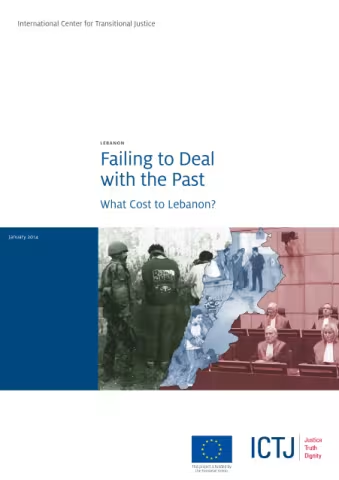
This paper examines the situation of impunity in Lebanon that has persisted since the 1975–1990 war. It highlights the price of the Lebanese authorities’ failure to address the legacy of past conflict.
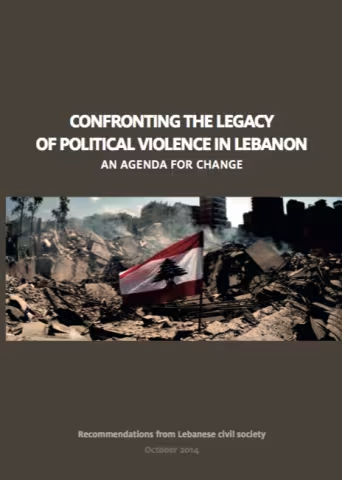
This study recommends a holistic approach to crafting a comprehensive and victim-centered transitional justice process in Lebanon. An incremental approach to reform would be of value, given the likely challenges to pursuing accountability in the country. Programming must involve state and nonstate actors—political and community leaders, civil society, and the broader public. In addition, human...
This report examines the situation of impunity in Lebanon that has persisted since the 1975-1990 war through the lenses of core elements of transitional justice.
This report examines variations in wartime experiences and the attitudes of residents in Greater Beirut regarding measures to confront Lebanon’s legacy of political violence.
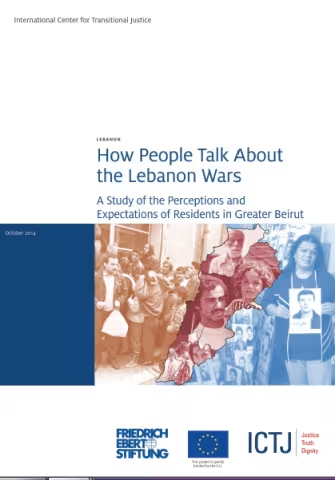
This report presents qualitative data collected by ICTJ on how individuals in Greater Beirut talk about the Lebanon wars and the need for truth, justice, and an end to violence in their country.
This paper highlights the specificity of the refugee crisis in the unstable Lebanese landscape and calls for the reconfiguring of current relief mechanisms by enabling decentrali
This paper discusses the risk of a renewed civil strife in Lebanon as a result of the Syrian Crisis. It argues that the security situation inside Lebanon could deteriorate due to three interrelated spillover effects stemming from Syria’s ongoing civil war.
The continuing unrest in Syria is resulting in a growing influx of Syrian refugees to Lebanon. The United Nations High Commissioner for Refugees has registered over 57,000 Syrian refugees in Lebanon (September 7, 2012) while many refugees are awaiting registration.
This report constitutes the final publication of the outcomes of the program "Development in Lebanon: Poverty Eradication, Gender Equity and Youth Participation; the Role of NGOs Civil Society and Other Actors".
This report is the result of 4 months of field data collection from April to August 2013 carried out in the Informal Tented Settlements (ITS) of the two districts of Zgharta and Minieh-Dennieh by SOLIDARITÉS INTERNATIONAL’s (SI) outreach workers.