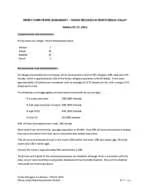
28 refugee households were surveyed, which represented a total of 501 refugees, 48% male and 52% female, which is approximately 11% of the Syrian refugee population in North Bekaa.
The National Report for the United Nations Conference on Sustainable Development (Rio + 20) presents the current situation as is and highlights the achievements and failures, strengths and weaknesses, opportunities and risks.
The Strategic Planning is based on the findings of fieldwork carried out in several villages in Dinnieh, which aimed at identifying the major characteristics of the region in different fields.
Although Lebanon is known in the Middle East for its relative political openness and for the degree of freedom Lebanese women enjoy, it paradoxically has one of the lowest rates of women’s political engagement in the region.
The State and Trends of the Lebanese Environment report provides an overview of the current condition of natural resources and environmental management in the country. Furthermore, it gives an analysis of past and future developments across multiple different sectors.
This edition of the Global Education Digest (GED) explores the changing patterns in gender and schooling throughout the formal education system – from primary to tertiary education levels.
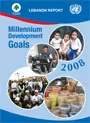
The report assesses the progress made in the achievement of the Millennium Development Goals (MDGs) based on new national data which was formulated after the first MDGR that was published in 2003.
Review of marginalisation of people with disabilities in Lebanon, Syria and Jordan. Using a social exclusion conceptual framework, this paper identifies several causes of marginalization of people with disabilities in the context of the MENA region.
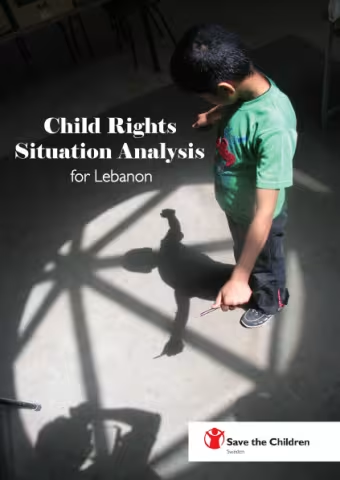
The Convention on the Rights of the Child is the most widely ratified international convention, confirming the commitment of the international community and governments around the world to the well-being and protection of the child.
This Country Study is based on a full national report that is the first to draw a profile of poverty in Lebanon based on money-metric poverty measurements of household expenditures.
The Israeli July 2006 war exposed the Lebanese population to disastrous conditions. It has profoundly affected residents’ livelihoods through bringing down access to services, infrastructure and natural resources. Responding to these emerging problems poses further challenges for the Lebanese government and society. In this respect, different emergency measures have been undertaken to address the arising needs, starting with assessing physical, economic and social damages.
As a contribution to identifying short and medium term intervention needs, the World Bank initiated undertaking a Post...
“Moukhtar” booklet provides guidelines for municipality leaders and mayors, on how to effectively implement practices and procedures that would benefit the local community, whether in regular daily activities or in conflict situations.
تشارك بما تقوم به حاليا بعض الجهات (جمعيات، تجمعات، أفراد...) في مجال التدخل التربوي (دعم اجتماعي نفسي للشباب والأطفال، نشاطات متنوعة مع الشباب والأطفال...) في الضاحية والبقاع والجنوب واحتمالات تدخل اليونسكو
This article addresses the public policy concept of gender mainstreaming and the extent of its efficacy since the 1995 Beijing Platform for Action (PfA) and the UN's adoption thereof in 1997.
This reference book includes chapters on resources, legal and integral frameworks, and the constitutional structure of NGOs. It aims at contributing to reinforce the role of civil society in the economic and social development of Lebanon.
In the framework of “Towards a National Dialogue on Corruption in Lebanon”, the United Nations Development Programme and the Lebanese Transparency Association were able to lay down the foundation of anti-corruption modules as translated into the document entitled “Towards a Na