This report constitutes the final publication of the outcomes of the program "Development in Lebanon: Poverty Eradication, Gender Equity and Youth Participation; the Role of NGOs Civil Society and Other Actors".
Since March 2011 and the continuously escalating crisis in Syria, Lebanon (along with Jordan, Iraq and Turkey) has been a refuge area for Syrian families fleeing the instability and violence in their country.
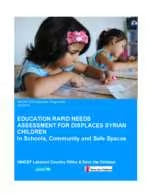
This report places the spotlight on children, hearing from them the biggest challenges they face each day. We visited with 100 Syrian children, aged 7-13 in Central and West Bekaa.
Severe weather struck the country this week, affecting Syrian refugees sheltered in the mountain region of Bekaa. Heavy rains and snowfall have flooded some settlements, and a number of refugee families were forced to seek shelter elsewhere.
UNHCR’s Policy Development and Evaluation Service (PDES) is committed to the systematic examination and assessment of UNHCR policies, programmes, projects and practices.
28 refugee households were surveyed, which represented a total of 501 refugees, 48% male and 52% female, which is approximately 11% of the Syrian refugee population in North Bekaa.
Although Lebanon is known in the Middle East for its relative political openness and for the degree of freedom Lebanese women enjoy, it paradoxically has one of the lowest rates of women’s political engagement in the region.
The report assesses the progress made in the achievement of the Millennium Development Goals (MDGs) based on new national data which was formulated after the first MDGR that was published in 2003.
The Convention on the Rights of the Child is the most widely ratified international convention, confirming the commitment of the international community and governments around the world to the well-being and protection of the child.
This study was envisioned by KAFA in partnership with Save the Children Sweden following the encounter with several child sexual abuse victims at the end of the July 2006 war.
This report, compiled by Pernilla Ouis and Tove Myhrman, is a comparative situation analysis of honour violence, early marriages and sexual abuse in Lebanon, the Occupied Palestinian Territories and Yemen.