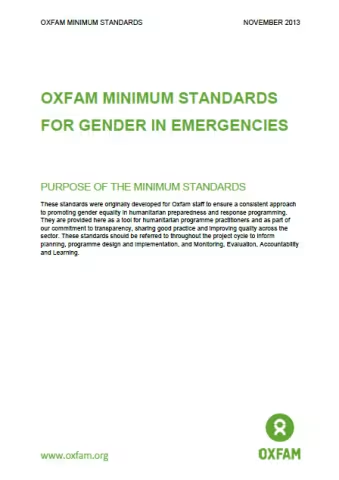
This resource, published by Oxfam in 2013, aims to present standards that were originally developed for Oxfam staff to ensure a consistent approach to promoting gender equality in humanitarian preparedness and response programming.
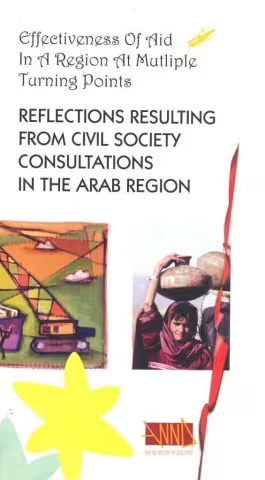
This book tackles key Issues of concern within the aid discussion. It outlines issues of particular importance for civil society in the Arab region and highlights the difference of prospectives between government representatives and CSOs.
The Strategic Planning is based on the findings of fieldwork carried out in several villages in Dinnieh, which aimed at identifying the major characteristics of the region in different fields.
This report will provide a description of the assessment conducted by IMC’s Mental Health and Psychosocial team in the region of Wadi Khaled following the displacement of Syrians into the northern villages between the Lebanese-Syrian borders as a result of the internal conflic
Accountability has many meanings. Traditionally, it was understood as the was in which those who authorised others to act on their behalf made sure that authority was being used as agreed.
The Manual on the Internal Management of the Non Governmental Organizations (NGOs) in Lebanon aims at providing a practical tool to develop and build the capacities of the NGOs in Lebanon.
This paper seeks to explain why women remain marginal in the Lebanese economy. It conducts a thorough review of literature to shed light on the economic, social and legal context to identify barriers to their full participation.
Pcode is an abbreviated term for 'Place Code'. P-codes are similar to zip codes and postal codes and are part of a data management system that provides unique reference codes to over a thousand locations in the Darfur region.
The Universal Declaration of Human Rights, proclaimed by the United Nations General Assembly on 10 December 1948, grants to everyone the right to seek, receive and impart information and ideas through any media and regardless of borders (Article 19).
Why would a reference book addressing non-governmental organizations (NGOs) of different sizes, interests, and functions begin with a discussion on development?
A simple answer to this very relevant question is that development is the ultimate aim and objective that underlies the work of each and every NGO, association, trade union, and civil society institution. In other words, development is a common ground for all these organizations, as well as the long-term goal that enables them to broaden their range of activities, to cooperate with others, and to expand their scope from the local to...