
Source: Rayanne Chammas
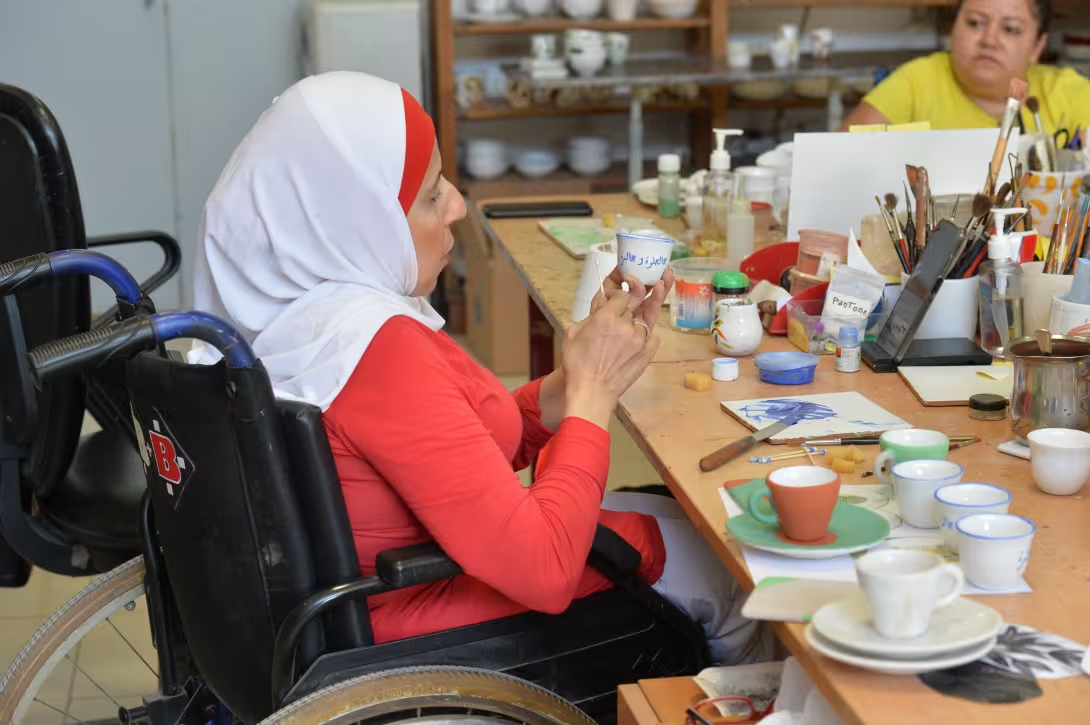
To Nour, an ambitious and motivated individual, a job interview is not just a one hour meeting, but rather a very well planned day, starting hours earlier, to accommodate for accessibility barriers. As a person with disabilities, power cuts, inaccessible transportation, uncertainty with finding assistance, inaccessible streets, and many more hurdles add to the complexity of her situation, all before she even reaches the interview room. Nour’s experience is not unique to her; many people with disabilities face similar challenges on a daily basis, not only pertinent to effort but also additional costs, making it more difficult for them to compete with others at an equal footing. Arcenciel assists hundreds of similar cases, working alongside both individuals and companies to overcome barriers and ensure full inclusion in society.
Arcenciel is one of the major non-governmental organizations (NGOs) in Lebanon, recognized as being of “public interest” in 1995 by Presidential Decree No. 7541, for being apolitical, non-confessional and serving all vulnerable people without distinction. Its mission is to “engage in the sustainable development of society by supporting fragile groups and integrating marginalized people.” Arcenciel is unique in involving “the vulnerable person in difficulty at the service of the person in need.” Arcenciel’s social entrepreneurship model is specifically designed to combine social impact with economic activity. By integrating marginalized individuals, notably those with disabilities whether physical or mental, Arcenciel serves its mission in contributing to sustainable development, placing those individuals as service providers themselves. 33% of the staff volunteers at Arcenciel have a disability whether physical, mental or intellectual while others face social challenges that make it difficult for them to compete in the job market. This inclusive approach ensures employment opportunities for individuals often excluded from the workplace while also strengthening the relevance of the services provided.
Arcenciel also follows a strategic approach called Community Based Inclusive Development (CBID) that consists of identifying and aligning both the needs and the resources in communities across Lebanon, thus generating both economic and social value.
To guarantee its independence, arcenciel adopts the social entrepreneurship model in most of its operations, maintaining a social and an environmental purpose, while keeping the economical dimension essential for its survival. Arcenciel was 80% financially independent up to 2019, with a successful business model generating funding to cover all activities including social support. This model was jeopardized in 2020 when public sector spending was halted including the Ministry of Social Development’s contract based budget for empowering people with disabilities. The law 220/2000 that restitutes the rights of people with disabilities was possible through the budget of the ministry. Subsequent to the financial crisis of 2019, this law could no longer support the needs of right holders because of budget cuts. With that, twenty years of service through disability equipment provision came to an end.
Faced by this challenge, arcenciel increasingly developed different income generating activities in agriculture, material valorisation and service provision, in line with principles such as sustainability, trust and collaboration. These are crucial because they touch upon multiple key themes including ideas that support is not always financial, even if it happens through traditional donors, solidarity and collaboration with other stakeholders ensure survival in difficult times where few funding resources are available, optimization of resources by referring cases to partners, instead of poorly executing them with limited means, and most importantly not everyone is an entrepreneur and not all entities can become social enterprises.
Social entrepreneurship is the most difficult and challenging business model requiring:
- Passion of a business entrepreneur who follows a gut feeling based on market needs, experience and exposure, forgetting one’s comfort zone and drowning in work. Pain of a social entrepreneur, who adds a layer of concern for a social and/or environmental cause, left out by the public authorities concerned. Patience to work steadily but surely because staff and beneficiaries rely on the enterprise for survival. Perseverance is also needed to learn from one’s mistakes and try again with improvements. There’s no room for giving up.
- Trust is another major element that must be nurtured if you intend to rally others to your cause. Needed support is usually financial, but it can also be in-kind or through volunteering and expertise sharing. It is built over time and can easily be lost for lack of consistency or transparency in activities. When trust is acquired, you can develop sufficient donor support in multiple ways including capacity strengthening and sharing.
- Solidarity and collaboration with other stakeholders ensure survival in difficult times where few funding resources are available. Referring cases to partners, instead of poorly executing with limited means, will certainly pay back in the future through other opportunities. Referring suitable professionals is more efficient than spending time and effort in acquiring the required skills. Optimization of resources is key to success, provided that the referred organizations share our values and are willing to reciprocate.
Arcenciel's founders had a dream to sustain the organization through income generating activities, without realizing that they were acting as social entrepreneurs. Inspired by their scout promise, they laid the foundation for peace and development for the past forty years. The organization thrives today thanks to the efforts of its volunteers, serving with love and humility.
Date of publication
Location
Lebanon