
Source: Miriam Younes
In the early hours of 2 March, most people in Beirut woke up to the thunderous sound of multiple explosions, marking the beginning of a new escalation in Israel's war on Lebanon. The bombs struck several areas within the Dahieh district, including Bir al-Abed, al-Ruwais, Haret Hreik, the Sayyed Hadi Nasrallah Highway, Saint Therese, Burj al-Barajneh, and al-Kafaat, while areas in the South and the Bekaa Valley were hit simultaneously.
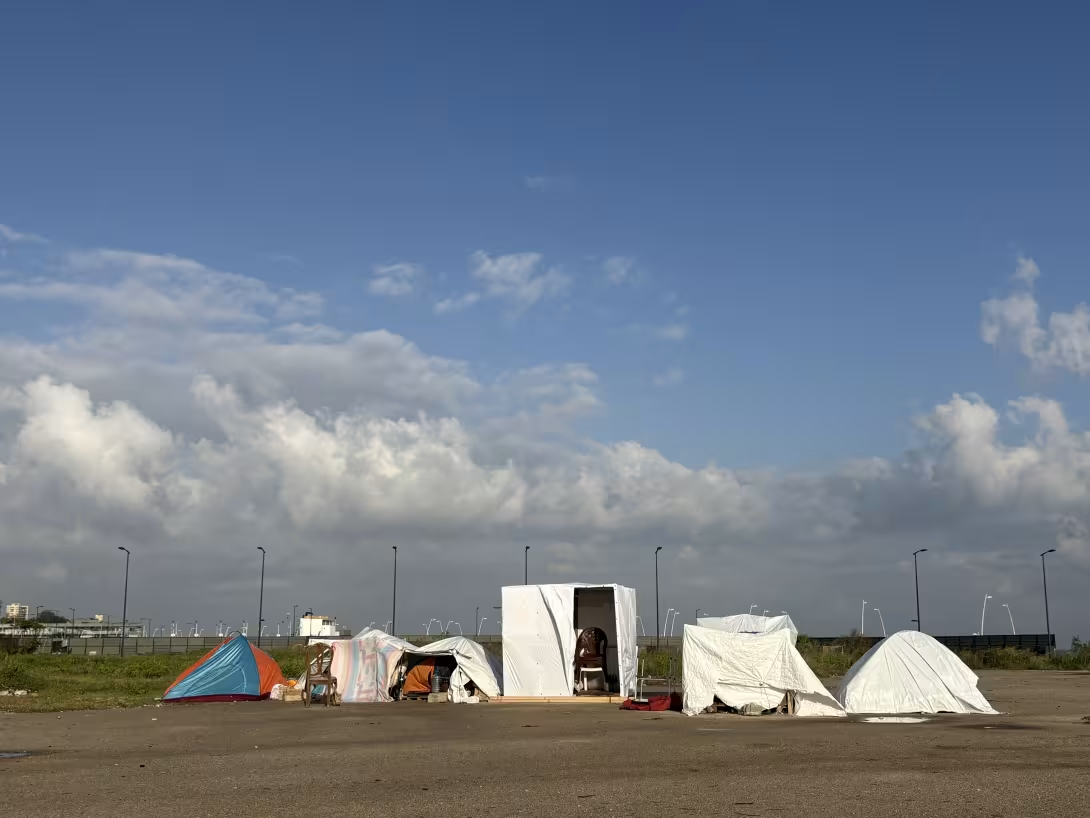
Within half an hour, the roads leading from the South, the Bekaa, and the southern suburbs into Beirut were filled with people fleeing, many in their cars, others on foot, some still in their pyjamas, carrying children and whatever basic belongings they could grab. Within a few hours, schools were converted into temporary shelters for the displaced. Some people managed to find refuge with friends or family, while many were left stranded on the streets with nowhere to go.
Activating the network
That same night, and increasingly through the following morning and days, many people stepped up to address the needs of the displaced, helping with logistics and the provision of essentials such as mattresses, tents, blankets, clothes, hygiene products, food, and water. While some of these immediate relief efforts were initiated and managed by national or international NGOs, many consisted of small grassroots and volunteer-led groups, several of which had also been active during the previous escalation in October 2024. Ziad, a young man who supported displaced people in Beirut alongside a group of volunteers, recalls:
"The last war was my first war, in 2006 I was still a child. At the beginning, I felt so useless, wondering what to do, until some friends asked if I wanted to help them support the displaced. That's how I got started. This time, we decided right away to do the same. It was horrible to see everything happening again in the space of a single night. But what helped was that our network was still in place: we knew what needed to be done and how to do it. We just had to activate it again."
In the weeks that followed, Ziad and his friends did exactly that: day after day, they collected and distributed clothes, mattresses, tents, blankets, cushions, hygiene products, medication, toys, and food to the many displaced people in and around Beirut. They also connected with other initiatives to share best practices and experiences, support one another, and coordinate their relief efforts. While many of these connections drew on relationships forged during the previous war, new ones are formed as well. Maha, who is active in a student network from her faculty supporting displaced people in Chweifat and Khalde, described how many people reached out to her on Instagram after seeing their daily work and asking either for support or to offer their help:
"Social media and WhatsApp groups play a huge part in networking and outreach, because everything has to move so fast.”
Many volunteers describe their primary motivation for supporting the displaced as a national or humanitarian duty in the face of injustice, suffering, and violence, one they also understand as a political stance. Ziad describes the driving force behind his daily efforts: "For me, the main reason is the feeling that I have to do something about the inequality I witness. Why do I have money, food, and a home when others don't? I'm also aware that at any moment, this could be me, I could be one of them, and I would need people to support me. And I think a third reason I do this is to take a stand against the Israeli aggression on our country, but also against our politicians and our political system. I want people to know that I help them as a human being, not because I belong to a specific group or party. I want us to get through this crisis together and come out stronger."
Exhaustion and the impossibility of planning
By the time the interviews for this article were conducted, the war had entered its sixth week, with no ceasefire or end to the conflict in sight.1 Bombings continued daily, and an estimated one million people remained displaced. For many of the volunteers interviewed, two pressing questions had begun to emerge: the relentless urgency of immediate needs, and the long-term sustainability of their initiatives. Wissam, a middle-aged man who founded a small initiative to support displaced people during the previous war, describes the impossibility of planning as the greatest challenge:
"In the end, this is something we do on top of everything else. The war starts, we put our lives on hold, just to help. We work like ants, every minute and every hour spent collecting things, sorting and distributing them, raising money, allocating it, spending it so we can distribute more. Listening to people, understanding their needs, and trying to meet them. And we have no idea: will this go on for another week, another month, maybe even years? There is no way to plan our lives alongside this work, or to imagine any kind of future, for us individually or for the country, society at large. And until the war ends and people can go home, to houses and neighbourhoods that are actually liveable, where there is no longer any danger, until that happens, there is no way we can stop."
Maha echoes this: " In this work, there is no way to plan ahead: one day you need blankets because it's cold, the next day people need soap and cleaning supplies because they want to clean the toilets in the school, and then someone calls in urgent need of medication that costs around 150 USD. Everything has to be there immediately. If we don't share our work and our needs with others, we can't get anything done. A donor organisation asked me to estimate our needs within a budget. How am I supposed to do that? What is the timeframe — two months? A year? How can I know? We could spend thousands of dollars every day, but for now we are trying to save as much as possible, relying mainly on donated goods so that we have some reserves for whatever comes next."
Over time, the combination of being constantly on call, responding to an endless stream of shifting urgent needs, and having no clarity about the future has produced a particular kind of exhaustion, and, for many volunteers, a growing frustration. They do not know how to plan: not their daily lives, not any short- or long-term future. And yet they feel they are never doing enough. “The feeling of not doing enough isn't just about having to say no when I can't provide something. I'm only part of a small initiative; I'm not a state institution. It's more of a sense of needing to be doing something constantly. I want to rest, but I know I could still go and pick up some blankets from somewhere and bring them to people who are cold. So what do I prioritise? How do I divide my time? I have no idea, and that is what is so exhausting.”
Sustainability, return, and the role of the state
Looking ahead into an uncertain future, many volunteers foresee serious challenges regardless of how the war unfolds. Rania, who volunteers with an initiative that was already active before the recent escalation to support people in the south, anticipates a particularly difficult moment when the displaced are finally able to return home: “Once they can actually go back, that is when our real challenge begins. We will need to support them as much as possible with everything at our disposal, so that they can rebuild their homes and their lives. But I am also afraid that if the war drags on and people remain in shelters and on the streets, the public will lose interest and stop donating or helping. Sustaining these efforts over a long period will be very difficult.”
This concern points to a broader issue that many of those involved in grassroots relief work think about: the question of where voluntary effort ends and state responsibility begins. As Ziad puts it: “At some point, the state has to step in. As NGOs and small initiatives, we cannot compensate for what is ultimately a failure of governance. We can sustain this for a month, maybe two or three, but if it goes on longer, the state has to take over, because things will spiral out of control. The only real solution is for the state to be far more involved than it is right now.”
Yet for now, this involvement remains largely absent, and it is the volunteers who fill the gap, day after day, despite their own fatigue, challenges, and doubts about the future.
1 At the time of publishing, the war is still ongoing in spite of a ceasefire agreement.
Date of publication
Location
Lebanon