International Medical Corps Lebanon began providing services for Syrian refugees in September 2011 in North Lebanon. Since then, International Medical Corps has scaled up considerably, both geographically and in terms of types of services offered.
In August, International Medical Corps:
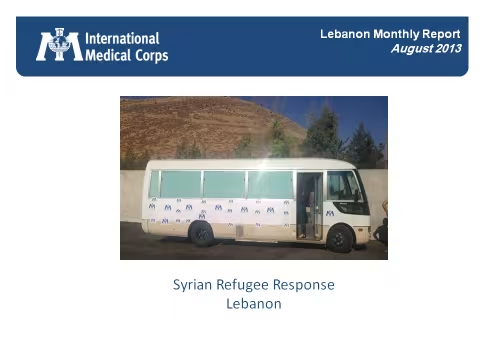
mobilized a mobile medical unit for the Masnaa border crossing
provided ToT training for 54 Syrian refugee women on health-related topics
supported over 14,000 primary health care (PHC) consultations
admitted 2,600 patients for hospitalization
completed two mental health GAP refresher trainings for 24 PHC...
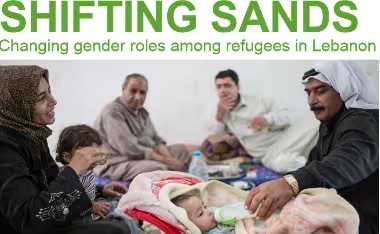
Shifting Sands: Changing gender roles among refugees in Lebanon is new study published by ABAAD-Resource Center for Gender Equality and Oxfam GB. The study explores the different pressures facing men and women refugees from Syria living in Lebanon from a gender perspective. It highlights the gendered impact of the crises on women, men, boys and girls. Key research findings highlight changes in gendered norms, values and identities, as well as changes in levels of gender-based violence, protection and emotional stress. Moreover, the study depicts changes in gendered access and control over...
International Medical Corps Lebanon began providing services for Syrian refugees in September 2011 in North Lebanon. Since then, IMC has scaled up considerably, both geographically and in terms of types of services offered.
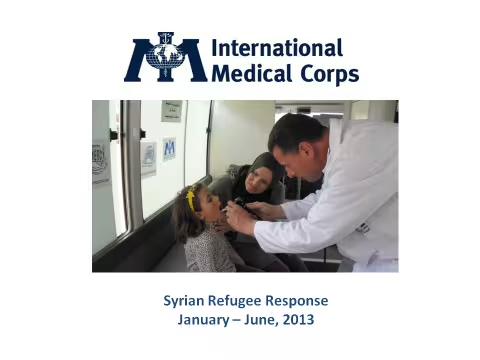
In the health sector International Medical Corps is at the forefront of the emergency response effort, providing services for both registered and nonregistered refugees. In the first six months of 2013, through its primary, secondary and mental health care programs across Lebanon, International Medical Corps has:
• Provided 53,885 primary health care consultations;
•...
The continuing unrest in Syria is resulting in a growing influx of Syrian refugees to Lebanon. The United Nations High Commissioner for Refugees has registered over 57,000 Syrian refugees in Lebanon (September 7, 2012) while many refugees are awaiting registration.
The number of Syrian refugees registered in Lebanon has more than quadrupled over the past six months. On January 1, 2013 Lebanon was hosting some 130,000 refugees; today that figure stands at more than 600,000.
The purpose of the needs assessment conducted in the Bekaa area is to identify the needs of Syrian refugees (SR), in terms of food, non food items (NFIs), shelter, water and education.
This operational guidance note is anchored on the principles of universal health care for all persons of concern fleeing the ongoing conflict in Syria and in need of international protection in Lebanon.
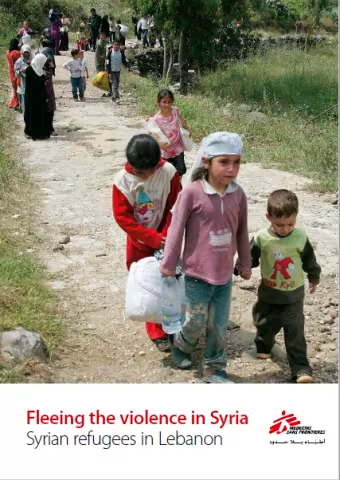
Since March 2011 and the continuously escalating crisis in Syria, Lebanon (along with Jordan, Iraq and Turkey) has been a refuge area for Syrian families fleeing the instability and violence in their country.
This report summarises the findings of the recent Rapid Needs Assessment at Amel Association International’s Burj el Barajneh (Baajour) community centre, which took place in late March 2013.
Severe weather struck the country this week, affecting Syrian refugees sheltered in the mountain region of Bekaa. Heavy rains and snowfall have flooded some settlements, and a number of refugee families were forced to seek shelter elsewhere.
The general objective of the project is to contribute to mitigate the impact of the Syrian Crisis on the most vulnerable persons and their families - including Syrian injured refugees and other vulnerable groups - by responding to their basic and specific needs.
UNHCR’s Policy Development and Evaluation Service (PDES) is committed to the systematic examination and assessment of UNHCR policies, programmes, projects and practices.
Over 57,000 displaced Syrians are receiving protection and assistance in Lebanon through the efforts of the Government of Lebanon and UN and NGO partners.