Resources

Dossier
Displaying 1 - 20 of 33
International
Publishing Date
Have a read of our CubeX Company Profile to find out more about the services we provide and our past projects!
National
Publishing Date
The third toolbox: Institutionalizing Conflict Sensitivity at the Organizational Level aims to ensure that organizations working within the humanitarian and stabilization response in Lebanon can better integrate the concept of conflict sensitivity and its principles at all aspects and levels across an organization’s structure, procedures, and policies.
National
Publishing Date
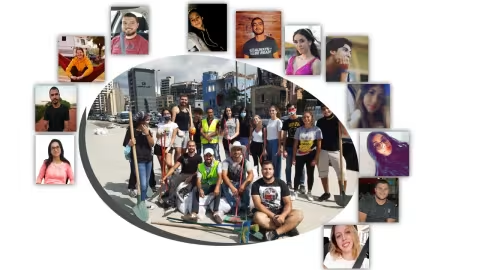
Beirut Explosion: Greatest Tragedies Come With Greatest Acts of Kindness. Youth from a Sports and Youth Association (Chabibeh Sporting Club) become volunteers and share stories of compassion and pain mixed together to shed light on the darkest hour of their country.
National
Publishing Date
The 2019 CPDE Monitoring Report’s Key Messages and Recommendations aim to inform and augment dialogue in the Global Partnership for Effective Development Cooperation (henceforth the Global Partnership). CPDE is committed to dialogue on outstanding development effectiveness challenges, including ‘unfinished business’ for many key commitments and indicators agreed in Paris (2005) and Busan (2011). The Report focuses on the centrality of democratic country ownership by examining in more depth issues of inclusion in development policy and practices, in the context of a human rights-based approach...
International
Publishing Date
This Gender Manual is a practical guide for civil society organisations in Lebanon that wish to enhance gender equity in their practices and policies. Far from being exhaustive, this manual contains practical guidelines that can help to both gain a better understanding of gender-sensitive topics, as well as to integrate and implement them in internal processes, action plans, and organisational structures and policies. It is informed by the findings of a series of meetings and consultations with various stakeholders engaged in gender issues. It is worth noting, however, that the guidelines...
National
Publishing Date

In the absence of a clear national plan for Integrated Waste Management (IWM), and due to various political and governmental issues, Lebanon has had to face a serious waste crisis in 2015.  The paper scrutinizes events leading up to the 17th of July 2015, and the impact of its aftermath on Lebanon’s environment, infrastructure, health and landscape. Parallels are drawn throughout the paper to a similar crisis faced by residents of Campania, Italy.


This paper thoroughly analyzes Lebanon’s “waste profile” and benchmarks it against a spectrum of countries to further understand global trends in...


National
Publishing Date

Research Report | April 2015
In this paper, we analyze the susceptibility of agricultural outputs to future climate change in Lebanon, and the extent to which it propagates to the economic system as a whole. We use a methodological framework in which physical and economic models are integrated for assessing the higher-order economic impacts of projected climate changes. By using this integrated modeling approach, we are able to quantify the broader economic impacts in the country by considering not only the temporal dimension but also the regional disaggregation of the results. Our estimates...

National
Publishing Date

Working Paper | March 2015
Sustainable Transportation and Mega Sporting Events in Arab Countries: the Case of Qatar by Robert Wittkuhn and Danyel Reiche
​Qatar has successfully developed into a hub for mega sporting events; the most prestigious of them will be the FIFA World Cup in 2022. Qatar promotes it as the “first completely carbon-neutral” and “most compact” World Cup. Such statements emphasize a very small impact of transport on the event’s carbon footprint; but they also raise questions about the understanding and applicability of carbon neutrality. As motive for hosting mega events...

National
Publishing Date

Working Paper | February 2015
Commuters’ Behavior towards Upgraded Bus Services in Greater Beirut: Role of Itinerary and Implications for Greenhouse Gas Emissions, Social Welfare and Transport Policy by Ali Chalak, Hani Al-Naghi, Alexandra Irani, and Maya Abou-Zeid
Climate change is one of the most critical environmental challenges facing the world today. The transportation sector alone contributes to 22% of carbon emissions, of which 80% are contributed by road transportation. In this paper, we investigate the potential greenhouse gas (GHG) emissions reduction and social welfare gains...

National
Publishing Date

Working Paper | February 2015
Economic Impacts of Adopting a Sustainable Transport System in Beirut by Mazen Omran, Johnny Ojeil, and Youssef Fawaz
​The work carried out in this paper demonstrates the economic benefit of a sustainable transport system. It compared a scenario with and without such system, and calculated loss time as a result of being held up in congestion during key peak hours mainly due to relying entirely on the private car. The work demonstrates that in addition to reducing congestion levels a sustainable transport system will generate benefits related to travel time...

National
Publishing Date

Working Paper | February 2015
Getting to Campus: Sustainable Public Transportation and Relocating the American University in Cairo by Richard Tutwiler, Hagar Eldidi, Yumna Kassim, and Andrew Petrovich
​Cairo is one of the most congested cities in the world, and public transportation is one of its greatest challenges. Government strategies to alleviate congestion have stressed horizontal expansion into the surrounding desert areas and the construction of more and ever larger motorways. This paper uses the experience of the American University in Cairo, which physically relocated in 2008 from...

National
Publishing Date

Working Paper | February 2015
Harnessing Motorists' Potential Demand for Hybrid-Electric Vehicles in Lebanon: Policy Options, CO2 Emissions Reduction and Welfare Gains by Alexandra Irani and Ali Chalak
Public concern over deteriorating air quality and the associated local and global impacts has grown significantly in the past decade. Air quality degradation is linked first and foremost to the transportation sector in the Arab region with about 90% of total emissions of carbon monoxide resulting from transportation activities. In Lebanon’s capital, Beirut, current levels of ozone and smog...