Resources

Displaying 1 - 5 of 5
National
Publishing Date
The 2019 CPDE Monitoring Report’s Key Messages and Recommendations aim to inform and augment dialogue in the Global Partnership for Effective Development Cooperation (henceforth the Global Partnership). CPDE is committed to dialogue on outstanding development effectiveness challenges, including ‘unfinished business’ for many key commitments and indicators agreed in Paris (2005) and Busan (2011). The Report focuses on the centrality of democratic country ownership by examining in more depth issues of inclusion in development policy and practices, in the context of a human rights-based approach...
National
Publishing Date
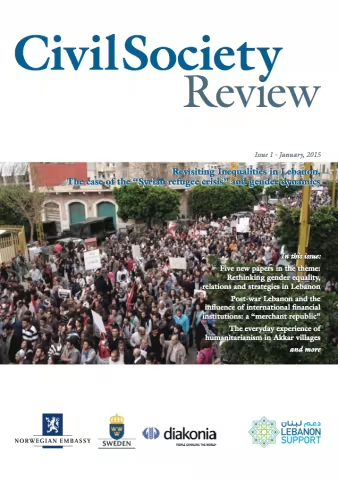
The objective of the Civil Society Review is to bring civil society practitioners, experts, activists, and researchers together to develop knowledge, as well as to innovate new tools and practices so as to strengthen Lebanon’s civil society and its voice. The Civil Society Review produces evidence-based research and analysis and disseminates findings and recommendations to promote civic engagement, shape policies, and stimulate debate within civil society spheres in Lebanon.
National
Publishing Date

Research Study | June 2013
Irish Peacekeeping in the United Nations Interim Force in Lebanon (UNIFIL) A Historical, Political, and Socio-Cultural Study by Rita Sakr
This study explores Irish peacekeeping within UNIFIL, since 1978 through the expanded UNIFIL after its formation in the aftermath of the 2006 Lebanon war, from historical, social, political, and cultural perspectives. The methodological approach relies mainly on interviews with a number of retired and active members of the Irish Defence Forces, academics, and journalists as well as primary and secondary sources including military...


National
Publishing Date

Research Report | January 2013
Lawfare and Armed Conflict: Comparing Israeli and US Targeted Killing Policies and Challenges Against Them by Lisa Hajjar
The term lawfare, an amalgamation of “law” and “warfare,” is used in reference to various kinds of legal challenges to state policies and practices in the realm of national security. Unsurprisingly, it has a negative connotation among those who oppose efforts to legally constrain state prerogatives, to fetter the discretion of officials in their pursuit of national security goals, and to pursue accountability for violations. This article...