Resources

Displaying 1 - 13 of 13
National
Publishing Date
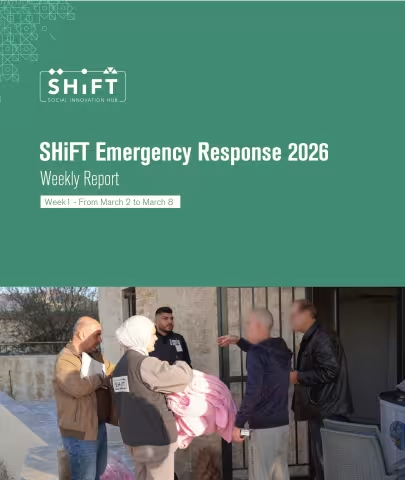
SHiFT launched its emergency response on March 2, 2026, to support families displaced by the escalation of violence in Lebanon. Thousands of people fled their homes with minimal belongings and are now sheltering in public schools and collective shelters across the country. Over 700,000 internally displaced people (IDPs) have been registered, including 119,700 staying in collective shelters, highlighting the scale of humanitarian needs.
National
Publishing Date
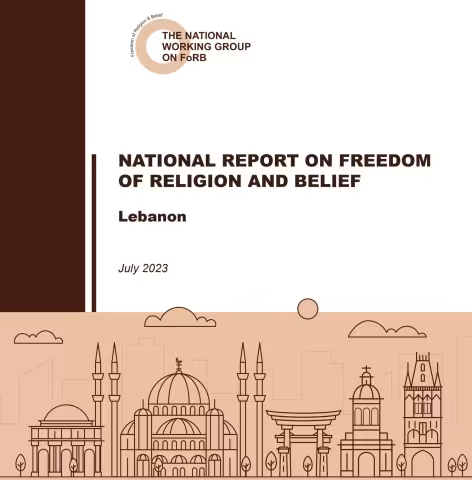
The National Report on Freedom of Religion & Belief was launched by the National Working Group on FoRB in Lebanon, which Peace of Art is part of. This report is the proud work of the National Working Group on Freedom of Religion and Belief (FoRB) in Lebanon.
National
Publishing Date
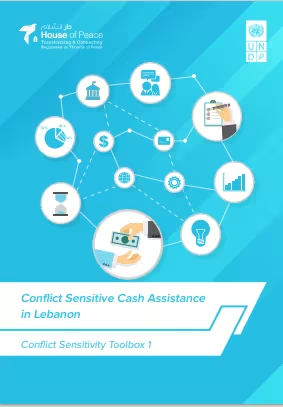
The first toolbox: Conflict Sensitive Cash Assistance in Lebanon aims to support partners to ensure that cash-based assistance does not inadvertently do harm and is conflict sensitive. The toolbox is complementary to the Guidance Note: Getting Started with Conflict Sensitivity in Lebanon which introduces basic conflict sensitivity elements and practical tips for getting started with conflict sensitivity. within the unique context of Lebanon.
National
Publishing Date
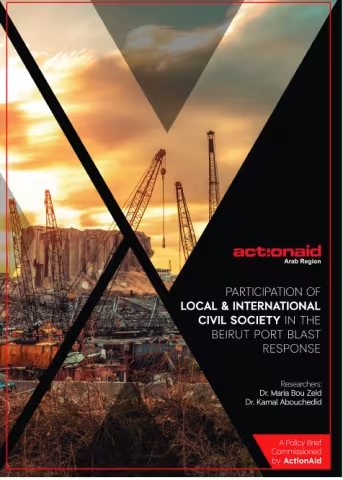
CONCLUSION AND RECOMMENDATIONS This policy brief examined the complex trajectories and mechanisms of the intervention deployed in the aftermath of the explosion raising questions of fairness and equality to the forefront of the humanitarian regime in Lebanon. Based on results yielded from fieldwork, we recommend the following: Launching a consortium of CSOs, fourth sector civil society, and government representatives in order to set out a coordination scheme among humanitarian players for future crises. CSOs, fourth sector organizations in collaboration with the Ministry of Social Affairs are...
National
Publishing Date
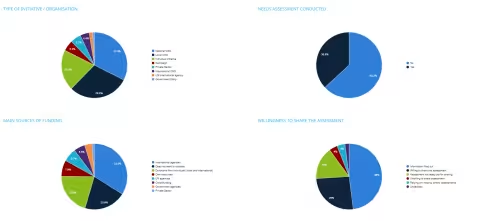
The mapping below documents organisational and individual solidarity initiatives and interventions in the aftermath of the Beirut blast on August 4th, 2020. Each initiative is mapped according to a set of categories, including type of initiative, area of intervention, geographic area covered, needs assessment conducted, and identified priorities. The below data aims to enhance transparency and collaboration among civil society actors, but also strengthen coordination, in order to reduce duplication and identify priorities for action. Data was collected by Lebanon Support (through Daleel...
National
Publishing Date

Working Paper | February 2014
The Dilemma of Human Rights In Lebanese Electoral Laws by Elie Al-Hindy
This study concludes with a number of recommendations with respect to the issues that need to be introduced to the debate and that can strengthen advocacy efforts by the different stakeholders involved. Reflecting on all of the above, and in light of the current political realities in Lebanon, including present sectarian demographics and political structure, the study concludes that the standards imposed on the new electoral law is impossible to meet, as no law, which this study has reviewed...

National
Publishing Date
While women’s issues and rights have been at the forefront of public and civil society debate, academic, and activist publications, women’s inequalities and the discrimination women face in Lebanon have been notably undermined, whether as citizens, refugees, or migrants. However, if the publicising of the “issue of women in Lebanon” has prompted the production of more “gender-related” information and knowledge, it has oftentimes adopted the rhetoric of denunciation and victimisation. Hence, there is a scarcity of in-depth and sectoral studies on the logics of exclusion and discrimination in...
National
Publishing Date

Working Paper | October 2014
Operation Protective Edge & Legal Remedies by Noura Erakat, Bianca Isaias, and Salmah Rizvi
This briefing paper provides a non-exhaustive survey of the legal fora in which Palestinians have sought, or can seek, legal redress. These include international courts, in particular the International Court of Justice (ICJ), the International Criminal Court (ICC), and special tribunals; national courts under universal jurisdiction as well as the Alien Tort Statute (ATS) in US federal courts; and human rights bodies and mechanisms like the Human Rights Council, and human...

National
Publishing Date

تقرير بحثي | آب 2013
حين كان الزمن الفلسطيني -. اللبناني جميلاً
 مقاربة منهجية تاريخية تأصيلية للعلاقات الفلسطينية– اللبنانية والحقوق المشروعة لفلسطينيي لبنان من إعداد حسين ابو النمل

National
Publishing Date

Research Report | June 2013
Arab States and UN Human Rights Mechanisms by Fateh Azzam
The revolts that have rocked the Arab region in 2011 have focused on demands for dignity, social and economic justice, and political freedoms. As the protests unfolded and spread from one country to another, their chants gained remarkable consistency in their rejection of unaccountable leadership and exclusionary economic and development policies that had failed for decades. The revolts were a wake-up call to all those concerned with politics and development in the region, that development can no longer be...

National
Publishing Date

Working Paper | December 2012
Production of Norms and Securitization in Development Policies: From Human Security to Security Sector Reform by Penelope Larzilliere 
Several regional products have been very successful as region-based products, such as Saudi Dates, Jordanian Thyme, Syrian Barazi, Egyptian Foul Mdamas, and Lebanese Chick Pea paste (Homos Tahini). These trends of regionbased, Geographic indicator (GI) and governmental labeled products are considered to be an added value to agroindustrial sector, and are highly efficient tactics to increase small and medium-sized enterprises (SME’s...

National
Publishing Date

Working Paper | May 2012
Women’s Citizenship Rights in Lebanon by Maya W. Mansour and Sarah G. Abou Aad
This paper tackles citizenship rights of Lebanese women married to foreigners, from an international human rights perspective at first, as consecrated over and over by multiple conventions and treaties; to move afterwards to a more practical approach in exposing the provisions of the Lebanese Constitution, the nationality law and regulations, while pointing out the consequences and challenges in addition to the movements of the civil society facing such trials. The analysis used in...