This study explores the role of community-based organizations in preparing for and responding to crisis in Lebanon. While there has been considerable work conducted on preparedness, responsiveness and recovery to crisis in Lebanon, there has been little work so far that focuses on measuring and assessing the capacities, expertise, strengths and weaknesses of local CBOS in preparing and responding to crises. Managers and decisions makers from nine different organizations were interviewed on the overall expertise gained in past conflicts since the civil war as well as their current level of...
Launched on 12 December 2014, the Core Humanitarian Standard on Quality and Accountability (CHS) describes the essential elements of principled, accountable and quality humanitarian action.
Final Akkarouna activity report for the shelter project funded by OTI lebanon.
Project Budget 300,000$, funded by Office of transitional initiatives OTI lebanon to help and aid the syrian refugees have a decent shelter to live in.
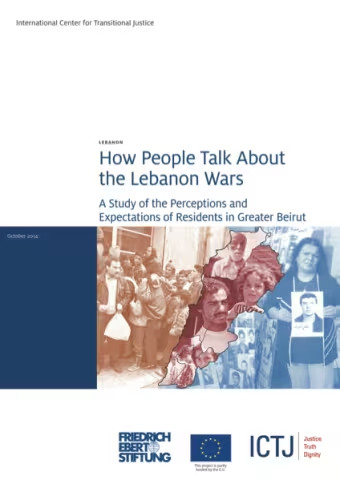
This report presents qualitative data collected by ICTJ on how individuals in Greater Beirut talk about the Lebanon wars and the need for truth, justice, and an end to violence in their country.
دليل الجمعيات غير الحكوميّة العاملة على قضايا الطفولة في لبنان « يشكّل مورداً ريادياً في سياق العمل بإتجاه ضمان تحقيق المصلحة »2013-2012 الفضلى للأطفال في لبنان وتكريس حقوقهم/هن بحسب الإتفاقية الدولية لحقوق الطفل، كونه يسهّل وصول الأطفال إلى الخدمات المختصّة والمتوفّرة في مختلف المحافظات وبحسب الحاجات ونوعية البرامج والخدمات الموجودة والتي تقدمها الجمعيات والهيئات الأهلية والمدنية المختصة في مجال الطفولة وحقوق الطفل.
يرمي هذا المورد إلى تعزيز التواصل وتنسيق الجهود بين مختلف الفاعلين/ات والناشطين/ات في مجال حقوق الأطفال كونه يوفّر معلومات حول أماكن تواجدهم/هن جغرافياً ونوعية البرامج والخدمات...
The continuing unrest in Syria is resulting in a growing influx of Syrian refugees to Lebanon. The United Nations High Commissioner for Refugees has registered over 57,000 Syrian refugees in Lebanon (September 7, 2012) while many refugees are awaiting registration.
This report compiles information on hundreds of incidents of serious human rights violations that occurred in Lebanon from 1975 to 2008, including mass killings, enforced disappearances, assassinations, forced displacement, and the shelling of civilian areas.
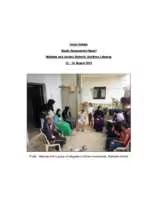
Swiss Solidar undertook a multi-sectoral needs assessment in August 2013 to assess the humanitarian needs of Syrian refugees residing in Nabatieh and Jezzine Districts in Southern Lebanon.1 Prior to undertaking its field assessment, Solidar undertook a detailed documentation r
Swiss Solidar undertook a multi-sectoral needs assessment in August 2013 to assess the humanitarian needs of Syrian refugees residing in Nabatieh and Jezzine Districts in Southern Lebanon.
The average number of assisted families during the a/m period is 46% of the overall number of families reportedly arrived to DRC North Lebanon operational area (Akkar region).
The average number of assisted families during the a/m period is 35% of the overall number of families reportedly arrived to DRC Bekaa operational area.
This operational guidance note is anchored on the principles of universal health care for all persons of concern fleeing the ongoing conflict in Syria and in need of international protection in Lebanon.
Since March 2011 and the continuously escalating crisis in Syria, Lebanon (along with Jordan, Iraq and Turkey) has been a refuge area for Syrian families fleeing the instability and violence in their country.
Disability & Vulnerability Focal Point (DVFP) have been developed based on the observation that one of the greatest difficulties following a crisis is not only to identify and to access to vulnerable people including people with disabilities, but also to accompany them wit
The human rights situation in the Syrian Arab Republic has deteriorated significantly since November 2011, causing further suffering to the Syrian people. Widespread violence and increasingly aggravated socio-economic conditions have left many communities in a perilous state.
As of the end of April 2012, the number of Syrian families displaced in the Bekaa has increased to 2,800 households. Families registered with local partners receive kits of dry food, but they have requested more variety and choice in food items.
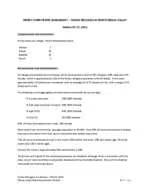
28 refugee households were surveyed, which represented a total of 501 refugees, 48% male and 52% female, which is approximately 11% of the Syrian refugee population in North Bekaa.