About NARA
نَرى (NARA) – Nurture, Access, Relief – is a youth-led initiative based in South Lebanon that empowers youth of all nationalities, including refugees, through education, protection, mental health support, and community peacebuilding.
This project aims to (1) bring statistical transparency to youth’s opinions, attitudes, feelings, and perceptions about social, cultural, political, and familial freedom of speech barriers within our society, and find what activities facilitate youth’s freedom of speech; (2) create discussion and widespread accountability by engaging the online and offline community, institutional stakeholders, and youth though an advocacy Call to Action based on our research findings, and (3) provide evidence that creative civic spaces are an integral part of our community and change negative attitudes...
يهدف هذا البحث العمليّ المنحى إلى إعلام الممارِسين وصانعي القرار بشأن وضع الحماية الاجتماعيّة واحتياجاتها والثغرات الموجودة فيها، وذلك بالنسبة إلى العاملين في قطاع المجتمع المدنيّ. يقدّم هذا البحث توصيات مستهدَفة تهدف إلى تعزيز وصول العاملين في قطاع المجتمع المدنيّ إلى الحماية الاجتماعيّة، كما تستهدف الدولة، جماعة المانحين والمنظّمات غير الحكوميّة الدّولية، والمنظّمات غير الحكوميّة المحليّة.
This action-oriented research aims to inform practitioners and decision makers on social protection status, needs and gaps of workers in the civil society sector. It formulates targeted recommendations that aim at enhancing access to civil society workers to social protection, and that target the Lebanese state, the donor community and international NGOs, and local NGOs.
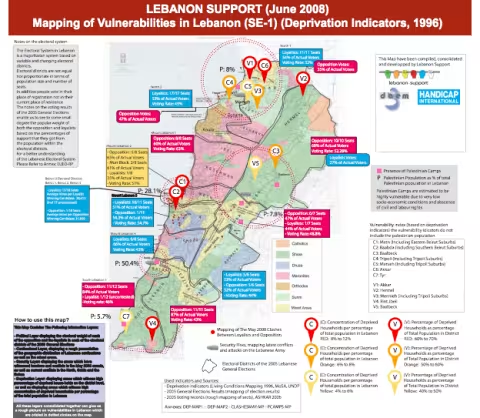
This package includes 3 maps pertaining to Lebanon's 2009 elections: - "confessional-distrib": showing the confessional geographic distribution of Lebanon's population - "election-results": showing the election results in West Bekaa/Rashaya and Metn areas. - "results&voters": showing the sectarian representation of parliamentary seats across Lebanon, the percentage of voters per electoral district, election results, and deputy representation per number of voters
Lebanon may witness a remarkable rise in the number of women serving in Parliament come May 2018 due to initiatives from women’s groups, “civil society” activists, and the substantial number of female candidates – 113 at the start of the election period. However, as this briefing paper shows, Lebanese women continue to face numerous challenges in entering government. The new electoral law passed in June 2017 does not provide women with equal opportunity to be elected, and it is yet to be seen whether it will increase female representation in Parliament. Nevertheless, the historic number of...
This report introduces the conflict context in the Central Bekaa region. The area is of geostrategic importance as it contains the main border crossing to Syria and the Damascus highway, the international route from Beirut to Damascus.
Based on the findings of participatory protection research that Oxfam undertook with refugees in Lebanon between late 2016 and early 2017, this paper explores refugees’ own definitions and conceptions of safety, and highlights refugee perspectives on how the international comm
The 2017 Vulnerability Assessment of Syrian Refugees in Lebanon (VASyR) is the fifth annual survey assessing the situation of a representative sample of registered Syrian refugee households to identify situational changes and trends.
The purpose of this policy brief is to inform policy formulation on local level security provision and refugee protection, and to propose modalities for upgrading the sys- tems of the Lebanese security institutions in a way that strengthens protection of the Lebanese communities and the Syrian refugees they host. Based on eld research conducted between February and May 2016 in three locations across Lebanon, this brief analyses the challenges to protecting local communities and refugees in a hybrid system, in which formal and informal security actors coexist and implement a mix of security...
This report aims to analyse how formal and informal security providers implement their respective social order agendas through a security “assemblage”. It also aims to inform the debate on refugee protection and security provision in urban settings, in the context of Lebanon’s hybrid security system. The accounts collected illustrate how state security institutions tacitly accept – or even rely on – informal security actors, managing at times to achieve their political and strategic goals through decentralised and/or illegal forms of control. In this vein, local municipalities imposed curfews...
This study explores the role of community-based organizations in preparing for and responding to crisis in Lebanon. While there has been considerable work conducted on preparedness, responsiveness and recovery to crisis in Lebanon, there has been little work so far that focuses on measuring and assessing the capacities, expertise, strengths and weaknesses of local CBOS in preparing and responding to crises. Managers and decisions makers from nine different organizations were interviewed on the overall expertise gained in past conflicts since the civil war as well as their current level of...
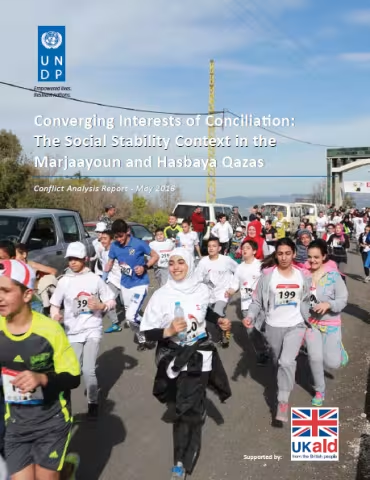
This report summarizes the conflict context of the Hasbaya and Marjaayoun Qazas of the Nabatieh Governorate, a religiously and politically diverse area which has for decades been at the forefront of regional dynamics and conflicts.A long history of coexistence between diverse
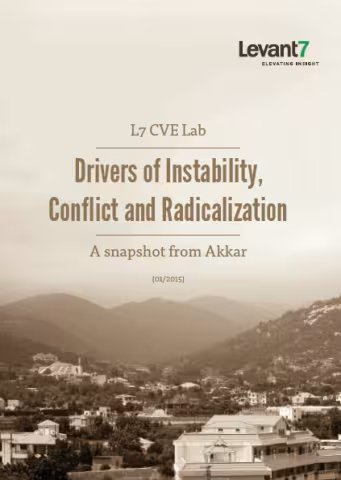
The influence of terrorist groups operating on the Lebanese-Syrian border, Hezbollah’s involvement in Syria, and the increasing sense of humiliation and powerlessness amongst Sunnis since Hezbollah’s takeover of west Beirut in 2008 is breeding concern about the radicalization