This project aims to (1) bring statistical transparency to youth’s opinions, attitudes, feelings, and perceptions about social, cultural, political, and familial freedom of speech barriers within our society, and find what activities facilitate youth’s freedom of speech; (2) create discussion and widespread accountability by engaging the online and offline community, institutional stakeholders, and youth though an advocacy Call to Action based on our research findings, and (3) provide evidence that creative civic spaces are an integral part of our community and change negative attitudes...
daleel.film is the guide of guides: an open resource made by Beirut DC and partners to help Arab filmmakers make great socially and environmentally engaged films that reach audiences in every Arab city and the world
دليل.فيلم هو مصدر مفتوح من تصميم بيروت دي سي وشركائها، يهدف إلى مساعدة صنّاع الأفلام العرب على إنتاج أفلام تصل إلى الجماهير على امتداد المدن العربية والعالم وتكون مراعية لمعايير الحفاظ على البيئة
We Rise through Art is a handbook produced under the project with the same title in response to Beirut's explosion, highlighting activities and tools that can be adopted by trainers, coaches and facilitators with pre-adolescents and children under arts, sports and recreation.
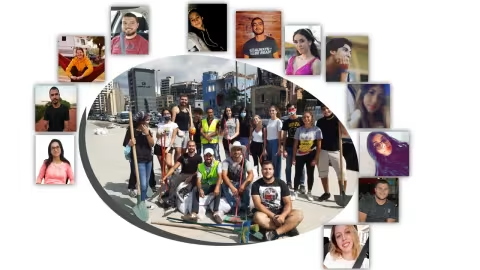
Beirut Explosion: Greatest Tragedies Come With Greatest Acts of Kindness.
Youth from a Sports and Youth Association (Chabibeh Sporting Club) become volunteers and share stories of compassion and pain mixed together to shed light on the darkest hour of their country.
We Play for Peace is a handbook produced under the project with the same title highlighting activities and tools that can be adopted by trainers, coaches and facilitators with pre-adolescents and children under arts, sports and recreation.
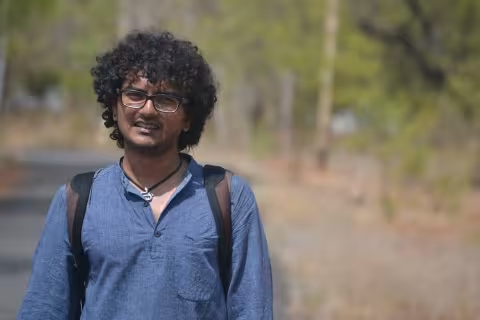
MOSAIC had the pleasure and privilege to speak with activist Gopi Shankar Madurai moments after the Supreme Court in India decriminalized Section 377 of the Penal Code.
Analyzing the Impact on the Personal and Professional Development
of Young Participants at Erasmus Plus/Youth in Action/Euromed projects through “Chabibeh Sporting Club” From 2008 till 2017
This report presents the findings of the labour market study in Bar Elias and the Bekaa, focusing on the labour activities, initiatives, and aspirations of current B&Z beneficiaries and Syrian refugee youth and women heads of household respondents that could potentially be
This report is based on answers to two surveys carried out in Lebanon in 2018 as part of a project to understand how refugees and humanitarian staff perceive the impact of the reforms enshrined in the Grand Bargain.
Only a handful of studies in Lebanon have shed light on the changing gendered dynamics within the refugee families by comparing gender roles, expectations, and practices before and after displacement (as result of armed conflict).
This report presents findings from a survey conducted from 3-11 July, 2017 with three distinct refugee groups in Lebanon: Syrian refugees; Palestine refugees from Syria; and Palestine refugees from Lebanon.
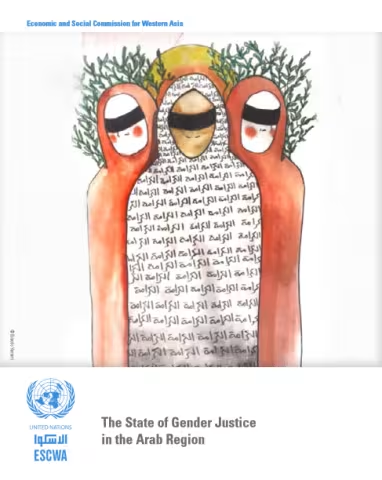
This study maps the current state of gender justice in the Arab region, documenting barriers as well as opportunities. Its primary research aim is to determine how to develop an environment, at the legal, policy, and social levels that is conducive to gender justice.
This report examines both the historical development and current situation of Syrians working in Lebanon through the analysis of policies established and implemented by the Lebanese government. While the report is not an assessment of these policies, it nevertheless reflects on its impact on Syrians’ working conditions and livelihoods. In this vein, this report notably focuses on emerging dynamics of increased informality, exploitation, and dependence.
It is part of a series of reports to be published in 2016, the 1st of which being "Formal Informality, Brokering Mechanisms, and Illegality...
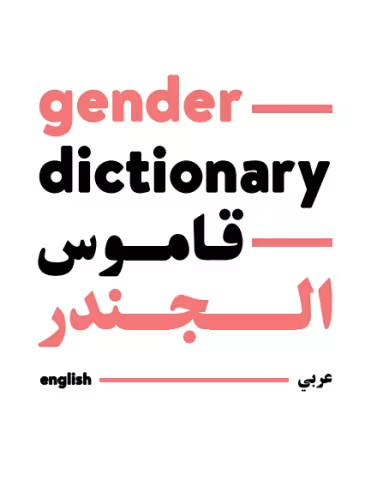
The Gender Dictionary, published by Lebanon Support, is a practical bilingual tool, based on multidisciplinary research and consultations with local gender actors (academics, experts, activists, practitioners).
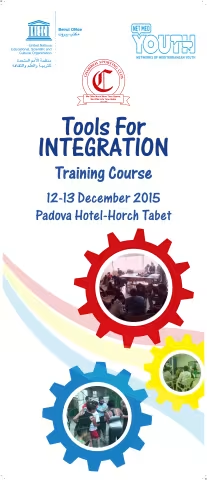
In December 2015, Chabibeh Sporting Club organized the
TOOLS FOR INTEGRATION project, funded by UNESCO, which was divided into 2 phases:
A 2 days training course (12-13 Dec 2015) that gathered 24 youth workers and leaders from different Leba-nese regions. Over these 2 days the topics of social cohesion and integration were discussed and participants reflected on traditional games they played when they were kids in order to develop together new tools and games under the themes of integration and cohesion
A 1 day camp (21 December 2015) for Lebanese, Syrian and Palestinian youth during which...