This project aims to (1) bring statistical transparency to youth’s opinions, attitudes, feelings, and perceptions about social, cultural, political, and familial freedom of speech barriers within our society, and find what activities facilitate youth’s freedom of speech; (2) create discussion and widespread accountability by engaging the online and offline community, institutional stakeholders, and youth though an advocacy Call to Action based on our research findings, and (3) provide evidence that creative civic spaces are an integral part of our community and change negative attitudes...
دليل.فيلم هو مصدر مفتوح من تصميم بيروت دي سي وشركائها، يهدف إلى مساعدة صنّاع الأفلام العرب على إنتاج أفلام تصل إلى الجماهير على امتداد المدن العربية والعالم وتكون مراعية لمعايير الحفاظ على البيئة
daleel.film is the guide of guides: an open resource made by Beirut DC and partners to help Arab filmmakers make great socially and environmentally engaged films that reach audiences in every Arab city and the world
We Rise through Art is a handbook produced under the project with the same title in response to Beirut's explosion, highlighting activities and tools that can be adopted by trainers, coaches and facilitators with pre-adolescents and children under arts, sports and recreation.
We Play for Peace is a handbook produced under the project with the same title highlighting activities and tools that can be adopted by trainers, coaches and facilitators with pre-adolescents and children under arts, sports and recreation.
يهدف هذا البحث العمليّ المنحى إلى إعلام الممارِسين وصانعي القرار بشأن وضع الحماية الاجتماعيّة واحتياجاتها والثغرات الموجودة فيها، وذلك بالنسبة إلى العاملين في قطاع المجتمع المدنيّ. يقدّم هذا البحث توصيات مستهدَفة تهدف إلى تعزيز وصول العاملين في قطاع المجتمع المدنيّ إلى الحماية الاجتماعيّة، كما تستهدف الدولة، جماعة المانحين والمنظّمات غير الحكوميّة الدّولية، والمنظّمات غير الحكوميّة المحليّة.
This action-oriented research aims to inform practitioners and decision makers on social protection status, needs and gaps of workers in the civil society sector. It formulates targeted recommendations that aim at enhancing access to civil society workers to social protection, and that target the Lebanese state, the donor community and international NGOs, and local NGOs.
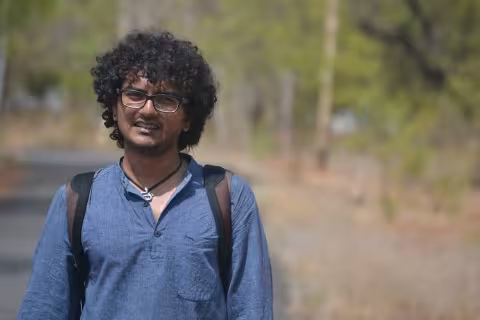
MOSAIC had the pleasure and privilege to speak with activist Gopi Shankar Madurai moments after the Supreme Court in India decriminalized Section 377 of the Penal Code.
Analyzing the Impact on the Personal and Professional Development
of Young Participants at Erasmus Plus/Youth in Action/Euromed projects through “Chabibeh Sporting Club” From 2008 till 2017
More than a decade after the United Nations’ adoption of the Convention on the Elimination of All Forms of Discrimination against Women, which is adopted by many countries including Lebanon, these countries returned in 2015 to commit themselves to achieve gender equality and t
UNFPA on behalf of UNDP and UN Women organized a national workshop on gender-related laws, policies and practices in Lebanon, which was held in Beirut on the 7th and 8th of August, 2018.
The Arab region continues to manage uncertainties on its path towards an inclusive and sustainable growth trajectory: geopolitical tensions persist, and global interest rates have soared.
This report introduces the conflict context in the Central Bekaa region. The area is of geostrategic importance as it contains the main border crossing to Syria and the Damascus highway, the international route from Beirut to Damascus.
This report presents findings from a survey conducted from 3-11 July, 2017 with three distinct refugee groups in Lebanon: Syrian refugees; Palestine refugees from Syria; and Palestine refugees from Lebanon.
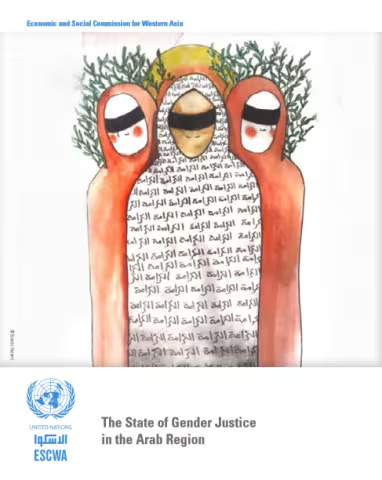
This study maps the current state of gender justice in the Arab region, documenting barriers as well as opportunities. Its primary research aim is to determine how to develop an environment, at the legal, policy, and social levels that is conducive to gender justice.
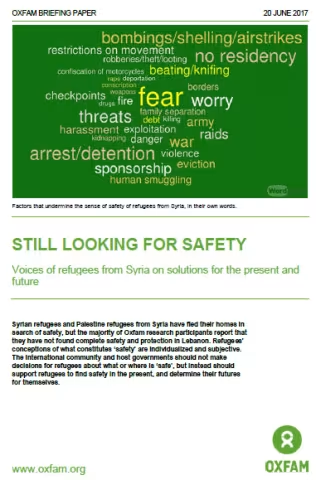
Based on the findings of participatory protection research that Oxfam undertook with refugees in Lebanon between late 2016 and early 2017, this paper explores refugees’ own definitions and conceptions of safety, and highlights refugee perspectives on how the international comm