The articles gathered in this dossier offer insights, based on case studies, into the transformation of the “associative sector” in Lebanon, a sector generally seen to be at the core of an increasingly active civil society.
The objective of the Civil Society Review is to bring civil society practitioners, experts, activists, and researchers together to develop knowledge, as well as to innovate new tools and practices so as to strengthen Lebanon’s civil society and its voice. The Civil Society Review produces evidence-based research and analysis and disseminates findings and recommendations to promote civic engagement, shape policies, and stimulate debate within civil society spheres in Lebanon.
This book tackles key Issues of concern within the aid discussion. It outlines issues of particular importance for civil society in the Arab region and highlights the difference of prospectives between government representatives and CSOs.
The report looks at different technologies related to the power, transport, agriculture and water sectors in Lebanon and assess their potential to reduce greenhouse gas emissions and increase resilience to climate change.
This report is the result of a joint effort by UNDP and UN-HABITAT to gain a better understanding of the various dynamics governing access to basic urban services in the Adjacent Areas of Palestine Refugee Camps in Lebanon.
This publication is a compilation of reports prepared by group of civil society organizations in light of the review of Lebanon under the first-cycle of Universal Periodic Review (2010).The booklet includes the report reviewing conditions of economic and social rights in Leban
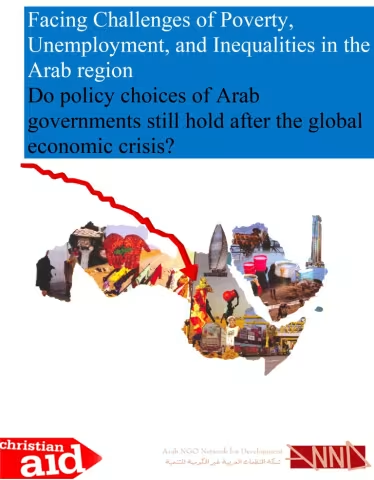
This paper was produced by ANND and Christian Aid and contains five main sections: “Executive Summary: a crisis of multiple dimensions; the threat of explosive vulnerabilities and increasing insecurities”, “Vulnerability to poverty: the key challenges faced by the Arab region”
“Moukhtar” booklet provides guidelines for municipality leaders and mayors, on how to effectively implement practices and procedures that would benefit the local community, whether in regular daily activities or in conflict situations.