مساعدة ذوي الإعاقة العقلیّة (الإخوة) في جمیع مجالات حیاتھم من خلال توفیر الدعم العملي والعاطفي بتوجیه من مسؤول البيت، والمساعدة في تطویر مقدراتھم بخلق بیئة محفزة ورعایة مناسبة.
“More than 60% of Syrian refugees households comprise a person with disabilities and 1/5 Syrian refugees has a disability in Lebanon and Jordan”, shows a large study conducted by Humanity & Inclusion (HI) and iMMAP.
This package includes 3 maps pertaining to Lebanon's 2009 elections: - "confessional-distrib": showing the confessional geographic distribution of Lebanon's population - "election-results": showing the election results in West Bekaa/Rashaya and Metn areas. - "results&voters": showing the sectarian representation of parliamentary seats across Lebanon, the percentage of voters per electoral district, election results, and deputy representation per number of voters
Lebanon may witness a remarkable rise in the number of women serving in Parliament come May 2018 due to initiatives from women’s groups, “civil society” activists, and the substantial number of female candidates – 113 at the start of the election period. However, as this briefing paper shows, Lebanese women continue to face numerous challenges in entering government. The new electoral law passed in June 2017 does not provide women with equal opportunity to be elected, and it is yet to be seen whether it will increase female representation in Parliament. Nevertheless, the historic number of...
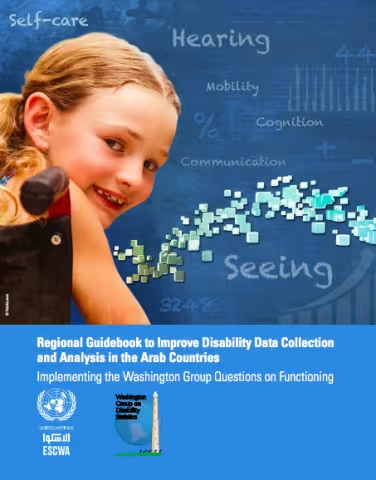
This regional Guidebook explores the different approaches in design, implementation and analysis of disability data collection in the Arab countries, in view of improving the standardization and implementation of the Washington Group Short Set on Functioning and related indica
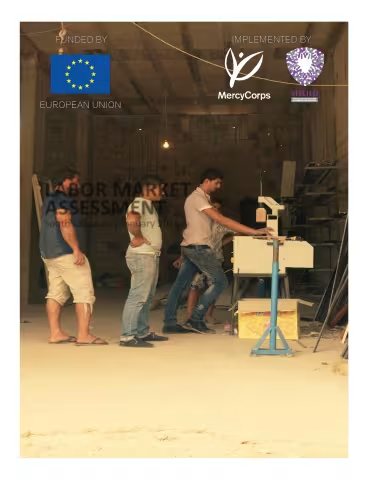
This report presents the findings of the labour market study in Bar Elias and the Bekaa, focusing on the labour activities, initiatives, and aspirations of current B&Z beneficiaries and Syrian refugee youth and women heads of household respondents that could potentially be
This report examines both the historical development and current situation of Syrians working in Lebanon through the analysis of policies established and implemented by the Lebanese government. While the report is not an assessment of these policies, it nevertheless reflects on its impact on Syrians’ working conditions and livelihoods. In this vein, this report notably focuses on emerging dynamics of increased informality, exploitation, and dependence.
It is part of a series of reports to be published in 2016, the 1st of which being "Formal Informality, Brokering Mechanisms, and Illegality...
Bringing together the years of regional and international experience within civil society activities, Besme was settled in Lebanon in September 2014, in order to contribute to the peaceful settlement of regional conflicts in Middle East. Through a route, which is full of difficulties, we managed to leave the year of 2015 behind, with successful and effective projects. We reckon 2015 as a year of investment for Besme. Reinvigorating the individual connections of management team at national, regional and international levels, we assume that a great step forward was taken for future. In the road...
Over 250,000 migrant women are employed by private households in Lebanon to carry out household tasks such as cleaning, cooking, and caring for children and the elderly.
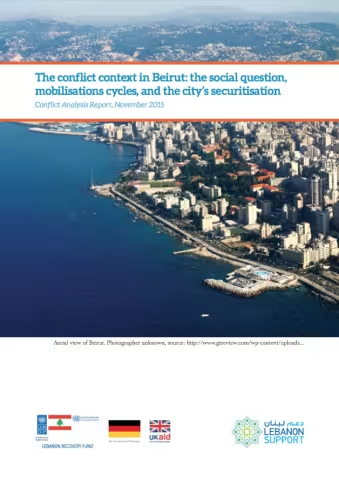
This report provides an analysis of the history and current situation of the conflict context, actors and dynamics in Beirut, Lebanon. The report seeks to shed light on the main actors, topics of contestation, conflict and mobilisation in its historical becoming as well as current expressions. The report includes a special focus on the social question, subsequent political and social mobilisation, gender issues, the securitisation of the city, as well as the interactions between the Lebanese host community and Syrian refugees and their unfolding within the last four years (since 2011).
This study was based on a comprehensive assessment of the vocational needs as well as the labor absorption capacity mainly with business owners in the area of intervention and individual workers and vocational trainings candidates following different assessment and data collection methodologies such as key informant interviews, focus groups, and individual assessments
GVC and YAB have implemented a pilot initiative in 6 public schools in order to provide directors, teachers, special educators and social workers with technical tools and expertise to encourage the inclusion of children with special needs. Almost 60 children have been included in regular classes all along the implementation (2012-2015). At the same time, the project involved parents and communities where the 6 schools are located to raise culture of diversity and respect and to enhance participation of children with special needs at all levels of social and cultural life.
This paper is inspired by examples of domestic workers organizing themselves in different parts of the world through social and solidarity economy enterprises and organizations which have become more evident since the advent of the ILO Domestic Workers Convention 2011, (No.189