مساعدة ذوي الإعاقة العقلیّة (الإخوة) في جمیع مجالات حیاتھم من خلال توفیر الدعم العملي والعاطفي بتوجیه من مسؤول البيت، والمساعدة في تطویر مقدراتھم بخلق بیئة محفزة ورعایة مناسبة.
“More than 60% of Syrian refugees households comprise a person with disabilities and 1/5 Syrian refugees has a disability in Lebanon and Jordan”, shows a large study conducted by Humanity & Inclusion (HI) and iMMAP.
This package includes 3 maps pertaining to Lebanon's 2009 elections: - "confessional-distrib": showing the confessional geographic distribution of Lebanon's population - "election-results": showing the election results in West Bekaa/Rashaya and Metn areas. - "results&voters": showing the sectarian representation of parliamentary seats across Lebanon, the percentage of voters per electoral district, election results, and deputy representation per number of voters
Lebanon may witness a remarkable rise in the number of women serving in Parliament come May 2018 due to initiatives from women’s groups, “civil society” activists, and the substantial number of female candidates – 113 at the start of the election period. However, as this briefing paper shows, Lebanese women continue to face numerous challenges in entering government. The new electoral law passed in June 2017 does not provide women with equal opportunity to be elected, and it is yet to be seen whether it will increase female representation in Parliament. Nevertheless, the historic number of...
This regional Guidebook explores the different approaches in design, implementation and analysis of disability data collection in the Arab countries, in view of improving the standardization and implementation of the Washington Group Short Set on Functioning and related indica
GVC and YAB have implemented a pilot initiative in 6 public schools in order to provide directors, teachers, special educators and social workers with technical tools and expertise to encourage the inclusion of children with special needs. Almost 60 children have been included in regular classes all along the implementation (2012-2015). At the same time, the project involved parents and communities where the 6 schools are located to raise culture of diversity and respect and to enhance participation of children with special needs at all levels of social and cultural life.
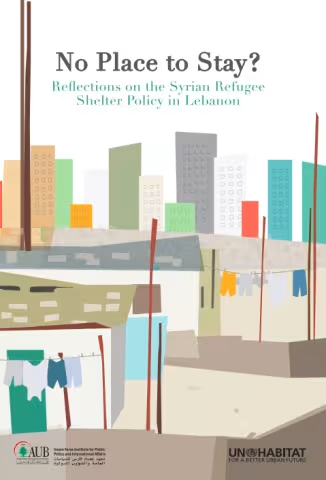
In Lebanon, the question of hosting and ensuring protection for Syrian refugees in light of the government stance against the erection of camps has created many deliberations concerning different proposed and implemented shelter options and solutions. UN-Habitat, in partnership with the American University of Beirut’s (AUB) Issam Fares Institute for Public Policy and International Affairs (IFI), initiated a research study in July 2014 to address solutions for hosting and ensuring protection for refugees specifically on the subject of erecting camps to address the Syrian crisis. The study...
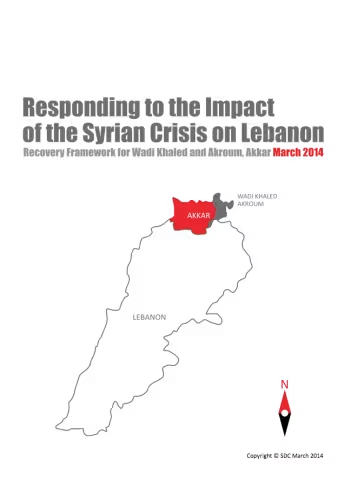
The Swiss Agency for Development and Cooperation (SDC) is pleased to share with you the report:
“Responding to the Impact of the Syrian Crisis on Lebanon: Recovery Framework for Wadi Khaled and Akroum, Akkar”, March 2014.
SDC facilitated a process to shed light on the impact of the Syria crisis at the national level but also on the local level. The formulation of a recovery framework for Wadi Khaled and Akroum is a process that can be replicated for other affected regions of Lebanon.
The findings and recommendations are based on consultations (between October 2013 and January 2014) with...
About the Zero Project: For a World without Barriers
The Zero Project was initiated by the Essl Foundation in 2010. It has been run in partnership with the World Future Council (WFC) since 2011 and the European Foundation Centre (EFC) since 2013. The mission of the Zero Project is to work for a world without barriers, according to the principles and Articles of the UN CRPD.
This "Thirty Questions Guide" is the first guide that addresses the various stages of work and employment based on the principles of the CRPD and its relevant detailed provisions.
Since March 2012, several towns and villages in the North, the Bekaa and the South started receiving Lebanese families who fled Syria, against the backdrop of sectarian conflicts. Most of those families left their hometown decades ago and got Syrian citizenship.