Resources

Intervention Sectors
Resource Type
Displaying 1 - 20 of 23
National
Publishing Date
Findings in the "Analysis on Stunting Among Syrian Refugee Children" showed that risk factors perceived to be contributing to stunting levels among Syrian refugee children included those at the individual and household level with poor maternal nutrition, household food insecurity and inadequate complementary feeding practices as the factors perceived to be contributing the most to stunting among Syrian children. On the other hand, at the institutional and community level, market food prices, poverty, income, employment and livelihoods were the factors perceived to be contributing the most to...
National
Publishing Date
This report aims to provide statistical and analytical tools for the recovery community working in North Lebanon, specifically those working with the Nahr el-Bared displaced and returnee population. The information will allow for better assessment of current needs and gaps, which will eventually support the development of appropriate strategies of intervention on both the short and long term.
National
Publishing Date
This is an assessment done in the detention centers and prisons in south Lebanon in coordination with the prisons department in the ministry of interior through which the WASH situation inside these prisons and centers was detected, needs and priorities were defined and possible rehabilitation and enhancement explored.
National
Publishing Date
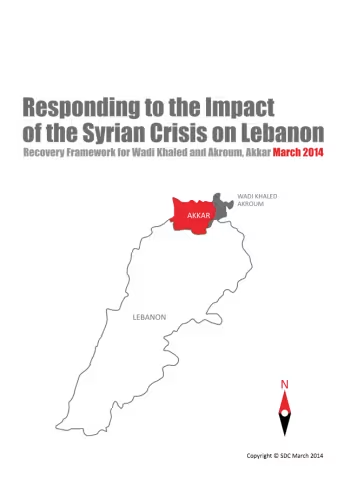
The Swiss Agency for Development and Cooperation (SDC) is pleased to share with you the report:  “Responding to the Impact of the Syrian Crisis on Lebanon: Recovery Framework for Wadi Khaled and Akroum, Akkar”, March 2014. SDC facilitated a process to shed light on the impact of the Syria crisis at the national level but also on the local level. The formulation of a recovery framework for Wadi Khaled and Akroum is a process that can be replicated for other affected regions of Lebanon. The findings and recommendations are based on consultations (between October 2013 and January 2014) with...
National
Publishing Date
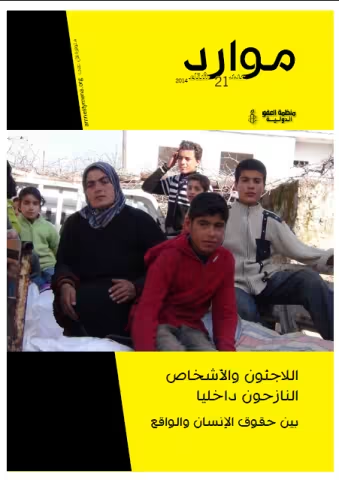
هذا هو العدد 21 من "موارد"، المجلة المتخصصة بالتربية على حقوق الانسان، التي يصدرها المكتب الإقليمي للشرق الأوسط و شمال أفريقيا بمنظمة العفو الدولية في بيروت. نخصص هذا العدد لموضوع اللاجئين والأشخاص النازحين داخليا، ويوفر العدد في هذا السياق مجموعة واسعة من الموارد.
National
Publishing Date

Working Paper | August 2013
Displacement in the Middle East and North Africa: Between an Arab Winter and the Arab Spring by Shaden Khallaf
The Middle East and North Africa region has been rife with volatility and turmoil for decades due to inter-State conflict, military occupation, intra-State power struggles, international sanctions, strained economic systems, social transformations, high population growth, varying illiteracy rates, high unemployment and underemployment, poverty, gender inequalities, extremism, and an overarching lack of transparency in dealing with these daunting challenges...


National
Publishing Date
As part of the assessment support mission, capacity assessment requested by the WASH partners to be carried out, the assessment team developed a Capacity Assessment Tool designed to collect information covering aspects, such as, profile, WASH response, WASH activities, transpo
National
Publishing Date
This thematic report provides an overview of available lessons identified from assessments undertaken concerning the humanitarian situation in Syria as well as the situation for Syrian refugees in host-countries.
National
Publishing Date
This report is the result of 4 weeks’ field work from April 22 to May 17 carried out in the two districts of Zgharta and Minieh-Dennieh by SOLIDARITÉS INTERNATIONAL’s (SI) outreach workers.
National
Publishing Date
Since Syria’s Arab Spring events began in March 2011, the Syrian Observatory for Human Rights estimates that the death toll has surpassed 21,000 people, mostly civilians, who have been killed in unrelenting violence in certain areas of the country1.
National
Publishing Date
The PDM consisted of conducting household surveys with beneficiaries who received Non-Food Items (NFIs in the form of hygiene kits) and food vouchers as part of WVL's Syrian refugee response in the Bekaa.