This report aims to provide statistical and analytical tools for the recovery community working in North Lebanon, specifically those working with the Nahr el-Bared displaced and returnee population. The information will allow for better assessment of current needs and gaps, which will eventually support the development of appropriate strategies of intervention on both the short and long term.
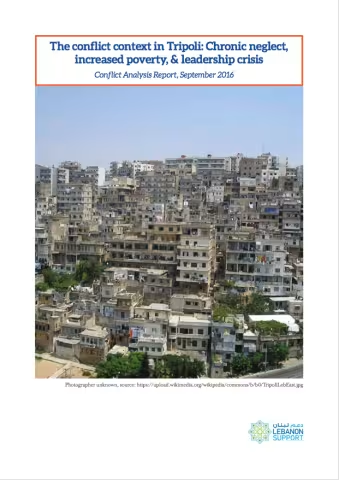
The “Roadmap to Reconciliation in Tripoli,” (RRT) project is a grassroots initiative that aims at launching a transitional justice route through understanding the public perceptions in Tripoli about reconciliation as well as people’s readiness and willingness to engage in a co
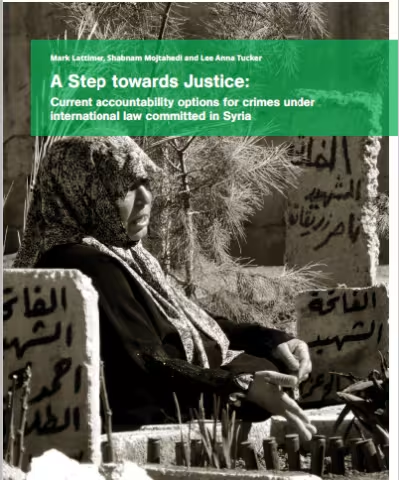
This document is an adaption of a speech delivered on May 12, 2015 at the launch of a report by the Syrian Justice and Accountability Center (SJAC) entitled ”A Step Towards Justice: Current Accountability Options for Crimes under International Law Committed in Syria.” The repo
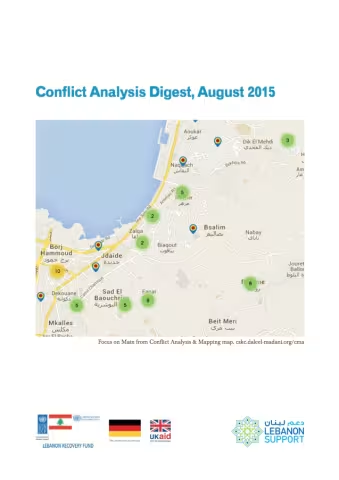
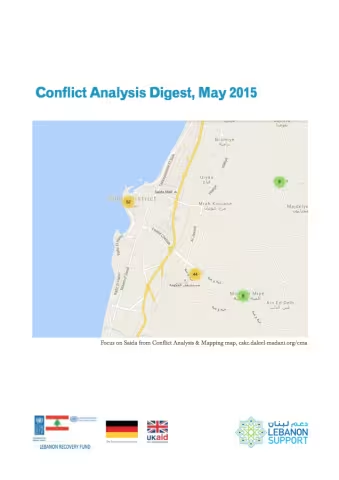
This Conflict Analysis Digest is composed of:
I. Current conflict trends
1- Overview of mapped conflict incidents in Lebanon, with the villages where most incidents are mapped for each classification. (Between 1 July 2014 and 28 June 2015) 2- Mapped air strikes/ armed conflicts and violations classified as Syrian Border Conflicts. (Between 1 July 2014 and 28 June 2015) 3- Overview of mapped conflict incidents in the Matn.
II. Brief thematic report Politics of security, discourses of fear and economic fatigue: the conflict dynamics in al-Matn
Abstract: This short report provides an...
This Conflict Analysis Digest is composed of:
I.Current conflict trends - p.5
II.Brief thematic report - p.11 Spatial Fragmentation and rise in poverty: the conflict context in Saida
Abstract: This short report provides a contextual and analytical summary of the conflict in the region of Saida, south of Lebanon, with a focus on spatial struggles and poverty growth. It describes the main conflict actors and how they have historically contributed to the shaping of conflictual dynamics in Saida from the fifties until today. Findings highlight that while most observers and media attention are...
The conflict in Syria is forging new forms of territorial control, and a political economy that is not unlike the patronage system that was previously fostered by the ruling Ba’ath party.
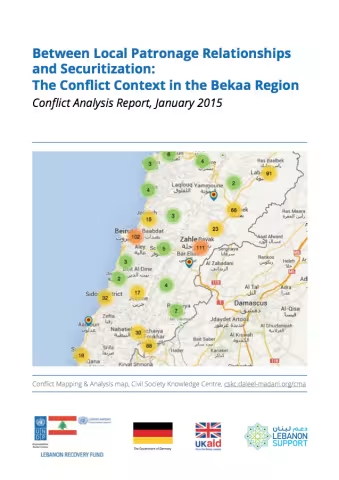
This report provides an analytical summary of the conflict context in the Bekaa region of Lebanon, with a focus on the relationships between the Syrian de facto refugees and the Lebanese host communities in the Baalbeck-Hermel area. It is based on a socio-political qualitative assessment and a conflict analysis that are primarily based on experiences and perspectives of key informants,2 as well as Lebanese and Syrian residents of the Bekaa. Unless otherwise noted, information in this report is based on these interviews. The report is intended as a quick reading of the field at a set point in...
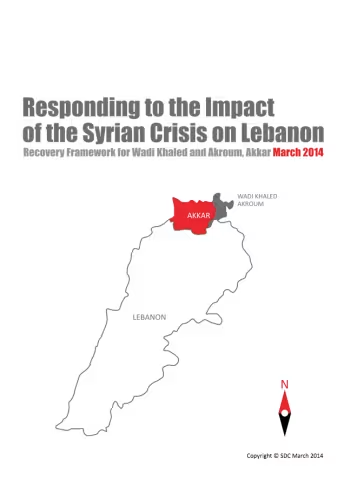
The Swiss Agency for Development and Cooperation (SDC) is pleased to share with you the report:
“Responding to the Impact of the Syrian Crisis on Lebanon: Recovery Framework for Wadi Khaled and Akroum, Akkar”, March 2014.
SDC facilitated a process to shed light on the impact of the Syria crisis at the national level but also on the local level. The formulation of a recovery framework for Wadi Khaled and Akroum is a process that can be replicated for other affected regions of Lebanon.
The findings and recommendations are based on consultations (between October 2013 and January 2014) with...
This report is this first of a three-part series focusing on the current status and lessons learned relating to transitional justice and policing initiatives in opposition-controlled Syria. • Part I focuses on the effects of the departure of judicial and security elements of the Syrian state has had on conditions on the ground currently and on the nascent justice institutions that have emerged in this void (including levels of institutionalisation, Islamic law, and the legal systems currently being debated and trialed in some areas). • Part II examines the variety of institutions and...
هذا هو العدد 21 من "موارد"، المجلة المتخصصة بالتربية على حقوق الانسان، التي يصدرها المكتب الإقليمي للشرق الأوسط و شمال أفريقيا بمنظمة العفو الدولية في بيروت. نخصص هذا العدد لموضوع اللاجئين والأشخاص النازحين داخليا، ويوفر العدد في هذا السياق مجموعة واسعة من الموارد.
This paper examines the situation of impunity in Lebanon that has persisted since the 1975–1990 war. It highlights the price of the Lebanese authorities’ failure to address the legacy of past conflict.
This study recommends a holistic approach to crafting a comprehensive and victim-centered transitional justice process in Lebanon. An incremental approach to reform would be of value, given the likely challenges to pursuing accountability in the country. Programming must involve state and nonstate actors—political and community leaders, civil society, and the broader public. In addition, human...
This report examines the situation of impunity in Lebanon that has persisted since the 1975-1990 war through the lenses of core elements of transitional justice.
This report examines variations in wartime experiences and the attitudes of residents in Greater Beirut regarding measures to confront Lebanon’s legacy of political violence.
This report presents qualitative data collected by ICTJ on how individuals in Greater Beirut talk about the Lebanon wars and the need for truth, justice, and an end to violence in their country.