The Building a Better Response project, together with the UN Office for the Coordination of Humanitarian Affairs (OCHA) and the International Humanitarian City, launched the Building a Better Response (BBR) e-learning course in Arabic with a panel discussion in Dubai on the role of local non-governmental organizations (NGOs) in humanitarian response. The event came in advance of the World Humanitarian Summit, set to take place in Istanbul in May 2016, where much of the conversation is expected to focus on placing local actors at the center of humanitarian response.
Our work cannot be as...
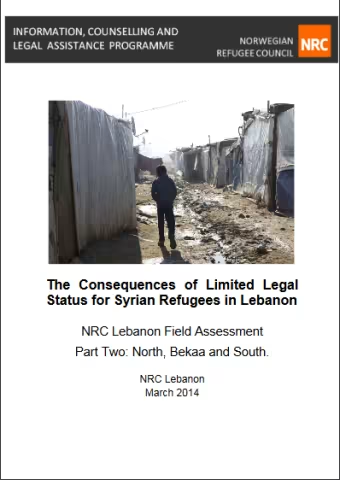
Lebanon has had an ambiguous approach to the more than one million Syrians seeking protection in the country since 2011. The country is neither party to the 1951 Convention relating to the Status of Refugees, nor does it have any national legislation dealing with refugees.
This is an analytical report based on data and statistics collected from public schools and aiming at detecting the effect of the Syrian refugees crisis on the public education sector and the priorities and needs for the public schools in the best interest of the Lebanese and refugees students.
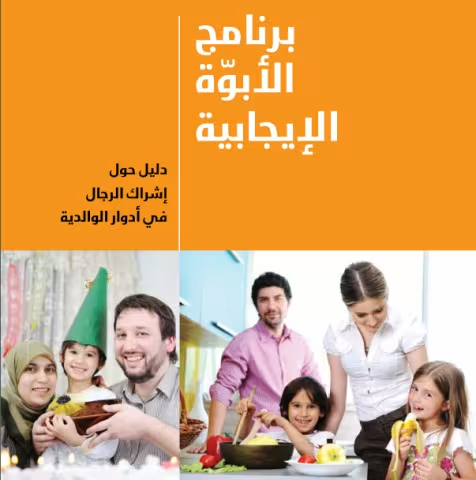
The adapted version of the Global "Program P" manual provides concrete strategies and activities to engage men in active positive fatherhood, from their partner’s pregnancies through their children’s early years. It identifies best practices on engaging men in maternal and child health, care-giving, and preventing violence against women and children on basis of equality and non-violence.
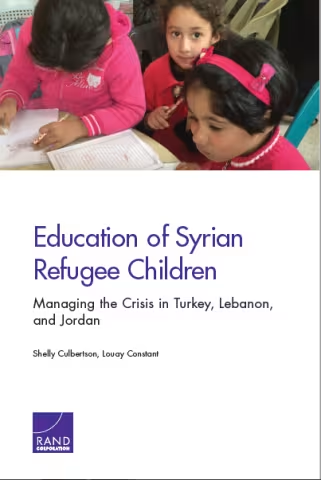
This scoping study is intended to contribute to the ongoing policy discussions among governments, donors, and United Nations agencies about the education of Syrian refugees in Lebanon, Turkey, and Jordan (the three countries with the largest populations of Syrian refugees),
In May 2015, the Lebanese authorities instructed UNHCR to temporarily suspend registration of Syrian refugees, including individuals already in the country and new arrivals.
Widening Access to Quality Education for Syrian Refugees: The role of private and
NGO Sectors in Lebanon
Authors
Maha Shuayb, Nisrine Makkouk and Suha Tuttunji
September 2014
This report is this first of a three-part series focusing on the current status and lessons learned relating to transitional justice and policing initiatives in opposition-controlled Syria. • Part I focuses on the effects of the departure of judicial and security elements of the Syrian state has had on conditions on the ground currently and on the nascent justice institutions that have emerged in this void (including levels of institutionalisation, Islamic law, and the legal systems currently being debated and trialed in some areas). • Part II examines the variety of institutions and...
The crisis in Syria continues to have a devastating impact on professors, university students, and the education sector, not only in Syria but also in the neighboring countries that are hosting so many displaced Syrians. In this report, the Institute of International Education (IIE) and its Syria Consortium for Higher Education in Crisis looks at the conditions and educational needs of Syrians university students and scholars in Lebanon. “The War Follows Them: Syrian University Students and Scholars in Lebanon,” is based on first-hand research and interviews conducted in Lebanon in March 2014...
The Syrian conflict, now in its fourth year, has taken a heavy toll on Lebanon’s society.
Among those most affected are young men and women in refugee camps and marginalized communities. Young people are increasingly confronting violence and discrimination. They are missing out on education and work opportunities. The rising number of unemployed and disenfranchised youth in Lebanon could become a security risk for both Lebanese and refugee communities.
A society’s well-being relies on its youth, who can help revitalize the economy when education, health care and job opportunities are available...
This paper examines the situation of impunity in Lebanon that has persisted since the 1975–1990 war. It highlights the price of the Lebanese authorities’ failure to address the legacy of past conflict.
This study recommends a holistic approach to crafting a comprehensive and victim-centered transitional justice process in Lebanon. An incremental approach to reform would be of value, given the likely challenges to pursuing accountability in the country. Programming must involve state and nonstate actors—political and community leaders, civil society, and the broader public. In addition, human...
Global civil society alliance, CIVICUS, has released a revised version of what is probably the world’s most comprehensive compilation of commitments made by governments on civil society rights.
Originally released in 2008, and now fully updated, the compendium consolidates various international standards and commitments made by governments at the regional and global levels to protect civil society and ensure participation in public processes.
In addition to collating relevant portions of major UN documents, the compendium also includes commitments made by regional bodies such as the Arab...
In December 2013, NRC launched a report entitled ‘The Consequences of Limited Legal Status for Syrian Refugees in Lebanon: NRC Field Assessment in Aarsal and Wadi Khaled’ (Part One) based on the findings of an assessment that NRC conducted between
The crisis in Syria has entered its fourth year. Children have been on the front-line from the outset. They have experienced or witnessed horrific acts of indiscriminate
Briefing papers on the preservation of cultural heritageInstitutions and individuals from the Middle East and North Africa experience many shortcomings in legislation, policies and current practices impeding the sustainable preservation of cultural heritage. In order to obtain a systematic overview and a sound basis for engaging in lobby and advocacy work for improved governance of the cultural sector, the Modern Heritage Observatory contracted local lawyers and researchers to analyze and assess current regulations, policies and practices concerning the preservation of cultural heritage in...
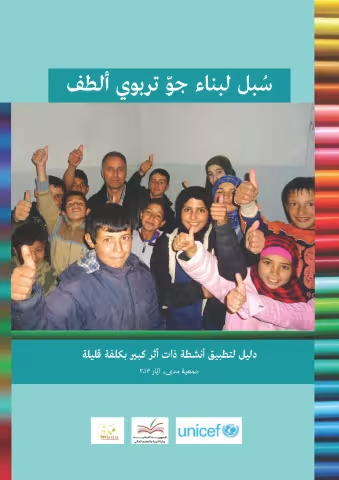
تم تصميم هذا الدليل إستناداً إلى الممارسات الجيدة التي تم جمعها في إطار مشروع «دعونا نذهب جميعاً إلى المدرسة » الممول من قبل منظّمة اليونيسف وقد أُعد ليكون مرجعاً مساعداً في عملية بناء شخصية الطفل مساهماً في تلطيف العملية التربوية التعليمية وخاصة في البيئة المحرومة التي تفتقر إلى أبسط الوسائل الترفيهية والثفافية. يتضمن هذا الدليل نماذج عن نشاطات لمختلف المراحل العمرية يمكن تطبيقها بأقل كلفة ممكنة، إضافتاً إلى مجموعة من المراجع عملت عليها جمعيات ومنظمات عديدة للهدف عينه.
بعد تحقيق المراحل الأساسية من المشروع تم إصدار هذا الدليل الذي يلخص كل الأعمال والخبرات التعلمية والنشاطات اللاصفية، نظراً...
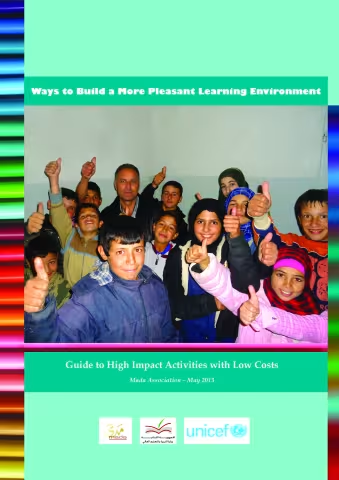
This guide has been designed by Mada, in close partnership UNICEF and the Ministry of Education, based on the good practices collected within the UNICEF funded project “Let’s All Go to School Initiative”. It has been prepared to serve as a reference tool to help in boosting up the educational and pedagogical process and developing the child’s personality, especially in deprived environments lacking the most basic recreational and cultural means.The guide offers easily implementable low-cost extracurricular activities and presents the reader with an overview of reference material and guides on...
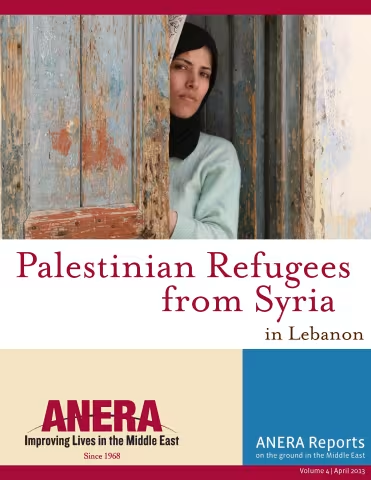
Palestinian refugees from Syria living in Lebanon are one of the most vulnerable sub-populations affected by the crisis. In April 2013, ANERA conducted a survey of these families to gain a clear picture of the situation on the ground and to assess the critical needs that exist. The findings are shocking and the situation is getting worse, day by day.