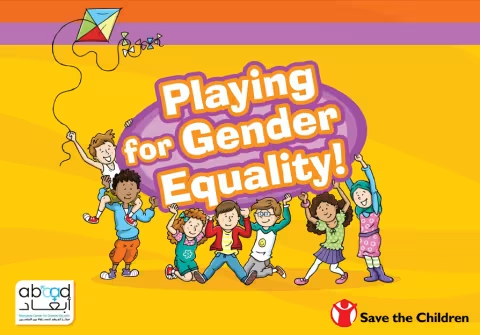
The manual is composed of fun and interactive games for children aged 8 to 12 years old. The games will facilitatethe learning of important concepts and terminology pertaining to Gender Equality. More importantly, during/afterthe games have been played, it allows the trainer the freedom to begin important discussions about the conceptsthat the children learned during the games.
This report constitutes the final publication of the outcomes of the program "Development in Lebanon: Poverty Eradication, Gender Equity and Youth Participation; the Role of NGOs Civil Society and Other Actors".
Over the span of three years, Instituto Promundo, with support from the United Nations Trust Fund to End Violence Against Women, implemented a multi-country project to engage men and boys in preventing violence against women and promote gender equality.
It is well known that the cultural norms and the patriarchal society in Lebanon contribute to encouraging discrimination and any form of violence against women and children.
Although Lebanon is known in the Middle East for its relative political openness and for the degree of freedom Lebanese women enjoy, it paradoxically has one of the lowest rates of women’s political engagement in the region.
The Central Administration of Statistics (CAS) and the World Bank organized a workshop entitled "Gender Statistics in Lebanon: Current Situation and Future Needs," which took place on June 17, 2010.
This edition of the Global Education Digest (GED) explores the changing patterns in gender and schooling throughout the formal education system – from primary to tertiary education levels.
The report assesses the progress made in the achievement of the Millennium Development Goals (MDGs) based on new national data which was formulated after the first MDGR that was published in 2003.
This report, compiled by Pernilla Ouis and Tove Myhrman, is a comparative situation analysis of honour violence, early marriages and sexual abuse in Lebanon, the Occupied Palestinian Territories and Yemen.