Resources

Intervention Sectors
Displaying 61 - 80 of 218
National
Publishing Date
This regional Guidebook explores the different approaches in design, implementation and analysis of disability data collection in the Arab countries, in view of improving the standardization and implementation of the Washington Group Short Set on Functioning and related indica
National
Publishing Date
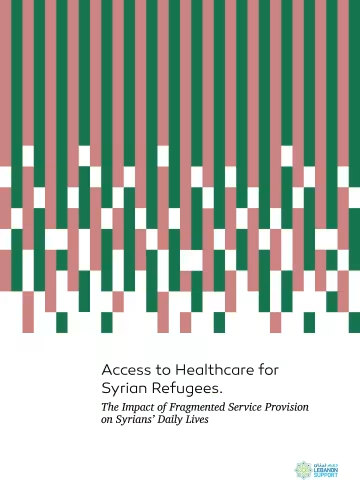
This report aims to explore the fragmented organisation of healthcare services in Lebanon, for Syrian refugees. Although it is not an assessment of the Lebanese healthcare system, this report does nevertheless reflect on the challenges and underlying dynamics of the current Lebanese system, which are reproduced in the healthcare provision for Syrian refugees. In this sense, the report highlights the privatised, rather ad hoc, and irregular provision of healthcare in Lebanon, notably for Syrian refugees, which tends to take on a more curative rather than preventive approach, resulting in...
National
Publishing Date
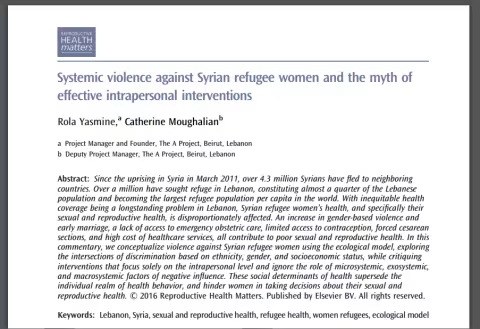
Since the uprising in Syria in March 2011, over 4.3 million Syrians have fled to neighboring countries. Over a million have sought refuge in Lebanon, constituting almost a quarter of the Lebanese population and becoming the largest refugee population per capita in the world. With inequitable health coverage being a longstanding problem in Lebanon, Syrian refugee women’s health, and specifically their sexual and reproductive health, is disproportionately affected. An increase in gender-based violence and early marriage, a lack of access to emergency obstetric care, limited access to...
National
Publishing Date
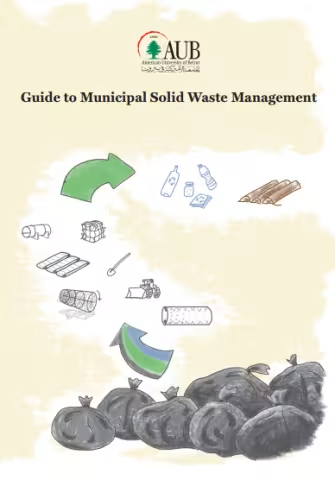
The American University of Beirut Solid Waste Management Task Force has published a manual entitled Guide to Municipal Solid Waste Management. The manual gives an overview of the waste management situation in the country (past, current, and potential solutions) along with some helpful tips on how to transition to more sustainable practices.
National
Publishing Date

In the absence of a clear national plan for Integrated Waste Management (IWM), and due to various political and governmental issues, Lebanon has had to face a serious waste crisis in 2015.  The paper scrutinizes events leading up to the 17th of July 2015, and the impact of its aftermath on Lebanon’s environment, infrastructure, health and landscape. Parallels are drawn throughout the paper to a similar crisis faced by residents of Campania, Italy.


This paper thoroughly analyzes Lebanon’s “waste profile” and benchmarks it against a spectrum of countries to further understand global trends in...

National
Publishing Date
يوجد في لبنان 21 سجنا وأربعة من هذه السجون مخصصة للنساء. و هناك سجنان اضافيان للأحداث. انّ الكشف النفسي و الرعاية الصحية النفسية غائبان في السجون اللبنانية. نأمل أن التوصيات الصادرة في هذه الدراسة تصبح واقعا كما أنها ستغير حياة العديد من الأشخاص المنسية خلف القضبان وستمنع "حكم بالسجن مدى الحياة" مماثل في المستقبل للسجناء.
National
Publishing Date
Lebanon has a total of 212 prisons, out of which 4 are specific to women. And there are 2 additional prisons dedicated to minors. Mental health screening and care is absent in Lebanese prisons. Catharsis hopes the recommendations from this study become a reality as they will change the live of many forgotten person behind bars, some of whom have been in prison for over 35 years, and it will prevent a similar “life sentence” fate for future mentally ill inmates.
National
Publishing Date
GVC and YAB have implemented a pilot initiative in 6 public schools in order to provide directors, teachers, special educators and social workers with technical tools and expertise to encourage the inclusion of children with special needs. Almost 60 children have been included in regular classes all along the implementation (2012-2015). At the same time, the project involved parents and communities where the 6 schools are located to raise culture of diversity and respect and to enhance participation of children with special needs at all levels of social and cultural life.
National
Publishing Date

Research Report | April 2015
In this paper, we analyze the susceptibility of agricultural outputs to future climate change in Lebanon, and the extent to which it propagates to the economic system as a whole. We use a methodological framework in which physical and economic models are integrated for assessing the higher-order economic impacts of projected climate changes. By using this integrated modeling approach, we are able to quantify the broader economic impacts in the country by considering not only the temporal dimension but also the regional disaggregation of the results. Our estimates...

National
Publishing Date

Working Paper | March 2015
Sustainable Transportation and Mega Sporting Events in Arab Countries: the Case of Qatar by Robert Wittkuhn and Danyel Reiche
​Qatar has successfully developed into a hub for mega sporting events; the most prestigious of them will be the FIFA World Cup in 2022. Qatar promotes it as the “first completely carbon-neutral” and “most compact” World Cup. Such statements emphasize a very small impact of transport on the event’s carbon footprint; but they also raise questions about the understanding and applicability of carbon neutrality. As motive for hosting mega events...

National
Publishing Date

Working Paper | February 2015
Commuters’ Behavior towards Upgraded Bus Services in Greater Beirut: Role of Itinerary and Implications for Greenhouse Gas Emissions, Social Welfare and Transport Policy by Ali Chalak, Hani Al-Naghi, Alexandra Irani, and Maya Abou-Zeid
Climate change is one of the most critical environmental challenges facing the world today. The transportation sector alone contributes to 22% of carbon emissions, of which 80% are contributed by road transportation. In this paper, we investigate the potential greenhouse gas (GHG) emissions reduction and social welfare gains...

National
Publishing Date

Working Paper | February 2015
Economic Impacts of Adopting a Sustainable Transport System in Beirut by Mazen Omran, Johnny Ojeil, and Youssef Fawaz
​The work carried out in this paper demonstrates the economic benefit of a sustainable transport system. It compared a scenario with and without such system, and calculated loss time as a result of being held up in congestion during key peak hours mainly due to relying entirely on the private car. The work demonstrates that in addition to reducing congestion levels a sustainable transport system will generate benefits related to travel time...