Resources

Intervention Sectors
Displaying 81 - 100 of 218
National
Publishing Date

Working Paper | February 2015
Getting to Campus: Sustainable Public Transportation and Relocating the American University in Cairo by Richard Tutwiler, Hagar Eldidi, Yumna Kassim, and Andrew Petrovich
​Cairo is one of the most congested cities in the world, and public transportation is one of its greatest challenges. Government strategies to alleviate congestion have stressed horizontal expansion into the surrounding desert areas and the construction of more and ever larger motorways. This paper uses the experience of the American University in Cairo, which physically relocated in 2008 from...

National
Publishing Date

Working Paper | February 2015
Harnessing Motorists' Potential Demand for Hybrid-Electric Vehicles in Lebanon: Policy Options, CO2 Emissions Reduction and Welfare Gains by Alexandra Irani and Ali Chalak
Public concern over deteriorating air quality and the associated local and global impacts has grown significantly in the past decade. Air quality degradation is linked first and foremost to the transportation sector in the Arab region with about 90% of total emissions of carbon monoxide resulting from transportation activities. In Lebanon’s capital, Beirut, current levels of ozone and smog...

National
Publishing Date

Working Paper | February 2015
Sustainable Transportation in the Arab World: International Benchmarking on Sustainable Transport Policies and their Impacts by Issam Kaysi and Farid Chaaban
​The world’s transport sector still suffers from unsustainable trends that lead to increased levels of greenhouse gas (GHG) emissions. There have been efforts, in the Arab world, as well as the rest of the world, to tackle the issue. Work done in the US and Europe exceeds that of the Arab world, and their efforts have been successful, and have thus succeeded in reducing GHG emissions. In the Arab world, most...

National
Publishing Date
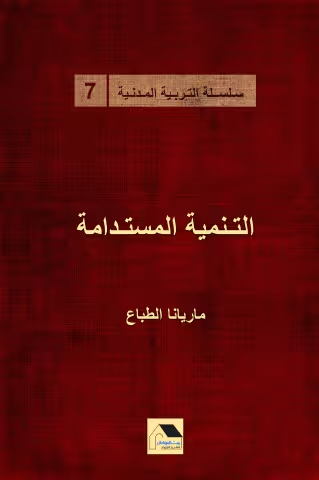
ترتّب المواطنة على الفرد/ المواطن مجموعة من الحقوق والواجبات التي تطبّق على الجميع، دون أي تمييز قائم على الاختلافات في القومية أو الجنس أو الجهة أو الموقع الاجتماعي أو الدين… وتحدد المواطنة شكل العلاقات التي يقيمها المواطن مع الدولة، والمجتمع، والفضاء المشترك. وفي هذا الجانب الأخير من العلاقات، تبرز أهمية التنمية المستدامة كقضية مواطنية بامتياز. في هذا الكتيب، تحاول الباحثة الإحاطة بمفهوم التنمية المستدامة، وبعلاقته مع المواطنة، وتفصّل العديد من القضايا البيئية الهامة، ثم تبيّن لنا ما يجب علينا، كمواطنين، فعله حيالها، لنحقق مواطنيتنا، من خلال التزامنا بالحق في البيئة السليمة للجميع....
National
Publishing Date
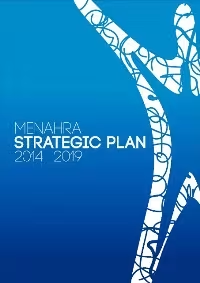
This document represents the strategic plan of the Middle East and North Africa Harm Reduction Association,MENAHRA, for the period of July 2014 till December 2019. The development of a revised strategic plan was necessary due to the new challenges faced, and changing contexts in which MENAHRA has been operating in the past few years. Established in 2007 as a network of organisations with a central Secretariat in Beirut and three Knowledge Hubs in Iran, Lebanon and Morocco,MENAHRA has taken on additional roles over the past years, including the management of a large regional HIV grant. The...
National
Publishing Date
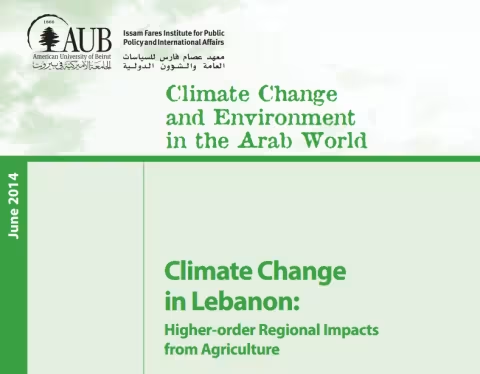
This working paper analyzes the susceptibility of agricultural outputs to future climate change in Lebanon, and the extent to which it propagates to the economic system as a whole. A methodological framework in which physical and economic models are integrated for assessing the higher-order economic impacts of projected climate changes is used. The researchers then quantify the broader economic impacts in the country considering not only the temporal dimension but also the regional disaggregation of the results. The results show that there are potential high costs and risks associated with a...
National
Publishing Date

Policy Brief | August 2014
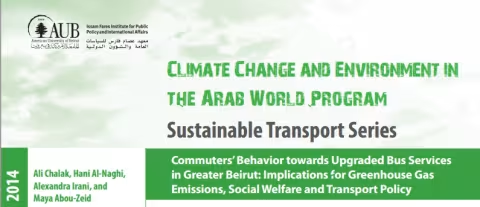
Commuters’ Behavior towards Upgraded Bus Services in Greater Beirut: Role of Itinerary and Implications for Greenhouse Gas Emissions, Social Welfare and Transport Policy by Ali Chalak, Hani Al-Naghi,Alexandra Irani, and Maya Abou-Zeid
​Potential greenhouse gas (GHG) emissions reduction and social welfare gains can be achieved from upgrading the bus service in the Greater Beirut Area through a bundle of realistic bus service improvements in the short term. Such improvements will need to be comprehensive in scope and include both improvements in bus level of service...

National
Publishing Date
Potential greenhouse gas (GHG) emissions reduction and social welfare gains can be achieved from upgrading the bus service in the Greater Beirut Area through a bundle of realistic bus service improvements in the short term. Such improvements will need to be comprehensive in scope and include both improvements in bus level of service attributes (access/egress time, headway, in-vehicle travel time, and number of transfers) and the provision of amenities, including air-conditioning and Wi-Fi. Moreover, such a service needs to be cheaply priced to achieve reasonably high levels of switching...
National
Publishing Date
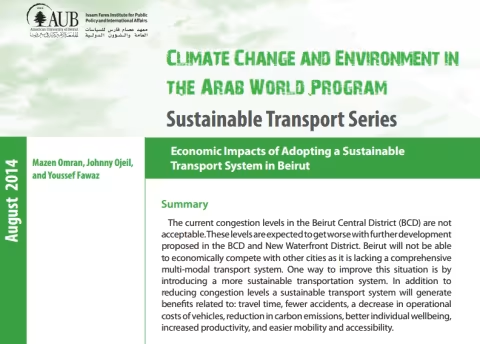
The current congestion levels in the Beirut Central District (BCD) are not acceptable. These levels are expected to get worse with further development proposed in the BCD and New Waterfront District. Beirut will not be able to economically compete with other cities as it is lacking a comprehensive multi-modal transport system. One way to improve this situation is by introducing a more sustainable transportation system. In addition to reducing congestion levels a sustainable transport system will generate benefits related to: travel time, fewer accidents, a decrease in operational costs of...
National
Publishing Date

Policy Brief | August 2014
Economic Impacts of Adopting a Sustainable Transport System in Beirut by Mazen Omran, Johnny Ojeil, and Youssef Fawaz
​The current congestion levels in the Beirut Central District (BCD) are not acceptable. These levels are expected to get worse with further development proposed in the BCD and New Waterfront District. Beirut will not be able to economically compete with other cities as it is lacking a comprehensive multi-modal transport system. One way to improve this situation is by introducing a more sustainable transportation system. In addition to reducing...

National
Publishing Date
IFI’s Climate Change and Environment in the Arab World Program, launched in 2008, has been tracking and framing climate change international negotiations under the United Nations Framework Convention on Climate Change (UNFCCC) - in particular to what pertains to Lebanon and Arab countries. Key members of the program have attended nearly all the Conferences of the Parties (COP) as part of the official Lebanese delegation since COP 15 in Copenhagen, Denmark in 2009. From this exposure, it has become apparent that literature on the history of the involvement of key Arab countries in the past 20...
National
Publishing Date
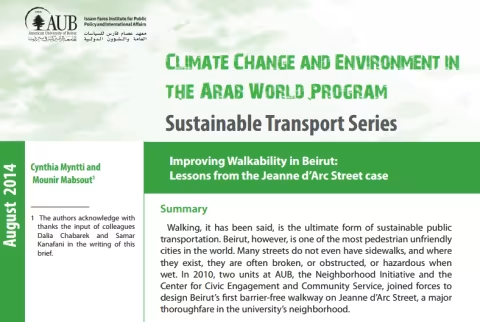
Walking, it has been said, is the ultimate form of sustainable public transportation. Beirut, however, is one of the most pedestrian unfriendly cities in the world. Many streets do not even have sidewalks, and where they exist, they are often broken, or obstructed, or hazardous when wet. In 2010, two units at AUB, the Neighborhood Initiative and the Center for Civic Engagement and Community Service, joined forces to design Beirut’s first barrier-free walkway on Jeanne d’Arc Street, a major thoroughfare in the university’s neighborhood. For more information check out IFI's Sustainable...
National
Publishing Date

Policy Brief | August 2014
Jeanne d’Arc Street; A Model Pedestrian-Friendly Street for all of Beirut by Cynthia Myntti and
Mounir Mabsout
Walking, it has been said, is the ultimate form of sustainable public transportation. Beirut, however, is one of the most pedestrian unfriendly cities in the world. Many streets do not even have sidewalks, and where they exist, they are often broken, or obstructed, or hazardous when wet. In 2010, two units at AUB, the Neighborhood Initiative and the Center for Civic Engagement and Community Service, joined forces to design Beirut’s first barrier-free walkway...


National
Publishing Date
The world’s transport sector still suffers from unsustainable trends that lead to increased levels of greenhouse gas (GHG) emissions. There have been efforts, in the Arab world, the United States and Europe, as well as the rest of the world, to tackle the issue. Much work remains to reach a sustainable transport system in the Arab world, but the recommendations presented offer basic guidelines on how to proceed with any sustainable transportation initiative. For more information check out IFI's Sustainable Transportation Series
National
Publishing Date

Policy Brief | August 2014
Sustainable Transportation in the Arab World: International Benchmarking on Sustainable Transport Policies and their Impacts by Issam Kaysi and Farid Chaaban
​The world’s transport sector still suffers from unsustainable trends that lead to increased levels of greenhouse gas (GHG) emissions. There have been efforts, in the Arab world, the United States and Europe, as well as the rest of the world, to tackle the issue. Much work remains to reach a sustainable transport system in the Arab world, but the recommendations presented offer basic guidelines on how to proceed...

National
Publishing Date

Policy Brief | August 2014
Sustainable Transportation and Mega Sporting Events in Arab Countries: the Case of Qatar by Robert Wittkuhn and Danyel Reiche
​As a motive for hosting mega sporting events, Qatar is highlighting their catalyst effect for planned infrastructure developments. Qatar plans on building intra-city, inter-city and inter-state road and railway networks for the FIFA 2022 initially, and further national use. The planned transportation construction could potentially be sustainable, but the social and political buildup of Qatar hinders such a development; especially when...

National
Publishing Date

Research Report | July 2014
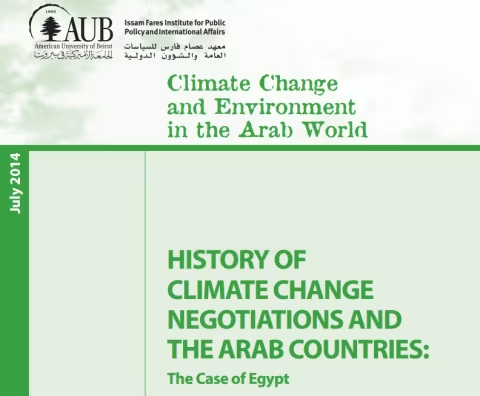
History of Climate Change Negotiations and the Arab Countries The Case of Egypt by Ibrahim Abdel Gelil
Even though Egypt’s share of Global Greenhouse Gases (GHGs) emissions is less than 1 %, Egypt has proved to be one of the most vulnerable countries to the potential risks of climate change. The most vulnerable sectors include coastal zones, water resources, and agriculture. Estimates show that a Sea Level Rise would lead to the permanent submersion of large areas of cropland in the Nile Delta, and accelerate the trend of desertification that is worsening the...

National
Publishing Date

Working Paper | June 2014
Climate Change in Lebanon: Higher-order Regional Impacts from Agriculture by Nadim Farajalla, Eduardo A. Haddad, Marina Camargo, Ricardo Lopes, and Flavio Vieira
This working paper analyzes the susceptibility of agricultural outputs to future climate change in Lebanon, and the extent to which it propagates to the economic system as a whole. A methodological framework in which physical and economic models are integrated for assessing the higher-order economic impacts of projected climate changes is used. The researchers then quantify the broader economic impacts in the...