Resources

Intervention Sectors
Displaying 41 - 60 of 119
National
Publishing Date
IFI’s Climate Change and Environment in the Arab World Program, launched in 2008, has been tracking and framing climate change international negotiations under the United Nations Framework Convention on Climate Change (UNFCCC) - in particular to what pertains to Lebanon and Arab countries. Key members of the program have attended nearly all the Conferences of the Parties (COP) as part of the official Lebanese delegation since COP 15 in Copenhagen, Denmark in 2009. From this exposure, it has become apparent that literature on the history of the involvement of key Arab countries in the past 20...
National
Publishing Date
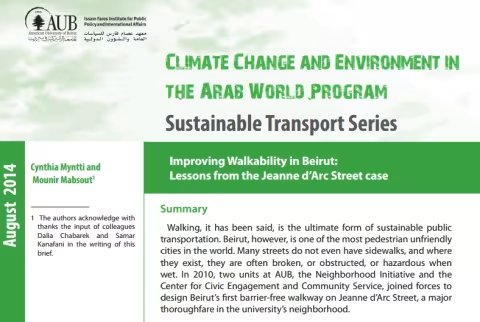
Walking, it has been said, is the ultimate form of sustainable public transportation. Beirut, however, is one of the most pedestrian unfriendly cities in the world. Many streets do not even have sidewalks, and where they exist, they are often broken, or obstructed, or hazardous when wet. In 2010, two units at AUB, the Neighborhood Initiative and the Center for Civic Engagement and Community Service, joined forces to design Beirut’s first barrier-free walkway on Jeanne d’Arc Street, a major thoroughfare in the university’s neighborhood. For more information check out IFI's Sustainable...
National
Publishing Date

Policy Brief | August 2014
Jeanne d’Arc Street; A Model Pedestrian-Friendly Street for all of Beirut by Cynthia Myntti and
Mounir Mabsout
Walking, it has been said, is the ultimate form of sustainable public transportation. Beirut, however, is one of the most pedestrian unfriendly cities in the world. Many streets do not even have sidewalks, and where they exist, they are often broken, or obstructed, or hazardous when wet. In 2010, two units at AUB, the Neighborhood Initiative and the Center for Civic Engagement and Community Service, joined forces to design Beirut’s first barrier-free walkway...

National
Publishing Date

Policy Brief | August 2014
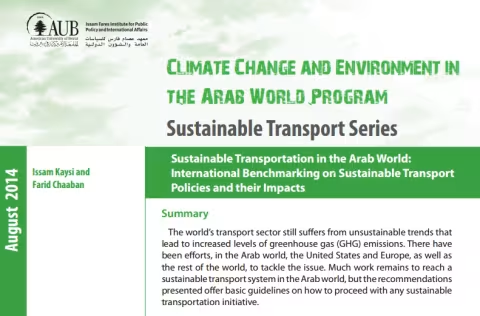
Sustainable Transportation in the Arab World: International Benchmarking on Sustainable Transport Policies and their Impacts by Issam Kaysi and Farid Chaaban
​The world’s transport sector still suffers from unsustainable trends that lead to increased levels of greenhouse gas (GHG) emissions. There have been efforts, in the Arab world, the United States and Europe, as well as the rest of the world, to tackle the issue. Much work remains to reach a sustainable transport system in the Arab world, but the recommendations presented offer basic guidelines on how to proceed...

National
Publishing Date
The world’s transport sector still suffers from unsustainable trends that lead to increased levels of greenhouse gas (GHG) emissions. There have been efforts, in the Arab world, the United States and Europe, as well as the rest of the world, to tackle the issue. Much work remains to reach a sustainable transport system in the Arab world, but the recommendations presented offer basic guidelines on how to proceed with any sustainable transportation initiative. For more information check out IFI's Sustainable Transportation Series
National
Publishing Date

Policy Brief | August 2014
Sustainable Transportation and Mega Sporting Events in Arab Countries: the Case of Qatar by Robert Wittkuhn and Danyel Reiche
​As a motive for hosting mega sporting events, Qatar is highlighting their catalyst effect for planned infrastructure developments. Qatar plans on building intra-city, inter-city and inter-state road and railway networks for the FIFA 2022 initially, and further national use. The planned transportation construction could potentially be sustainable, but the social and political buildup of Qatar hinders such a development; especially when...

National
Publishing Date

Research Report | July 2014
History of Climate Change Negotiations and the Arab Countries The Case of Egypt by Ibrahim Abdel Gelil
Even though Egypt’s share of Global Greenhouse Gases (GHGs) emissions is less than 1 %, Egypt has proved to be one of the most vulnerable countries to the potential risks of climate change. The most vulnerable sectors include coastal zones, water resources, and agriculture. Estimates show that a Sea Level Rise would lead to the permanent submersion of large areas of cropland in the Nile Delta, and accelerate the trend of desertification that is worsening the...

National
Publishing Date
Integrity’s research highlights that the truces agreed in several locations across Syria in the early months of 2014 do not represent the localised beginnings of a peacebuilding process. These agreements—and the negotiation and implementation processes that delivered them—were not built upon good practice and were significantly undermined by a lack of political will for peace from the outset. For opposition stakeholders, the truce agreements were a reaction to extreme levels of civilian suffering and a military capacity weakened by lengthy, government-enforced sieges. In all areas researched...
National
Publishing Date
This report is this first of a three-part series focusing on the current status and lessons learned relating to transitional justice and policing initiatives in opposition-controlled Syria. • Part I focuses on the effects of the departure of judicial and security elements of the Syrian state has had on conditions on the ground currently and on the nascent justice institutions that have emerged in this void (including levels of institutionalisation, Islamic law, and the legal systems currently being debated and trialed in some areas). • Part II examines the variety of institutions and...
National
Publishing Date

Working Paper | June 2014
Climate Change in Lebanon: Higher-order Regional Impacts from Agriculture by Nadim Farajalla, Eduardo A. Haddad, Marina Camargo, Ricardo Lopes, and Flavio Vieira
This working paper analyzes the susceptibility of agricultural outputs to future climate change in Lebanon, and the extent to which it propagates to the economic system as a whole. A methodological framework in which physical and economic models are integrated for assessing the higher-order economic impacts of projected climate changes is used. The researchers then quantify the broader economic impacts in the...

National
Publishing Date
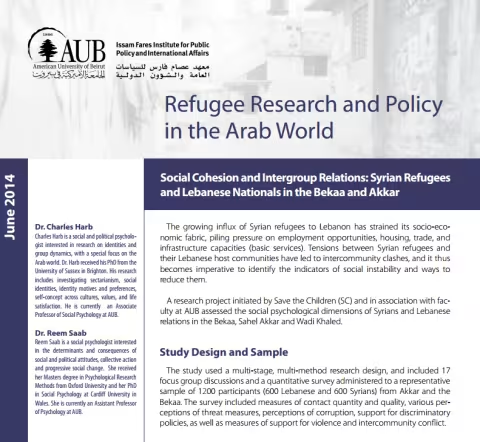
The growing influx of Syrian refugees to Lebanon has strained its socio-economic fabric, piling pressure on employment opportunities, housing, trade, and infrastructure capacities (basic services). Tensions between Syrian refugees and their Lebanese host communities have led to intercommunity clashes, and it thus becomes imperative to identify the indicators of social instability and ways to reduce them. A research project initiated by Save the Children (SC) and in association with faculty at AUB assessed the social psychological dimensions of Syrians and Lebanese relations in the Bekaa, Sahel...
National
Publishing Date

Research Report | April 2014
Impact of Population Growth and Climate Change on Water Scarcity, Agricultural Output and Food Security
This research project brought together several teams from across multiple countries to conduct a review and analysis on a wide range of complex, interconnected topics. Any one of these issues (e.g. climate change, population dynamics, food security and water security) can allow for vast and deep exploration. Seeking to integrate the concepts into unified analysis that is comprehensive and coherent is both exceptionally challenging and incredibly necessary. By...

National
Publishing Date

Research Report | April 2014
Impact of Population Growth and Climate Change on Water Scarcity, Agricultural Output and Food Security
This research project brought together several teams from across multiple countries to conduct a review and analysis on a wide range of complex, interconnected topics. Any one of these issues (e.g. climate change, population dynamics, food security and water security) can allow for vast and deep exploration. Seeking to integrate the concepts into unified analysis that is comprehensive and coherent is both exceptionally challenging and incredibly necessary. By...

National
Publishing Date
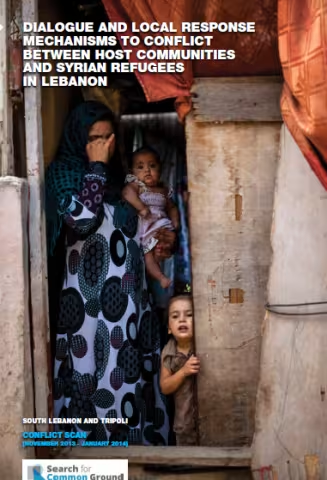
This paper discusses the risk of a renewed civil strife in Lebanon as a result of the Syrian Crisis. It argues that the security situation inside Lebanon could deteriorate due to three interrelated spillover effects stemming from Syria’s ongoing civil war.
National
Publishing Date
India shifted to the side of US primacy in 2004, but since then its foreign policy has shifted once more to the middle. Sitting with a senior Indian diplomat, I mentioned that India seemed to be caught between two stools, US primacy and regionalism. “That’s an apt image,” he said, “except we have not fallen between the stools.” Things are more fraught now, and less clear. Talk of the peace pipeline and of linkages with Iran returned to the agenda after 2004. As US power enters a period of decline as a result of economic trials and two expensive and inconclusive wars, the moment of regionalism...
National
Publishing Date

Working Paper | September 2013
Policy-making in Lebanon: Potential Offshore Oil and Gas Discoveries by Jeremy Arbid
This report follows the conclusion of the thesis research entitled “Policy-making in Lebanon: Potential Offshore Oil and Gas Discoveries” carried out with support from the Issam Fares Institute for Public Policy and International Affairs, United Nations in the Arab World Program at the American University of Beirut. The research aimed to clarify the inner workings of the policy-making process in Lebanon. Using the multiple streams framework of John Kingdon (2003), the research...

National
Publishing Date

Research Study | June 2013
Irish Peacekeeping in the United Nations Interim Force in Lebanon (UNIFIL) A Historical, Political, and Socio-Cultural Study by Rita Sakr
This study explores Irish peacekeeping within UNIFIL, since 1978 through the expanded UNIFIL after its formation in the aftermath of the 2006 Lebanon war, from historical, social, political, and cultural perspectives. The methodological approach relies mainly on interviews with a number of retired and active members of the Irish Defence Forces, academics, and journalists as well as primary and secondary sources including military...

National
Publishing Date

Research Study | January 2013
Effect of Distributed Electric Power Generation on Household Exposure to Airborne Carcinogens in Beirut by Alan Shihadeh, Marc Al Helou, Najat Saliba, Sara Jaber, Nader Alaeddine, Elias Ibrahim,
Zahra Salahieh, Maher Chiit
Due to inadequate power production capacity, EDL has in recent years instituted a rotating power outage regimen in Lebanon. People and businesses have turned to privately-owned diesel generator sets for power during outages. Because these generators are located in dense urban areas, their emissions may significantly increase inhalation exposure...