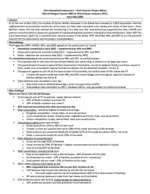
As of the end of April 2012, the number of Syrian families displaced in the Bekaa has increased to 2,800 households. Families registered with local partners receive kits of dry food, but they have requested more variety and choice in food items.
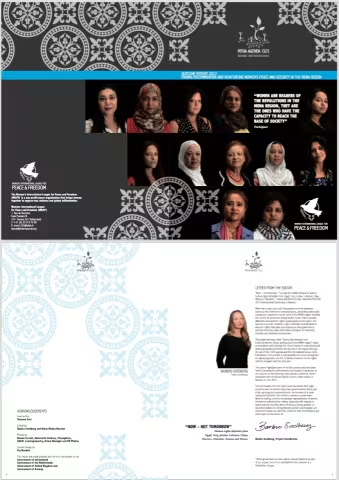
In late 2011, WILPF began to develop a programme to enhance the collective capacities of women’s rights organisations to respond to the unprecedented political events in the Middle East and North Africa (MENA).
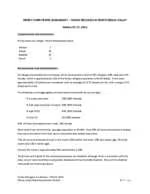
28 refugee households were surveyed, which represented a total of 501 refugees, 48% male and 52% female, which is approximately 11% of the Syrian refugee population in North Bekaa.
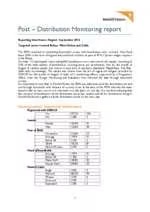
The PDM consisted of conducting household surveys with beneficiaries who received Non-Food Items (NFIs in the form of hygiene kits) and food vouchers as part of WVL's Syrian refugee response in the Bekaa.
UNHCR, coordinating the operations in the North along side with the HRC (High Relief Commission) and DRC as its main implementing partner, requested from DRC to conduct a first rapid assessment in the Bekaa with the following objectives: a) To identify existing areas of displa
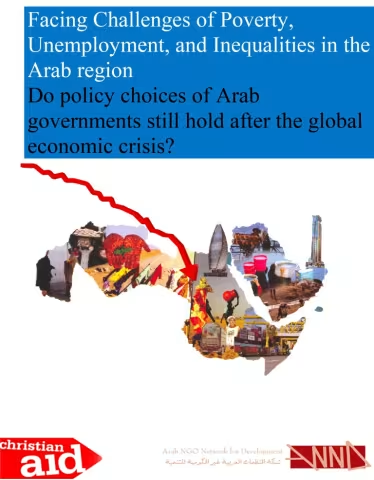
This paper was produced by ANND and Christian Aid and contains five main sections: “Executive Summary: a crisis of multiple dimensions; the threat of explosive vulnerabilities and increasing insecurities”, “Vulnerability to poverty: the key challenges faced by the Arab region”
The report assesses the progress made in the achievement of the Millennium Development Goals (MDGs) based on new national data which was formulated after the first MDGR that was published in 2003.
The fourth National Human Development Report, “Toward a Citizen’s State”, addresses citizenship in Lebanon through three principle perspectives: citizenship and sectarian state, socio-economic citizenship and citizenship and culture and education.
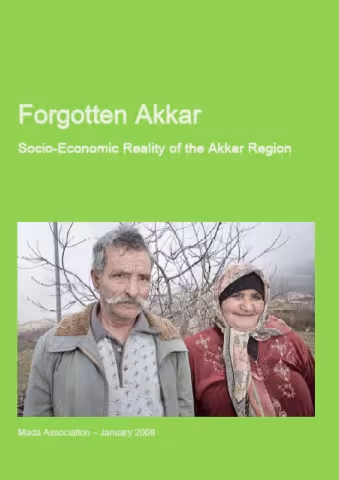
This study focuses on presenting the socio-economic reality of Akkar. It begins with a situational analysis, including an assessment measuring the impact of the July 2006 and Nahr al-Bared wars on the livelihoods of the people of Akkar.
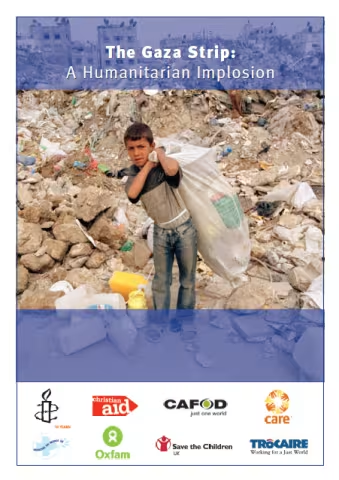
The situation for 1.5 million Palestinians in the Gaza Strip is worse now than it has ever been since the start of the Israeli military occupation in 1967.
Lebanon in Figures 2008 gathers number of social and economic indicators: About Lebanon, Population, Education, Employment, Tourism, Consumer Price Index, National Accounts...
The Israeli July 2006 war exposed the Lebanese population to disastrous conditions. It has profoundly affected residents’ livelihoods through bringing down access to services, infrastructure and natural resources. Responding to these emerging problems poses further challenges for the Lebanese government and society. In this respect, different emergency measures have been undertaken to address the arising needs, starting with assessing physical, economic and social damages.
As a contribution to identifying short and medium term intervention needs, the World Bank initiated undertaking a Post...
تهدف "دراسة الأحوال المعيشية للأسر للعام 2007 " إلى توفير قاعدة غنية من البيانات الإحصائية في المواضيع أدناه، وذلك بهدف التعرّف على الأوضاع المعيشية للأسر في العام 2007 ومدى تأثير عدوان تموز 2006عليها: • الخصائص الاجتماعية للأسر ولأفرادها • الخصائص الديموغرافية والتربوية لأفرا
Most theorists maintain that social exclusion is a process, not only the condition reflecting the outcome of that process. Yet few, if any, people ever reach the ultimate end of the imagined trajectory.
The National Survey of Household Living Conditions (The Multipurpose survey) provides a statistical database vital for the setting forth of national policies in various sectors.
The activities, presented in this brochure, are illustrative of UNDP – European Commission Humanitarian Aid Department (ECHO) funded interventions and support in restoring and preserving livelihoods in the Lebanese most damaged regions.