This issue of Tatimma focuses on the question of civil rights and liberties in Lebanon. Whilst it is usually considered that civil freedoms in Lebanon are light-years ahead of other Arab countries. Yet this state of liberties appears to be more a facade for a discriminatory system which limits the liberties of Lebanese citizens, specifically Lebanese women, refugees, foreign workers to name a few.
Today, women in Lebanon are fighting for equal access to opportunities and rights without prejudice against their gender, their expectations and their careers.
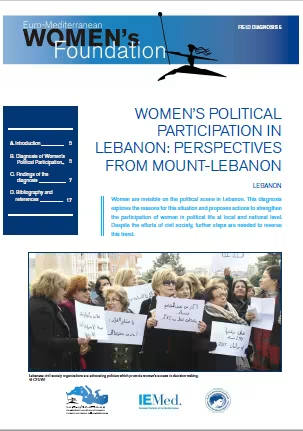
Although Lebanon is sometimes considered as the only democratic country in the Arab region with a free political environment and electoral system, the situation of women has not been strengthened enough for them to have a role on an equal footing with men. Lebanese women form a majority of 53% and they are actively participating in all aspects of Lebanese society. They enjoy equal constitutional rights with men and have the right to vote, hold public office, elect and be elected in municipal councils. Yet, this diagnosis, elaborated by the Committee for the Follow-Up on Women’s Issues (CFUWI)...
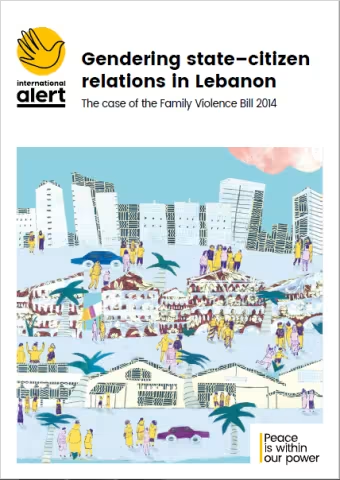
This report examines the nature of interaction and engagement between Lebanese citizens’ collectives and the state on gender-specific matters, through the case study of
Since the unrest in Syria began in March 2011, the Bekaa Valley in Lebanon has hosted varying numbers of displaced Syrian families. Local actors such as municipalities and NGOs registered families for assistance received through regional and international donors.
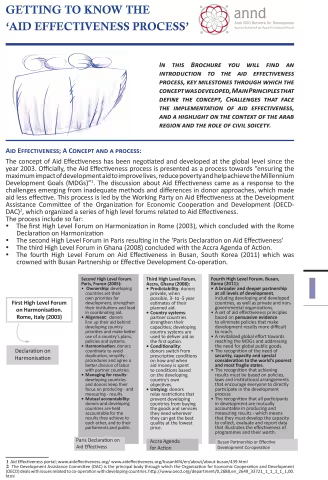
In this Brochure you will find an introduction to the aid effectiveness process, key milestones through which the concept was developed, Main Principles that define the concept, Challenges that face the implementation of aid effectiveness, and a highlight on the context of the
Although Lebanon is known in the Middle East for its relative political openness and for the degree of freedom Lebanese women enjoy, it paradoxically has one of the lowest rates of women’s political engagement in the region.
On December 9, 2009, a Lebanese criminal court sentenced a Lebanese woman to 15 days in jail for repeatedly beating Jonalin Malibago, her Filipina maid, three years earlier. Lebanese newspapers hailed the case a landmark victory for the country’s estimated 200,000 migrant domestic workers (MDWs), many of whom report abuse at the hands of their employers. The case illustrated the positive role that the judiciary can play in protecting MDWs, even though the sentence was lenient given the violation. But it also raised at least one significant question: was the Malibago verdict a rare instance of...
أنجزت الدكتورة فهميّة شرف الدين هذه الدراسة الميدانية التحليليّة، بالتعاون مع برنامج اللأمم المتحدة الإنمائي(مشروع حقوق المر أة اللبنانية وقانون الجنسية) واللجنة الاهلية لمتابعة قضايا المرأة، في 2009.
Using time-diary data from 25 countries, the authors demonstrate that there is a negative relationship between real GDP per capita and the female-male difference in total work time per day -- the sum of work for pay and work at home.
A detailed report on ANND’s participation in this forum that covered the issues of neoliberal globalization and human development, women’s rights, geopolitical changes, democracy and public freedoms, cultural dimensions, environment and sustainable development, migration and t
The popularity of the women’s rights cause and its obvious intrinsic merit have unfortunately generated many facile assumptions and much confusion about the conditions of women in the Middle East and the problems they face
To help expand the focus of the social protection debate to include the informal sector, particularly women workers, the ILO global programme STEP, "Strategies and Tools against Social Exclusion and Poverty" and the global network called Women in Informal Employment: Globalizi