Lebanon may witness a remarkable rise in the number of women serving in Parliament come May 2018 due to initiatives from women’s groups, “civil society” activists, and the substantial number of female candidates – 113 at the start of the election period. However, as this briefing paper shows, Lebanese women continue to face numerous challenges in entering government. The new electoral law passed in June 2017 does not provide women with equal opportunity to be elected, and it is yet to be seen whether it will increase female representation in Parliament. Nevertheless, the historic number of...
In Lebanon, the question of hosting and ensuring protection for Syrian refugees in light of the government stance against the erection of camps has created many deliberations concerning different proposed and implemented shelter options and solutions. UN-Habitat, in partnership with the American University of Beirut’s (AUB) Issam Fares Institute for Public Policy and International Affairs (IFI), initiated a research study in July 2014 to address solutions for hosting and ensuring protection for refugees specifically on the subject of erecting camps to address the Syrian crisis. The study...
The Swiss Agency for Development and Cooperation (SDC) is pleased to share with you the report:
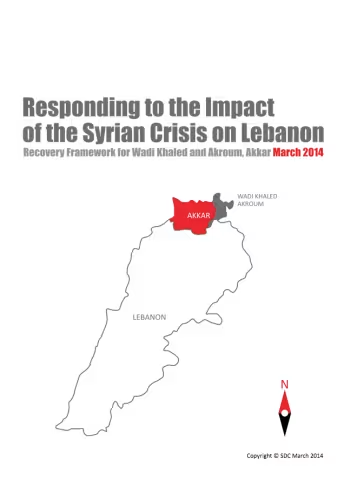
“Responding to the Impact of the Syrian Crisis on Lebanon: Recovery Framework for Wadi Khaled and Akroum, Akkar”, March 2014.
SDC facilitated a process to shed light on the impact of the Syria crisis at the national level but also on the local level. The formulation of a recovery framework for Wadi Khaled and Akroum is a process that can be replicated for other affected regions of Lebanon.
The findings and recommendations are based on consultations (between October 2013 and January 2014) with...
Since March 2012, several towns and villages in the North, the Bekaa and the South started receiving Lebanese families who fled Syria, against the backdrop of sectarian conflicts. Most of those families left their hometown decades ago and got Syrian citizenship.
This report is the result of 4 months of field data collection from April to August 2013 carried out in the Informal Tented Settlements (ITS) of the two districts of Zgharta and Minieh-Dennieh by SOLIDARITÉS INTERNATIONAL’s (SI) outreach workers.
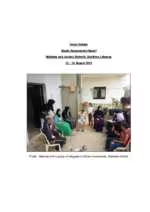
Swiss Solidar undertook a multi-sectoral needs assessment in August 2013 to assess the humanitarian needs of Syrian refugees residing in Nabatieh and Jezzine Districts in Southern Lebanon.1 Prior to undertaking its field assessment, Solidar undertook a detailed documentation r
Swiss Solidar undertook a multi-sectoral needs assessment in August 2013 to assess the humanitarian needs of Syrian refugees residing in Nabatieh and Jezzine Districts in Southern Lebanon.
The average number of assisted families during the a/m period is 46% of the overall number of families reportedly arrived to DRC North Lebanon operational area (Akkar region).
The average number of assisted families during the a/m period is 35% of the overall number of families reportedly arrived to DRC Bekaa operational area.
The objective of the project is to improve the housing conditions of the most vulnerable people affected by the Syrian crisis and to reduce their vulnerability to face the winter season.
This report is the result of 4 weeks’ field work from April 22 to May 17 carried out in the two districts of Zgharta and Minieh-Dennieh by SOLIDARITÉS INTERNATIONAL’s (SI) outreach workers.
The PDM consisted of conducting household surveys with beneficiaries who received Non-Food Items (NFIs in the form of hygiene kits) and food vouchers as part of WVL's Syrian refugee response in the Bekaa.
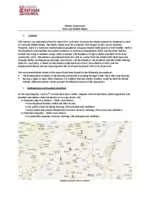
This mission was undertaken from 19 March to 5 April 2012 to assess the shelter options for displaced Syrians in West and Middle Bakaa. The shelter needs must be evaluated with respect to the current situation.
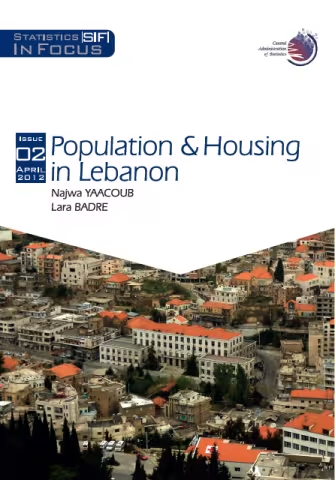
This issue of SIF looks briefly at the population and housing characteristics in Lebanon using key indicators and figures available from a number of surveys conducted by the Central Administration of Statistics (CAS) in Lebanon in recent years.
This mission was undertaken between the 2nd and 18thof July 2011 to assess the shelter options for the Syrians displaced in Northern Lebanon (the Akkar region).
This national survey provides a vital statistical database on the demographic and the educational status in Lebanon; the residential fact and the economic activity of the individuals; the health insurance, the migration, the family’s income and the aid received during the war