Resources

Intervention Sectors
Displaying 101 - 120 of 200
National
Publishing Date
يوجد في لبنان 21 سجنا وأربعة من هذه السجون مخصصة للنساء. و هناك سجنان اضافيان للأحداث. انّ الكشف النفسي و الرعاية الصحية النفسية غائبان في السجون اللبنانية. نأمل أن التوصيات الصادرة في هذه الدراسة تصبح واقعا كما أنها ستغير حياة العديد من الأشخاص المنسية خلف القضبان وستمنع "حكم بالسجن مدى الحياة" مماثل في المستقبل للسجناء.
National
Publishing Date
Lebanon has a total of 212 prisons, out of which 4 are specific to women. And there are 2 additional prisons dedicated to minors. Mental health screening and care is absent in Lebanese prisons. Catharsis hopes the recommendations from this study become a reality as they will change the live of many forgotten person behind bars, some of whom have been in prison for over 35 years, and it will prevent a similar “life sentence” fate for future mentally ill inmates.
National
Publishing Date
GVC and YAB have implemented a pilot initiative in 6 public schools in order to provide directors, teachers, special educators and social workers with technical tools and expertise to encourage the inclusion of children with special needs. Almost 60 children have been included in regular classes all along the implementation (2012-2015). At the same time, the project involved parents and communities where the 6 schools are located to raise culture of diversity and respect and to enhance participation of children with special needs at all levels of social and cultural life.
National
Publishing Date
This document represents the strategic plan of the Middle East and North Africa Harm Reduction Association,MENAHRA, for the period of July 2014 till December 2019. The development of a revised strategic plan was necessary due to the new challenges faced, and changing contexts in which MENAHRA has been operating in the past few years. Established in 2007 as a network of organisations with a central Secretariat in Beirut and three Knowledge Hubs in Iran, Lebanon and Morocco,MENAHRA has taken on additional roles over the past years, including the management of a large regional HIV grant. The...
National
Publishing Date

Policy Brief | August 2014
Jeanne d’Arc Street; A Model Pedestrian-Friendly Street for all of Beirut by Cynthia Myntti and
Mounir Mabsout
Walking, it has been said, is the ultimate form of sustainable public transportation. Beirut, however, is one of the most pedestrian unfriendly cities in the world. Many streets do not even have sidewalks, and where they exist, they are often broken, or obstructed, or hazardous when wet. In 2010, two units at AUB, the Neighborhood Initiative and the Center for Civic Engagement and Community Service, joined forces to design Beirut’s first barrier-free walkway...

National
Publishing Date
This report is this first of a three-part series focusing on the current status and lessons learned relating to transitional justice and policing initiatives in opposition-controlled Syria. • Part I focuses on the effects of the departure of judicial and security elements of the Syrian state has had on conditions on the ground currently and on the nascent justice institutions that have emerged in this void (including levels of institutionalisation, Islamic law, and the legal systems currently being debated and trialed in some areas). • Part II examines the variety of institutions and...
National
Publishing Date
This paper examines the situation of impunity in Lebanon that has persisted since the 1975–1990 war. It highlights the price of the Lebanese authorities’ failure to address the legacy of past conflict. This study recommends a holistic approach to crafting a comprehensive and victim-centered transitional justice process in Lebanon. An incremental approach to reform would be of value, given the likely challenges to pursuing accountability in the country. Programming must involve state and nonstate actors—political and community leaders, civil society, and the broader public. In addition, human...
National
Publishing Date
About the Zero Project: For a World without Barriers The Zero Project was initiated by the Essl Foundation in 2010. It has been run in partnership with the World Future Council (WFC) since 2011 and the European Foundation Centre (EFC) since 2013. The mission of the Zero Project is to work for a world without barriers, according to the principles and Articles of the UN CRPD.
National
Publishing Date
Global civil society alliance, CIVICUS, has released a revised version of what is probably the world’s most comprehensive compilation of commitments made by governments on civil society rights. Originally released in 2008, and now fully updated, the compendium consolidates various international standards and commitments made by governments at the regional and global levels to protect civil society and ensure participation in public processes. In addition to collating relevant portions of major UN documents, the compendium also includes commitments made by regional bodies such as the Arab...
National
Publishing Date
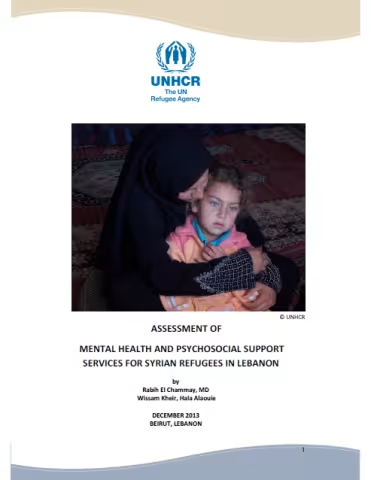
Syria's third year of civil war has caused a rapid acceleration in influx of the refugees to Lebanon with the intensification of clashes in recent months. In fall 2013 more than 2000 Syrian refugees are fleeing to Lebanon on daily basis. The mental health needs of Syrian refugees in Lebanon have not received thorough assessment. Information about the nature, the quality, and coverage of these services for the Syrian refugees is lacking. Methodology The Syrian refugee assessment for Mental Health and Psychosocial Support (MHPSS) took place in August and September 2013. The assessment had two...
National
Publishing Date
Briefing papers on the preservation of cultural heritageInstitutions and individuals from the Middle East and North Africa experience many shortcomings in legislation, policies and current practices impeding the sustainable preservation of cultural heritage. In order to obtain a systematic overview and a sound basis for engaging in lobby and advocacy work for improved governance of the cultural sector, the Modern Heritage Observatory contracted local lawyers and researchers to analyze and assess current regulations, policies and practices concerning the preservation of cultural heritage in...
National
Publishing Date
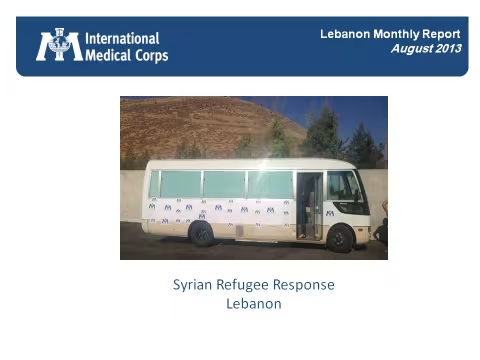
International Medical Corps Lebanon began providing services for Syrian refugees in September 2011 in North Lebanon. Since then, International Medical Corps has scaled up considerably, both geographically and in terms of types of services offered. In August, International Medical Corps: mobilized a mobile medical unit for the Masnaa border crossing provided ToT training for 54 Syrian refugee women on health-related topics supported over 14,000 primary health care (PHC) consultations admitted 2,600 patients for hospitalization  completed two mental health GAP refresher trainings for 24 PHC...