In most Arab countries, family matters including Domestic Violence continue to be handled by religious courts as civil legislation does not criminalise acts of violence within the family.
This report examines the situation of impunity in Lebanon that has persisted since the 1975-1990 war through the lenses of core elements of transitional justice.
This report examines variations in wartime experiences and the attitudes of residents in Greater Beirut regarding measures to confront Lebanon’s legacy of political violence.
This report presents qualitative data collected by ICTJ on how individuals in Greater Beirut talk about the Lebanon wars and the need for truth, justice, and an end to violence in their country.
This paper discusses the risk of a renewed civil strife in Lebanon as a result of the Syrian Crisis. It argues that the security situation inside Lebanon could deteriorate due to three interrelated spillover effects stemming from Syria’s ongoing civil war.
Syria's third year of civil war has caused a rapid acceleration in influx of the refugees to Lebanon with the intensification of clashes in recent months. In fall 2013 more than 2000 Syrian refugees are fleeing to Lebanon on daily basis. The mental health needs of Syrian refugees in Lebanon have not received thorough assessment. Information about the nature, the quality, and coverage of these services for the Syrian refugees is lacking.
Methodology
The Syrian refugee assessment for Mental Health and Psychosocial Support (MHPSS) took place in August and September 2013. The assessment had two...
This "Thirty Questions Guide" is the first guide that addresses the various stages of work and employment based on the principles of the CRPD and its relevant detailed provisions.
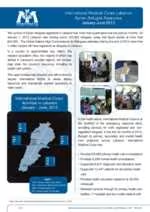
International Medical Corps Lebanon began providing services for Syrian refugees in September 2011 in North Lebanon. Since then, International Medical Corps has scaled up considerably, both geographically and in terms of types of services offered.
In August, International Medical Corps:
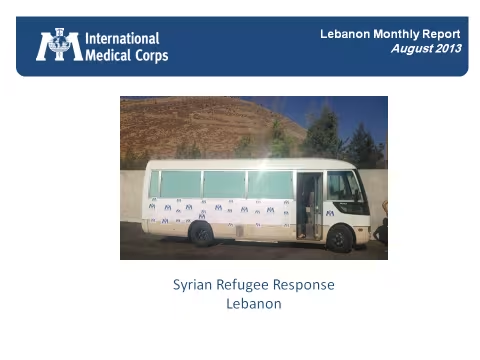
mobilized a mobile medical unit for the Masnaa border crossing
provided ToT training for 54 Syrian refugee women on health-related topics
supported over 14,000 primary health care (PHC) consultations
admitted 2,600 patients for hospitalization
completed two mental health GAP refresher trainings for 24 PHC...
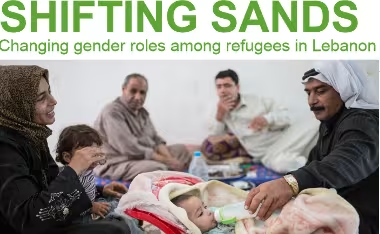
Shifting Sands: Changing gender roles among refugees in Lebanon is new study published by ABAAD-Resource Center for Gender Equality and Oxfam GB. The study explores the different pressures facing men and women refugees from Syria living in Lebanon from a gender perspective. It highlights the gendered impact of the crises on women, men, boys and girls. Key research findings highlight changes in gendered norms, values and identities, as well as changes in levels of gender-based violence, protection and emotional stress. Moreover, the study depicts changes in gendered access and control over...
International Medical Corps Lebanon began providing services for Syrian refugees in September 2011 in North Lebanon. Since then, IMC has scaled up considerably, both geographically and in terms of types of services offered.
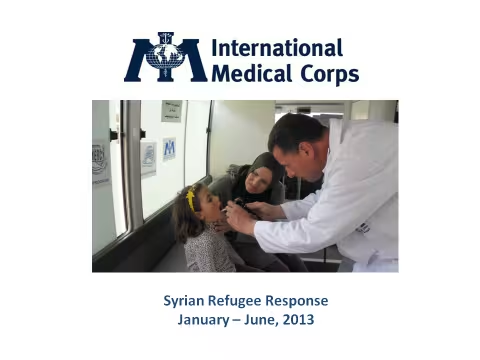
In the health sector International Medical Corps is at the forefront of the emergency response effort, providing services for both registered and nonregistered refugees. In the first six months of 2013, through its primary, secondary and mental health care programs across Lebanon, International Medical Corps has:
• Provided 53,885 primary health care consultations;
•...
The continuing unrest in Syria is resulting in a growing influx of Syrian refugees to Lebanon. The United Nations High Commissioner for Refugees has registered over 57,000 Syrian refugees in Lebanon (September 7, 2012) while many refugees are awaiting registration.
The number of Syrian refugees registered in Lebanon has more than quadrupled over the past six months. On January 1, 2013 Lebanon was hosting some 130,000 refugees; today that figure stands at more than 600,000.
The purpose of the needs assessment conducted in the Bekaa area is to identify the needs of Syrian refugees (SR), in terms of food, non food items (NFIs), shelter, water and education.