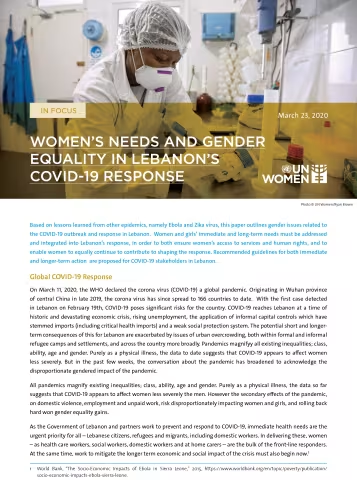
On March 11, 2020, the WHO declared the corona virus (COVID-19) a global pandemic. Originating in Wuhan province
of central China in late 2019, the corona virus has since spread to 166 countries to date.
“More than 60% of Syrian refugees households comprise a person with disabilities and 1/5 Syrian refugees has a disability in Lebanon and Jordan”, shows a large study conducted by Humanity & Inclusion (HI) and iMMAP.
In most Arab countries, family matters including Domestic Violence continue to be handled by religious courts as civil legislation does not criminalise acts of violence within the family.
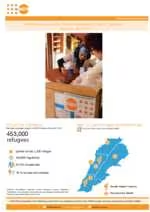
The continuing unrest in Syria is resulting in a growing influx of Syrian refugees to Lebanon. The United Nations High Commissioner for Refugees has registered over 57,000 Syrian refugees in Lebanon (September 7, 2012) while many refugees are awaiting registration.
The purpose of the needs assessment conducted in the Bekaa area is to identify the needs of Syrian refugees (SR), in terms of food, non food items (NFIs), shelter, water and education.
Severe weather struck the country this week, affecting Syrian refugees sheltered in the mountain region of Bekaa. Heavy rains and snowfall have flooded some settlements, and a number of refugee families were forced to seek shelter elsewhere.
Disability & Vulnerability Focal Point (DVFP) have been developed based on the observation that one of the greatest difficulties following a crisis is not only to identify and to access to vulnerable people including people with disabilities, but also to accompany them wit
28 refugee households were surveyed, which represented a total of 501 refugees, 48% male and 52% female, which is approximately 11% of the Syrian refugee population in North Bekaa.
UNHCR, coordinating the operations in the North along side with the HRC (High Relief Commission) and DRC as its main implementing partner, requested from DRC to conduct a first rapid assessment in the Bekaa with the following objectives: a) To identify existing areas of displa
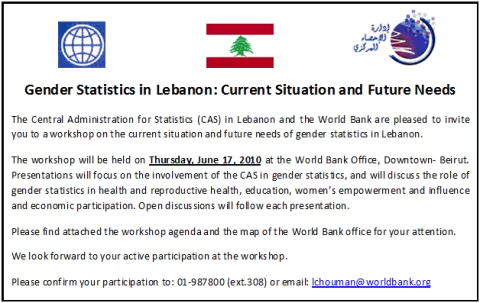
The Central Administration of Statistics (CAS) and the World Bank organized a workshop entitled "Gender Statistics in Lebanon: Current Situation and Future Needs," which took place on June 17, 2010.
This essay proposes to re-orient feminist debates on epistemology towards the care-security nexus as a pathway that can plausibly provide an integral understanding of a human-centred and eco-minded security.
This paper explores some faces of globalization by using a gender perspective, in order to consider reproduction (psychological and emotional as well as biological) and the activities and attitudes of care that give moral resources for response to systemic tragedy, not only fo
The study upon which this article is based analyzes the status of Arab women in general, gender relations in the Middle East, and the situation of Arab women with disabilities, based on available disability statistics from a few selected countries and the author's observations
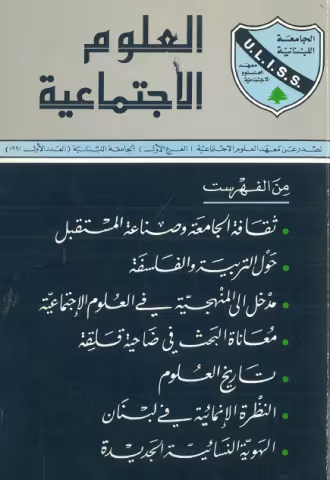
"الهوية النسائية الجديدة" هي دراسة ميدانيّة في تجاوز التنميط الجنسي لدى فئة من الشابات اللبنانيات قامت بها عزة شرارة بيضون، ونشرت في مجلة العلوم الاجتماعية الصادرة عن معهد العلوم الاجتماعية (الفرع الاوّل) من الجامعة اللبنانية، في العدد الاول الصادر عام 1991.