This report presents the findings of the labour market study in Bar Elias and the Bekaa, focusing on the labour activities, initiatives, and aspirations of current B&Z beneficiaries and Syrian refugee youth and women heads of household respondents that could potentially be
This report is based on answers to two surveys carried out in Lebanon in 2018 as part of a project to understand how refugees and humanitarian staff perceive the impact of the reforms enshrined in the Grand Bargain.
This report examines both the historical development and current situation of Syrians working in Lebanon through the analysis of policies established and implemented by the Lebanese government. While the report is not an assessment of these policies, it nevertheless reflects on its impact on Syrians’ working conditions and livelihoods. In this vein, this report notably focuses on emerging dynamics of increased informality, exploitation, and dependence.
It is part of a series of reports to be published in 2016, the 1st of which being "Formal Informality, Brokering Mechanisms, and Illegality...
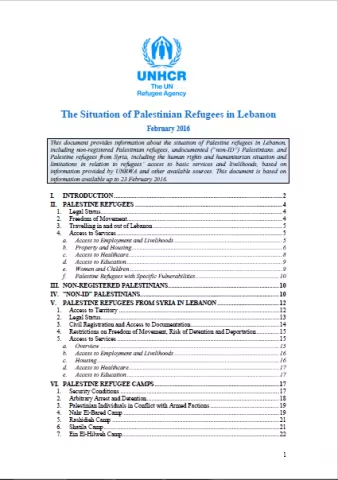
This document provides information about the situation of Palestine refugees in Lebanon, including non-registered Palestinian refugees, undocumented (“non-ID”) Palestinians, and Palestine refugees from Syria.
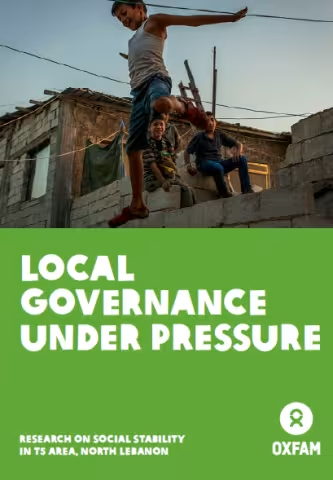
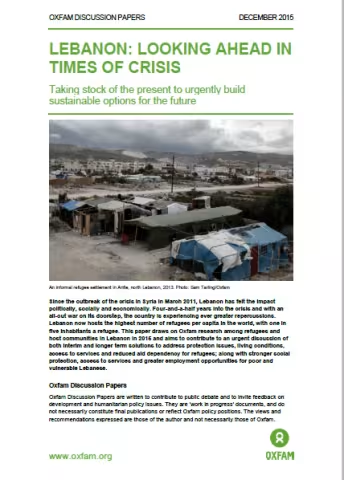
This paper draws on Oxfam research among refugees and host communities in Lebanon in 2015 and aims to contribute to an urgent discussion of both interim and longer term solutions to address protection issues, living conditions, access to services and reduced aid dependency for refugees; along with stronger social protection, access to services and greater employment opportunities for poor and vulnerable Lebanese.
Considerable analysis has been undertaken to date on the challenges and impacts on and of Syrian refugees in Lebanon – including by Oxfam – but the bulk of this analysis is seen through the lens of the wider Syria crisis and often fails to take into consideration Lebanon itsel
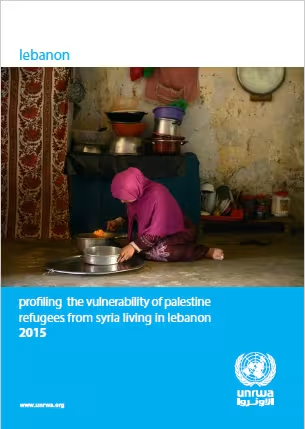
The “Profiling vulnerability of Palestine refugees from Syria living in Lebanon” report is a multi-sectorial analysis of the vulnerability experienced by the Palestine Refugees from Syria [PRS] according to the following sectors: economic; education; food-security; health; protection; non-food items; shelter and water, sanitation and hygiene. It provides information on the living conditions of PRS to inform decision-making on programmatic activities. The survey is based on the VASyR [Vulnerability Assessment of Syrian Refugees in Lebanon] and adapted for UNRWA’s specific context. Data was...
Since 2011, Lebanon has seen a huge influx of refugees fleeing the violence in Syria and currently hosts the biggest number of Syrian refugees in the world.
The Swiss Agency for Development and Cooperation (SDC) is pleased to share with you the report:
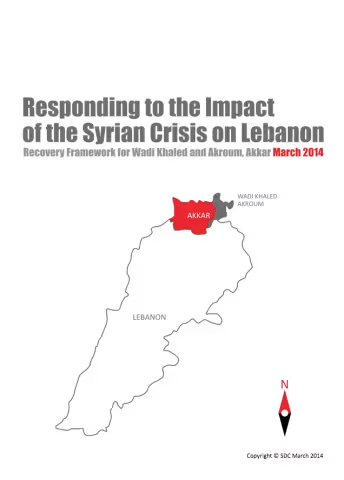
“Responding to the Impact of the Syrian Crisis on Lebanon: Recovery Framework for Wadi Khaled and Akroum, Akkar”, March 2014.
SDC facilitated a process to shed light on the impact of the Syria crisis at the national level but also on the local level. The formulation of a recovery framework for Wadi Khaled and Akroum is a process that can be replicated for other affected regions of Lebanon.
The findings and recommendations are based on consultations (between October 2013 and January 2014) with...
Over three years after it began, the Syria crisis continues to weigh extremely heavily upon Lebanon. Around a quarter of its population is now made up of refugees, whose needs remain dire even as the resources available to address them appear to be shrinking.
Since March 2012, several towns and villages in the North, the Bekaa and the South started receiving Lebanese families who fled Syria, against the backdrop of sectarian conflicts. Most of those families left their hometown decades ago and got Syrian citizenship.