The Swiss Agency for Development and Cooperation (SDC) is pleased to share with you the report:
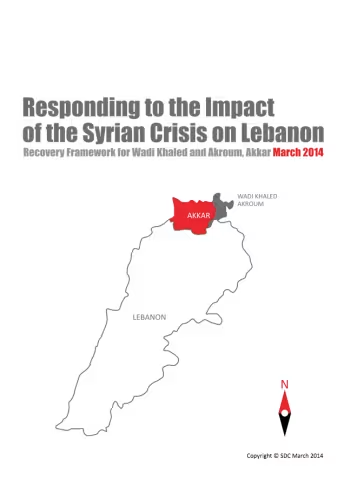
“Responding to the Impact of the Syrian Crisis on Lebanon: Recovery Framework for Wadi Khaled and Akroum, Akkar”, March 2014.
SDC facilitated a process to shed light on the impact of the Syria crisis at the national level but also on the local level. The formulation of a recovery framework for Wadi Khaled and Akroum is a process that can be replicated for other affected regions of Lebanon.
The findings and recommendations are based on consultations (between October 2013 and January 2014) with...
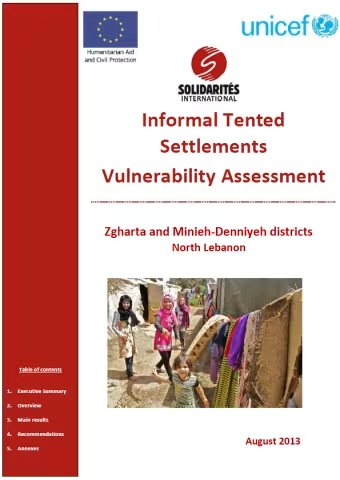
This report is the result of 4 months of field data collection from April to August 2013 carried out in the Informal Tented Settlements (ITS) of the two districts of Zgharta and Minieh-Dennieh by SOLIDARITÉS INTERNATIONAL’s (SI) outreach workers.
The purpose of the needs assessment conducted in the Bekaa area is to identify the needs of Syrian refugees (SR), in terms of food, non food items (NFIs), shelter, water and education.
Swiss Solidar undertook a multi-sectoral needs assessment in August 2013 to assess the humanitarian needs of Syrian refugees residing in Nabatieh and Jezzine Districts in Southern Lebanon.
Since March 2011 and the continuously escalating crisis in Syria, Lebanon (along with Jordan, Iraq and Turkey) has been a refuge area for Syrian families fleeing the instability and violence in their country.
This study, supported by UNFPA, assessed the reproductive health and gender-based violence among displaced Syrian women in Lebanon between July and September 2012.
Since the unrest in Syria began in March 2011, the Bekaa Valley in Lebanon has hosted varying numbers of displaced Syrian families. Local actors such as municipalities and NGOs registered families for assistance received through regional and international donors.
The human rights situation in the Syrian Arab Republic has deteriorated significantly since November 2011, causing further suffering to the Syrian people. Widespread violence and increasingly aggravated socio-economic conditions have left many communities in a perilous state.