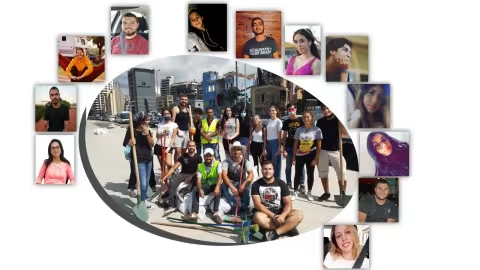
Beirut Explosion: Greatest Tragedies Come With Greatest Acts of Kindness.
Youth from a Sports and Youth Association (Chabibeh Sporting Club) become volunteers and share stories of compassion and pain mixed together to shed light on the darkest hour of their country.
TrustLaw is the Thomson Reuters Foundation’s global pro bono legal programme, connecting the best law firms and
corporate legal teams around the world with high-impact NGOs and social enterprises working to create social and
environmental change. We produce groundbreaking legal research, and offer innovative training courses worldwide.
Through TrustLaw, over 100,000 lawyers offer their time and knowledge to help organisations achieve their social
mission for free. This means NGOs and social enterprises can focus on their impact instead of spending vital resources
on legal support.
TrustLaw connects the world’s leading legal teams with high-impact NGOs and social
enterprises working to create social and environmental change. We help produce
groundbreaking legal research and offer innovative training courses worldwide.
We have supported grassroots organisations to employ their first staff members, helped
vulnerable women access loans to start their first businesses and brought renewable
energy lighting to slums. Free legal assistance on these projects has made a significant
impact on local communities working to overcome poverty and discrimination.
We are the largest...
This report aims to provide statistical and analytical tools for the recovery community working in North Lebanon, specifically those working with the Nahr el-Bared displaced and returnee population. The information will allow for better assessment of current needs and gaps, which will eventually support the development of appropriate strategies of intervention on both the short and long term.
The third edition of the Arab Governance Report introduces post-war best practices from international and regional experiences. It suggests strategies and policies for Libya and Yemen that focus on the immediate aftermath once combat ceases and a future political settlement.
In light of recent proposals for legislation againsts sexual harassment (SH) in Lebanon, this policy brief explores the subject of SH in public, institu
More than a decade after the United Nations’ adoption of the Convention on the Elimination of All Forms of Discrimination against Women, which is adopted by many countries including Lebanon, these countries returned in 2015 to commit themselves to achieve gender equality and t
This report aims to provide a contextual understanding of migration governance in the Lebanese context, as well as its implications for refugees and migrants.
UNFPA on behalf of UNDP and UN Women organized a national workshop on gender-related laws, policies and practices in Lebanon, which was held in Beirut on the 7th and 8th of August, 2018.
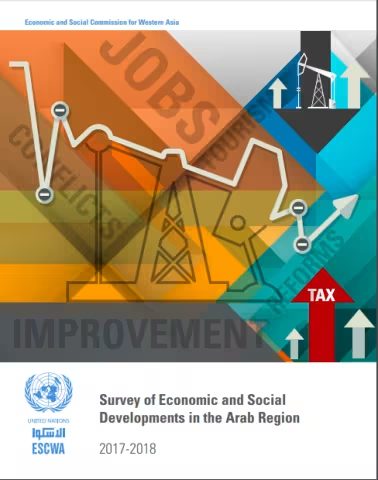
The Arab region continues to manage uncertainties on its path towards an inclusive and sustainable growth trajectory: geopolitical tensions persist, and global interest rates have soared.
The July war 2006, lasted 34 days, and led to the displacement of 915,762 (almost 25% of the Lebanese population) persons, relocating into public and private schools all over the country. With the coming into force of the cease fire in August 14th 2006, there was a rapid return of the displaced to the south.
“الجهل بالقانون لا يُنهض عُذراً لأحد”
يشير هذا المبدأ الجوهري في الممارسة المواطنية إلى ضرورة توعية المواطنين على قوانينهم وأهميتها وسبل التمتع بما توفره من حماية لهم ولحقوقهم. والمعرفة بالقانون تستدعي أيضا معرفة بالنظام المخوّل بتطبيقه وتنفيذه.
التوعية القانونية عملية معقدة وواسعة وتتطلب تفاعل العديد من المؤسسات الوطنية كالمدرسة والجامعة ووسائل الإعلام ومنظمات المجتمع المدني… ولا نكشف سرّاً إذ نقول إن هذه التوعية لا تمارَس إلا بحدّها الأدنى في بلادنا، في حين يُمارس التعسف في تطبيق القانون، بل ويُنتهك القانون طولاً وعرضاً، بدون ضابط أو قيد.
يحاول هذا الكتاب أن يساهم في عملية التوعية هذه،...
The Arab region lacks sustainable natural resource management, mostly in the areas of energy efficiency and its overwhelming reliance on fossil fuels for virtually all its energy needs.
This Policy Brief is based on research that explored the process of establishing and implementing Law 293, and on a policy dialogue that took place at the Institute on March 8, 2017 t
This study maps the current state of gender justice in the Arab region, documenting barriers as well as opportunities. Its primary research aim is to determine how to develop an environment, at the legal, policy, and social levels that is conducive to gender justice.
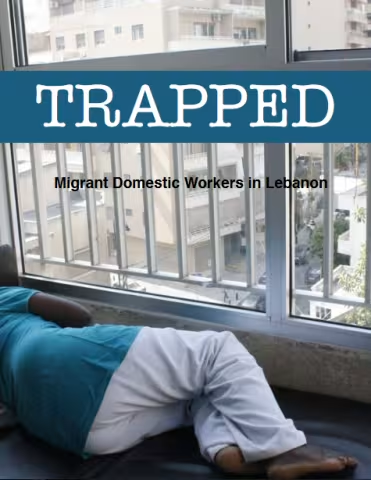
Over 250,000 migrant women are employed by private households in Lebanon to carry out household tasks such as cleaning, cooking, and caring for children and the elderly.
Lebanon has had an ambiguous approach to the more than one million Syrians seeking protection in the country since 2011. The country is neither party to the 1951 Convention relating to the Status of Refugees, nor does it have any national legislation dealing with refugees.
The concept of resilience offers a framework that facilitates cross-institutional and cross-disciplinary dialogue and pushes us to examine systems that influence complex situations.
The right to freedom of movement forms one of the cornerstones of the international human rights regime and the Lebanese legal system. It is a right that everyone ought to enjoy regardless of race, national origin, residence status, religion or any other criteria.
This paper is inspired by examples of domestic workers organizing themselves in different parts of the world through social and solidarity economy enterprises and organizations which have become more evident since the advent of the ILO Domestic Workers Convention 2011, (No.189