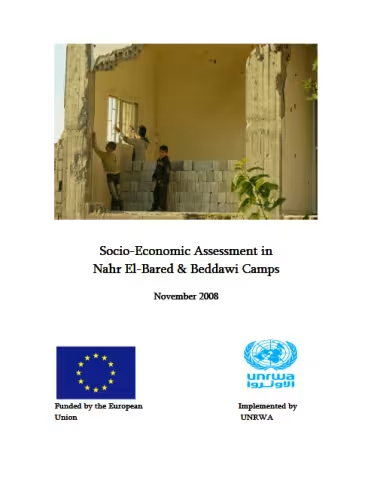
This report aims to provide statistical and analytical tools for the recovery community working in North Lebanon, specifically those working with the Nahr el-Bared displaced and returnee population. The information will allow for better assessment of current needs and gaps, which will eventually support the development of appropriate strategies of intervention on both the short and long term.
The July war 2006, lasted 34 days, and led to the displacement of 915,762 (almost 25% of the Lebanese population) persons, relocating into public and private schools all over the country. With the coming into force of the cease fire in August 14th 2006, there was a rapid return of the displaced to the south.
The Arab region lacks sustainable natural resource management, mostly in the areas of energy efficiency and its overwhelming reliance on fossil fuels for virtually all its energy needs.
The concept of resilience offers a framework that facilitates cross-institutional and cross-disciplinary dialogue and pushes us to examine systems that influence complex situations.
This report examines variations in wartime experiences and the attitudes of residents in Greater Beirut regarding measures to confront Lebanon’s legacy of political violence.
This report is the result of 4 months of field data collection from April to August 2013 carried out in the Informal Tented Settlements (ITS) of the two districts of Zgharta and Minieh-Dennieh by SOLIDARITÉS INTERNATIONAL’s (SI) outreach workers.
Shedding the lights on UNDP's recovery efforts in South Lebanon and the Southern Suburb of Beirut in the aftermath of the July 2006 aggression, the booklet tackles the recovery initiatives undertaken by UNDP from rubble removal activities to other quick impact initiatives.
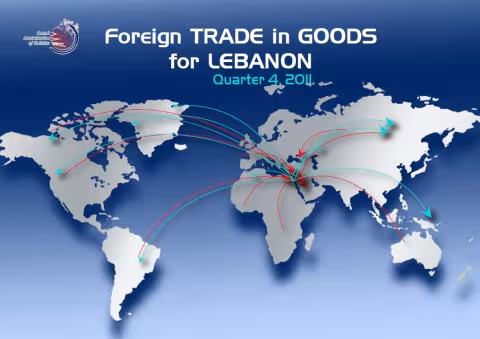
The value of Lebanese imports of goods in Quarter Q1 year 2012 was 9346 billion LBP. This was 518 billion LBP, 5.9% higher than imports in Q4 of previous year 2011, and 2162 billion LBP, i.e. 30% increase comparing to the same Quarter Q1 of year 2011.
The value of exports from Lebanon in Quarter 4 2011, was LBP 2,052 billion. This was LBP 72 billion, 3.4%, lower than exports in Q3 2011 and LBP 148 billion, 6.7%, lower than exports in the same quarter last year.
This report will provide a description of the assessment conducted by IMC’s Mental Health and Psychosocial team in the region of Wadi Khaled following the displacement of Syrians into the northern villages between the Lebanese-Syrian borders as a result of the internal conflic
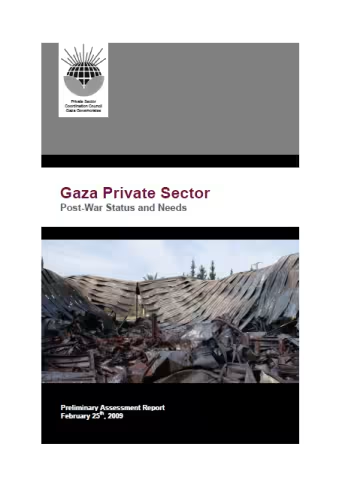
Israeli forces conducted a major combined military operation in the Gaza Strip for a period of 22 days (December 27, 2008 – January 18, 2009), where “Israeli forces used aerial bombing, tank shelling and armored bulldozers to eliminate the productive capacity of some of Gaza's
June 14, 2009 marks the second year of closure of the Gaza Strip for movement of both people and goods. The large majority of these movements are classified under the humanitarian functions with only limited quantities of exports mainly cash crops.
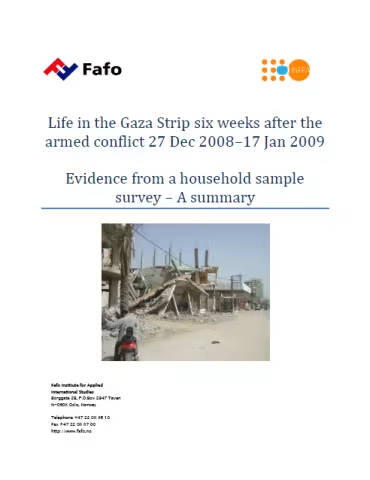
This multi-topic household sample survey was implemented to collect data to document the living conditions in the Gaza Strip in the wake of Israel’s assault on 27 December and the ensuing armed conflict.
Following the Nahr EL Bared War, LPDC launched in 2008 a workshop mapping the recovery and development initiatives in the camp's area. They followed up in 2009 with another workshop reviewing the development projects that took place in the NBC area.
This report highlights the post war status of private sector businesses represented in the Palestinian Federation of Industries (PFI) in the Gaza Strip.