Since March 2012, several towns and villages in the North, the Bekaa and the South started receiving Lebanese families who fled Syria, against the backdrop of sectarian conflicts. Most of those families left their hometown decades ago and got Syrian citizenship.
The purpose of the needs assessment conducted in the Bekaa area is to identify the needs of Syrian refugees (SR), in terms of food, non food items (NFIs), shelter, water and education.
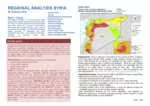
This Regional Analysis of the Syria Conflict (RAS) seeks to bring together information from all sources in the region and provide holistic analysis of the overall Syria crisis.
The “Review of the Public Procurement Legal Framework in Lebanon” introduces the Sustainable Public Procurement (SPP) in Lebanon and elaborates on the legal of the country’s procurement and sustainability laws that may offer a legal possibility for the adoption of SPP principl
This study, supported by UNFPA, assessed the reproductive health and gender-based violence among displaced Syrian women in Lebanon between July and September 2012.
This book tackles key Issues of concern within the aid discussion. It outlines issues of particular importance for civil society in the Arab region and highlights the difference of prospectives between government representatives and CSOs.
The human rights situation in the Syrian Arab Republic has deteriorated significantly since November 2011, causing further suffering to the Syrian people. Widespread violence and increasingly aggravated socio-economic conditions have left many communities in a perilous state.
The National Report for the United Nations Conference on Sustainable Development (Rio + 20) presents the current situation as is and highlights the achievements and failures, strengths and weaknesses, opportunities and risks.
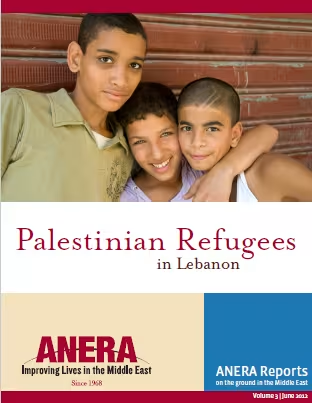
The list of challenges Palestinian refugee families living in Lebanon face is long and overwhelming. They live in overcrowded camps and have to deal with discrimination, isolation and social exclusion.
The Strategic Planning is based on the findings of fieldwork carried out in several villages in Dinnieh, which aimed at identifying the major characteristics of the region in different fields.
Oxfam GB commissioned the pilot study discussed in this report in order to understand further the context that shapes men’s gender roles and affects their behaviours, practices, and attitudes towards gender equality, with an explicit focus on VAW.
The State and Trends of the Lebanese Environment report provides an overview of the current condition of natural resources and environmental management in the country. Furthermore, it gives an analysis of past and future developments across multiple different sectors.
This report was presented at the International Labour Conference, 99th Session, 2010. It was intended to facilitate the discussion of domestic work at the Conference and consists of ten chapters, each of which covers issues pertaining to the topic of domestic work.
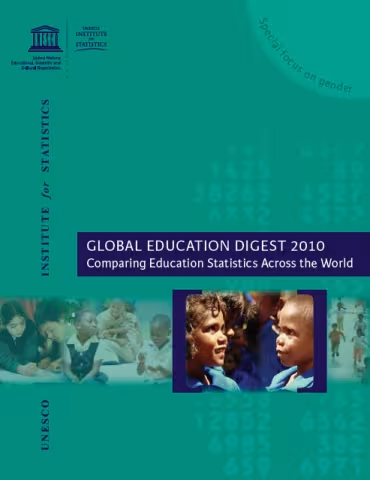
This edition of the Global Education Digest (GED) explores the changing patterns in gender and schooling throughout the formal education system – from primary to tertiary education levels.
The report assesses the progress made in the achievement of the Millennium Development Goals (MDGs) based on new national data which was formulated after the first MDGR that was published in 2003.