Resources

Intervention Sectors
Resource Type
Theme
Displaying 1 - 20 of 23
National
Publishing Date
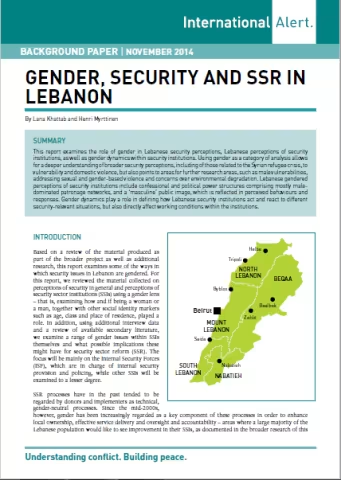
The purpose of this policy brief is to inform policy formulation on local level security provision and refugee protection, and to propose modalities for upgrading the sys- tems of the Lebanese security institutions in a way that strengthens protection of the Lebanese communities and the Syrian refugees they host. Based on eld research conducted between February and May 2016 in three locations across Lebanon, this brief analyses the challenges to protecting local communities and refugees in a hybrid system, in which formal and informal security actors coexist and implement a mix of security...
National
Publishing Date
This report aims to analyse how formal and informal security providers implement their respective social order agendas through a security “assemblage”. It also aims to inform the debate on refugee protection and security provision in urban settings, in the context of Lebanon’s hybrid security system. The accounts collected illustrate how state security institutions tacitly accept – or even rely on – informal security actors, managing at times to achieve their political and strategic goals through decentralised and/or illegal forms of control. In this vein, local municipalities imposed curfews...
National
Publishing Date
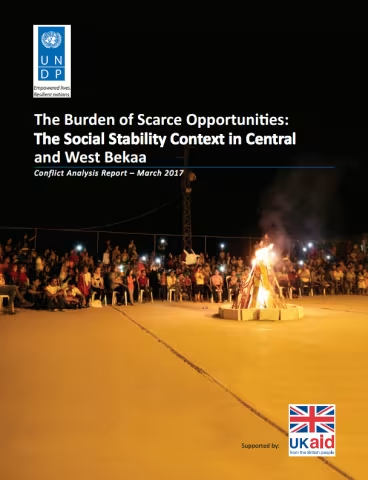
This report presents a brief analysis of the social stability context in the Qazas of Nabatieh and Bint Jbeil in the Nabatieh governorate, a sparsely populated religiously and politically homogenous area which hosts a small number of Syrian refugees.
National
Publishing Date
Working Paper Series # 24 | October 2014 Operation Protective Edge & Legal RemediesNoura Erakat, Bianca Isaias, and Salmah Rizvi On 26 August 2014, Israel and Palestinian resistance groups entered into a long-term ceasefire agreement. The terms of the agreement look almost identical to those established in November 2012, including a lack of implementation mechanisms. Indeed, if the parties fail to make these terms more precise and binding, it will be no more than a holding position before Israel’s next assault on the Gaza Strip Its most significant omission is a commitment to lift Israel’s...
National
Publishing Date
Working Paper Series # 24 | October 2014 Operation Protective Edge & Legal RemediesNoura Erakat, Bianca Isaias, and Salmah Rizvi On 26 August 2014, Israel and Palestinian resistance groups entered into a long-term ceasefire agreement. The terms of the agreement look almost identical to those established in November 2012, including a lack of implementation mechanisms. Indeed, if the parties fail to make these terms more precise and binding, it will be no more than a holding position before Israel’s next assault on the Gaza Strip Its most significant omission is a commitment to lift Israel’s...
National
Publishing Date
Integrity’s research highlights that the truces agreed in several locations across Syria in the early months of 2014 do not represent the localised beginnings of a peacebuilding process. These agreements—and the negotiation and implementation processes that delivered them—were not built upon good practice and were significantly undermined by a lack of political will for peace from the outset. For opposition stakeholders, the truce agreements were a reaction to extreme levels of civilian suffering and a military capacity weakened by lengthy, government-enforced sieges. In all areas researched...
National
Publishing Date
This report is this first of a three-part series focusing on the current status and lessons learned relating to transitional justice and policing initiatives in opposition-controlled Syria. • Part I focuses on the effects of the departure of judicial and security elements of the Syrian state has had on conditions on the ground currently and on the nascent justice institutions that have emerged in this void (including levels of institutionalisation, Islamic law, and the legal systems currently being debated and trialed in some areas). • Part II examines the variety of institutions and...
National
Publishing Date
The growing influx of Syrian refugees to Lebanon has strained its socio-economic fabric, piling pressure on employment opportunities, housing, trade, and infrastructure capacities (basic services). Tensions between Syrian refugees and their Lebanese host communities have led to intercommunity clashes, and it thus becomes imperative to identify the indicators of social instability and ways to reduce them. A research project initiated by Save the Children (SC) and in association with faculty at AUB assessed the social psychological dimensions of Syrians and Lebanese relations in the Bekaa, Sahel...
National
Publishing Date
India shifted to the side of US primacy in 2004, but since then its foreign policy has shifted once more to the middle. Sitting with a senior Indian diplomat, I mentioned that India seemed to be caught between two stools, US primacy and regionalism. “That’s an apt image,” he said, “except we have not fallen between the stools.” Things are more fraught now, and less clear. Talk of the peace pipeline and of linkages with Iran returned to the agenda after 2004. As US power enters a period of decline as a result of economic trials and two expensive and inconclusive wars, the moment of regionalism...
National
Publishing Date

Research Study | June 2013
Irish Peacekeeping in the United Nations Interim Force in Lebanon (UNIFIL) A Historical, Political, and Socio-Cultural Study by Rita Sakr
This study explores Irish peacekeeping within UNIFIL, since 1978 through the expanded UNIFIL after its formation in the aftermath of the 2006 Lebanon war, from historical, social, political, and cultural perspectives. The methodological approach relies mainly on interviews with a number of retired and active members of the Irish Defence Forces, academics, and journalists as well as primary and secondary sources including military...

National
Publishing Date

Research Report | January 2013
Lawfare and Armed Conflict: Comparing Israeli and US Targeted Killing Policies and Challenges Against Them by Lisa Hajjar
The term lawfare, an amalgamation of “law” and “warfare,” is used in reference to various kinds of legal challenges to state policies and practices in the realm of national security. Unsurprisingly, it has a negative connotation among those who oppose efforts to legally constrain state prerogatives, to fetter the discretion of officials in their pursuit of national security goals, and to pursue accountability for violations. This article...

National
Publishing Date
Research Paper | October 2011 A Case Study on Lebanon’s National Strategy for Forest Fire Management Elissar Harati and Hana A. El‐Ghali The case study on Lebanon’s forest fire policy aims to trace the policy-formulation process which led to the National Strategy for Forest Fire Management. The policy represents a successful example of a civil society organization, namely a nongovernmental organization (NGO) specialized in reforestation activities, influencing policy-making through research and advocacy. The mandate of forest fires falls under the jurisdiction of a number of institutions...