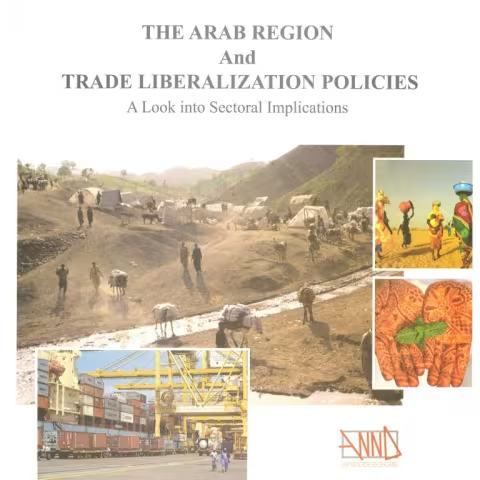
It contains 8 chapters: 1) an introduction to the general debate on trade and development, 2) an overview of the situation In the Arab region, 3) the engagement of Arab countries with the WTO, 4) Arab countries and the Euro-Mediterranean partnership, 5) Arab countries and free
This case study book entitled “Cases of Femicide before Lebanese Courts” was written by Azza Charara Baydoun and published by KAFA (enough) Violence & Exploitation in 2011.
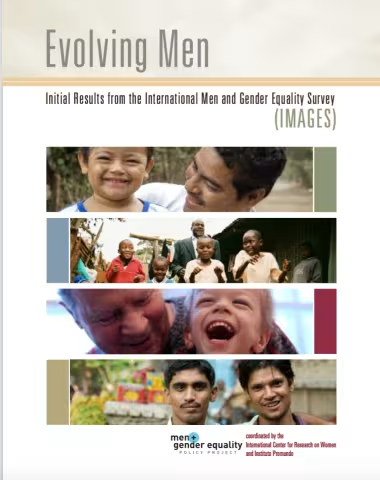
Oxfam GB commissioned the pilot study discussed in this report in order to understand further the context that shapes men’s gender roles and affects their behaviours, practices, and attitudes towards gender equality, with an explicit focus on VAW.
The International Men and Gender Equality Survey (IMAGES) is a comprehensive household questionnaire on men’s attitudes and practices – along with women’s opinions and reports of men’s practices – on a wide variety of topics related to gender equality.
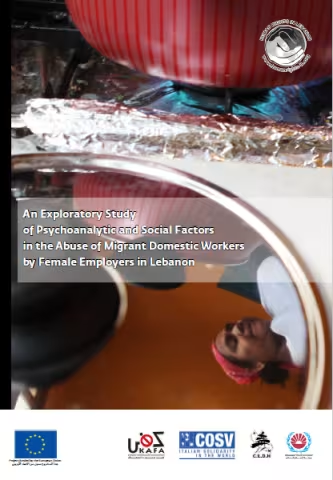
The brief of this qualitative exploratory study was to conduct targeted interviews with female employers of migrant domestic workers, psychiatrists, lawyers and institutional stakeholders in Lebanon.
UNDP, through the CEDRO project, and the Ministry of Energy & Water published the first version of the "National Wind Atlas of Lebanon" which will create a growing momentum in Lebanon towards strengthening and developing the renewable energy sector in the country.
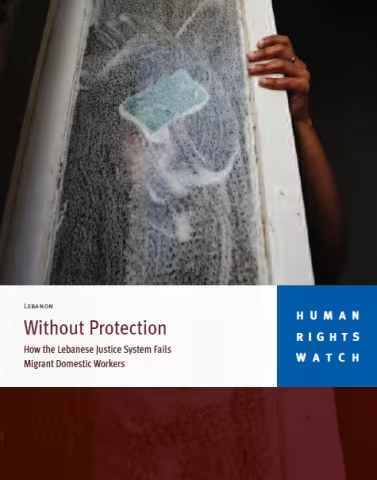
On December 9, 2009, a Lebanese criminal court sentenced a Lebanese woman to 15 days in jail for repeatedly beating Jonalin Malibago, her Filipina maid, three years earlier. Lebanese newspapers hailed the case a landmark victory for the country’s estimated 200,000 migrant domestic workers (MDWs), many of whom report abuse at the hands of their employers. The case illustrated the positive role that the judiciary can play in protecting MDWs, even though the sentence was lenient given the violation. But it also raised at least one significant question: was the Malibago verdict a rare instance of...
This document is the outcome of a workshop organised by UNRWA on the 31st of March 2010 on “Community of Practice in Building Referral Systems for Women Victims of Violence”.
Executive summary of a survey conducted by UNICEF. Objectives of the study: - To assess the magnitude of the problem of violence at home, in schools, in institutions and in the neighborhood of camp environment.
هذه الدراسة تم انجازها عام 2010، من قبل عزّة شرارة بيضون، بدعم من منظمتي أوكسفام برطانيا(OXFAM) و كفى عنف و استغلال و بتمويل من UNTRUSTED FUND ضمن إطار مشروع "تطوير مقاربات و استراتيجيات العمل مع الرجال لمناهضة العنف المنزلي في الشرق الاوسط".
Around the world, gender-based violence (GBV) reflects and reinforces inequalities between men and women. It is entrenched by power relations and control, cultures of silence and denial, political and cultural apathy, and affects men and women throughout their lives.
This paper seeks to explain why women remain marginal in the Lebanese economy. It conducts a thorough review of literature to shed light on the economic, social and legal context to identify barriers to their full participation.
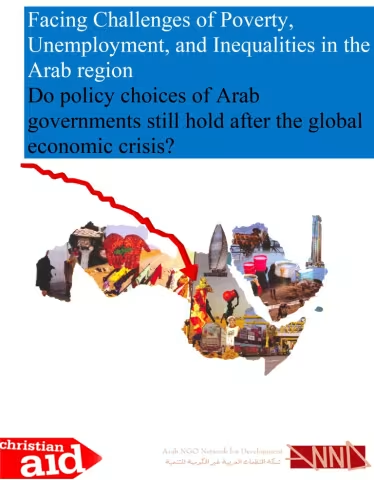
This paper was produced by ANND and Christian Aid and contains five main sections: “Executive Summary: a crisis of multiple dimensions; the threat of explosive vulnerabilities and increasing insecurities”, “Vulnerability to poverty: the key challenges faced by the Arab region”
Following the Nahr EL Bared War, LPDC launched in 2008 a workshop mapping the recovery and development initiatives in the camp's area. They followed up in 2009 with another workshop reviewing the development projects that took place in the NBC area.
The fourth National Human Development Report, “Toward a Citizen’s State”, addresses citizenship in Lebanon through three principle perspectives: citizenship and sectarian state, socio-economic citizenship and citizenship and culture and education.
This paper examines the impact of a rise in the Value Added Tax (VAT) on poverty and inequality in Lebanon. It develops an empirical model based on consumer demand theory and uses only household survey data on expenditures and spatial price indexes.