The European Bank for Reconstruction and Development (EBRD) was established in 1991, in response to the major changes in the political and economic context in Central and Eastern European countries.1 Today it has 65 shareholders, of which 63 are countries, and the other two ar
The EIB is the European Union’s bank. It is the financing institution of the EU founded in 1958 by the Treaty of Rome and owned by the 27 EU member states. The EIB is headquartered in Luxembourg and has a network of local and regional offices in Europe and beyond.
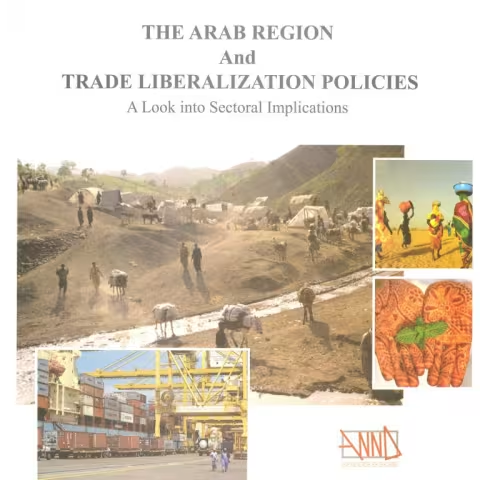
It contains 8 chapters: 1) an introduction to the general debate on trade and development, 2) an overview of the situation In the Arab region, 3) the engagement of Arab countries with the WTO, 4) Arab countries and the Euro-Mediterranean partnership, 5) Arab countries and free
This paper examines the impact of a rise in the Value Added Tax (VAT) on poverty and inequality in Lebanon. It develops an empirical model based on consumer demand theory and uses only household survey data on expenditures and spatial price indexes.
In the framework of “Towards a National Dialogue on Corruption in Lebanon”, the United Nations Development Programme and the Lebanese Transparency Association were able to lay down the foundation of anti-corruption modules as translated into the document entitled “Towards a Na