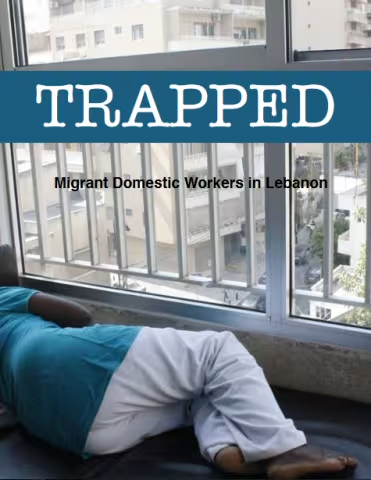
Over 250,000 migrant women are employed by private households in Lebanon to carry out household tasks such as cleaning, cooking, and caring for children and the elderly.
In October 2014, Lebanon’s Council of Ministers adopted a comprehensive policy on Syrian displacement, one explicit goal of which is to decrease the number of Syrians in Lebanon by reducing access to territory and encouraging return to Syria.
This report aims to present a general overview of the current local gender actors and their interventions in Lebanon. It also aims to shed light on the complex relationship between women’s organisations in Lebanon and their donors. In this context, it is important to ask to what extent the funding tends to shape project design at a local level? And moreover, does funding of short-term and service-oriented projects edulcorate the political change that these organisations could bring?
Based on a survey done by Lebanon Support during 2015, it gives an overview of the main gender actors, their...
This document provides information about the situation of Palestine refugees in Lebanon, including non-registered Palestinian refugees, undocumented (“non-ID”) Palestinians, and Palestine refugees from Syria.
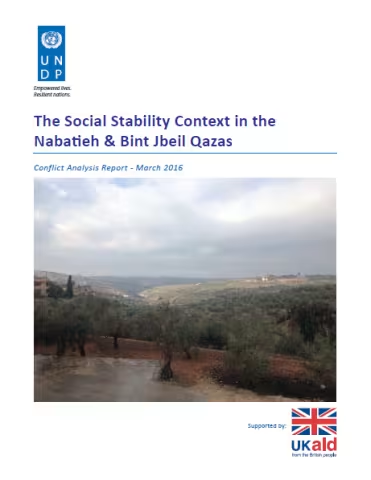
This report presents a brief analysis of the social stability context in the Qazas of Nabatieh and Bint Jbeil in the Nabatieh governorate, a sparsely populated religiously and politically homogenous area which hosts a small number of Syrian refugees.
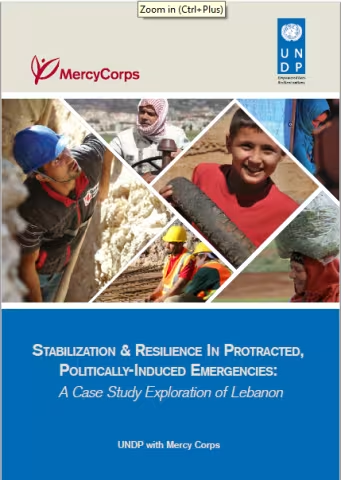
The concept of resilience offers a framework that facilitates cross-institutional and cross-disciplinary dialogue and pushes us to examine systems that influence complex situations.
Since the Syrian conflict began in 2011, 11 million people have been internally displaced or have fled to neighboring states. This has put an incredible strain on the hosting societies, particularly in Lebanon,Jordan, Iraq and Turkey.
The objective of the report is to identify the psychosocial impact and needs of humanitarian actors working with refugees in Syria, Lebanon, Jordan, Egypt, North Iraq and Palestine.
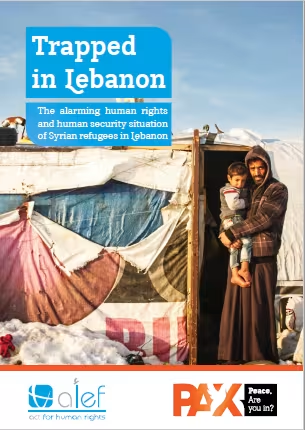
This report analyses the human rights and human security situation of refugees from Syria and their impact on the Lebanese society. Since the beginning of the conflict
The right to freedom of movement forms one of the cornerstones of the international human rights regime and the Lebanese legal system. It is a right that everyone ought to enjoy regardless of race, national origin, residence status, religion or any other criteria.
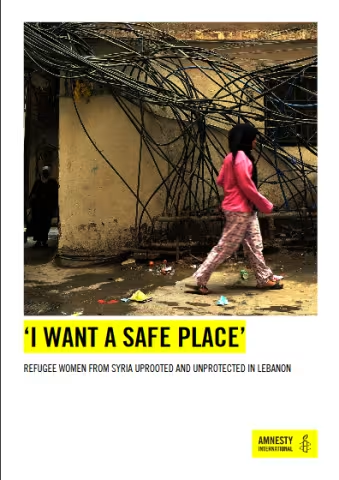
Syrian refugee women and Palestinian refugee women from Syria face risks of serious human rights violations and abuses in Lebanon, including gender-based violence and exploitation. Those who are heads of their households are at particular risk.