Resources

Resource Type
Displaying 221 - 240 of 598
National
Publishing Date

Policy Brief | August 2014
Jeanne d’Arc Street; A Model Pedestrian-Friendly Street for all of Beirut by Cynthia Myntti and
Mounir Mabsout
Walking, it has been said, is the ultimate form of sustainable public transportation. Beirut, however, is one of the most pedestrian unfriendly cities in the world. Many streets do not even have sidewalks, and where they exist, they are often broken, or obstructed, or hazardous when wet. In 2010, two units at AUB, the Neighborhood Initiative and the Center for Civic Engagement and Community Service, joined forces to design Beirut’s first barrier-free walkway...


National
Publishing Date
The world’s transport sector still suffers from unsustainable trends that lead to increased levels of greenhouse gas (GHG) emissions. There have been efforts, in the Arab world, the United States and Europe, as well as the rest of the world, to tackle the issue. Much work remains to reach a sustainable transport system in the Arab world, but the recommendations presented offer basic guidelines on how to proceed with any sustainable transportation initiative. For more information check out IFI's Sustainable Transportation Series
National
Publishing Date

Policy Brief | August 2014
Sustainable Transportation in the Arab World: International Benchmarking on Sustainable Transport Policies and their Impacts by Issam Kaysi and Farid Chaaban
​The world’s transport sector still suffers from unsustainable trends that lead to increased levels of greenhouse gas (GHG) emissions. There have been efforts, in the Arab world, the United States and Europe, as well as the rest of the world, to tackle the issue. Much work remains to reach a sustainable transport system in the Arab world, but the recommendations presented offer basic guidelines on how to proceed...

National
Publishing Date

Policy Brief | August 2014
Sustainable Transportation and Mega Sporting Events in Arab Countries: the Case of Qatar by Robert Wittkuhn and Danyel Reiche
​As a motive for hosting mega sporting events, Qatar is highlighting their catalyst effect for planned infrastructure developments. Qatar plans on building intra-city, inter-city and inter-state road and railway networks for the FIFA 2022 initially, and further national use. The planned transportation construction could potentially be sustainable, but the social and political buildup of Qatar hinders such a development; especially when...

National
Publishing Date
The private sector has long been a major contributor to humanitarian action. At the community level, businesses frequently use their materials and resources to aid people affected by crises. As local markets recover and supply chains are repaired, crisis-affected people are once again able to access basic goods and, in some cases, resume livelihoods. Large national, regional and multinational firms are also closely involved in supporting humanitarian objectives, whether indirectly, by resuming operations in crisis affected areas, or directly, by providing cash and in kind donations of goods or...
National
Publishing Date
The humanitarian aid system is growing and expanding, and so surely its capacity to meet these challenges should also be growing. Yet despite the enormous resources, in the more complex, less high-profile and difficult contexts, MSF teams in the field have seen that humanitarian responses to displacement emergencies have not occurred in a timely and effective way. This is especially the case in conflict areas. These observations have prompted MSF to conduct this review, to better understand how the humanitarian system is responding to acute displacement emergencies. The review is based on...
National
Publishing Date
Final Akkarouna activity report for the shelter project funded by OTI lebanon. Project Budget 300,000$, funded by Office of transitional initiatives OTI lebanon to help and aid the syrian refugees have a decent shelter to live in.
National
Publishing Date
In May 2014 the Lebanese authorities put in place new requirements for Palestinian refugees from Syria trying to enter Lebanon. Many of the conditions are very difficult to meet and have the effect of denying people fleeing conflict the possibility of seeking safety in Lebanon. This briefing details the restrictions facing Palestinian refugees from Syria who try to enter or stay in Lebanon, as far as these are known. It describes some of the implications for refugees and includes the accounts of several Palestinian refugees from Syria who have been directly affected.
National
Publishing Date

Research Report | July 2014
History of Climate Change Negotiations and the Arab Countries The Case of Egypt by Ibrahim Abdel Gelil
Even though Egypt’s share of Global Greenhouse Gases (GHGs) emissions is less than 1 %, Egypt has proved to be one of the most vulnerable countries to the potential risks of climate change. The most vulnerable sectors include coastal zones, water resources, and agriculture. Estimates show that a Sea Level Rise would lead to the permanent submersion of large areas of cropland in the Nile Delta, and accelerate the trend of desertification that is worsening the...

National
Publishing Date
DRC in Lebanon The Danish Refugee Council has been operating in Lebanon since September 2004.The focus of the organization has shifted over time as the country’s needs changed. DRC’s main focus in Lebanon in 2013 has been on providing emergency assistance to refugees from Syria, and on developing the capacities of hosting communities across Lebanon. The emergency response program focuses on four sectors of intervention: Protection, Direct Assistance, Shelter/Community Center Management, and Community Development. In parallel, the organization’s Development Programme works with Migrant...
National
Publishing Date
Integrity’s research highlights that the truces agreed in several locations across Syria in the early months of 2014 do not represent the localised beginnings of a peacebuilding process. These agreements—and the negotiation and implementation processes that delivered them—were not built upon good practice and were significantly undermined by a lack of political will for peace from the outset. For opposition stakeholders, the truce agreements were a reaction to extreme levels of civilian suffering and a military capacity weakened by lengthy, government-enforced sieges. In all areas researched...
National
Publishing Date
Integrity’s research highlights that women’s networks and organisations in Syria are active across a range of service delivery sectors. In many cases these groups are either responding to gaps in services provided by other NGOs, civil society organisations (CSO), or other service delivery actors, or they are providing understanding and access to the specific needs of women and children beneficiaries that other groups cannot. Women’s groups interviewed by Integrity are most active (62 per cent) in the education, skills training, and livelihoods sectors. These areas both help meet immediate...
National
Publishing Date
This report is this first of a three-part series focusing on the current status and lessons learned relating to transitional justice and policing initiatives in opposition-controlled Syria. • Part I focuses on the effects of the departure of judicial and security elements of the Syrian state has had on conditions on the ground currently and on the nascent justice institutions that have emerged in this void (including levels of institutionalisation, Islamic law, and the legal systems currently being debated and trialed in some areas). • Part II examines the variety of institutions and...
National
Publishing Date
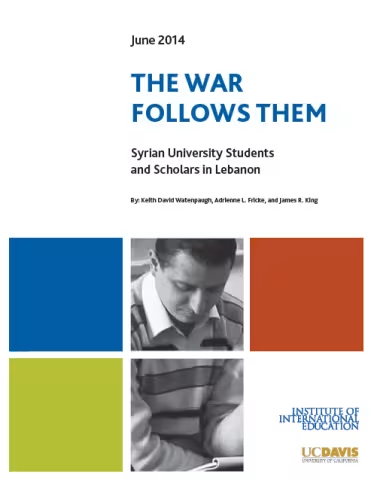
The crisis in Syria continues to have a devastating impact on professors, university students, and the education sector, not only in Syria but also in the neighboring countries that are hosting so many displaced Syrians. In this report, the Institute of International Education (IIE) and its Syria Consortium for Higher Education in Crisis looks at the conditions and educational needs of Syrians university students and scholars in Lebanon. “The War Follows Them: Syrian University Students and Scholars in Lebanon,” is based on first-hand research and interviews conducted in Lebanon in March 2014...
National
Publishing Date

موجز السياسات | حزيران 2014
 الانسجام الاجتماعي والعلاقات بين المجموعات: اللاجئون السوريون و المواطنون اللبنانيون في البقاع وعكار من إعداد شارل حرب و ريم صعب
 

National
Publishing Date

Working Paper | June 2014
Climate Change in Lebanon: Higher-order Regional Impacts from Agriculture by Nadim Farajalla, Eduardo A. Haddad, Marina Camargo, Ricardo Lopes, and Flavio Vieira
This working paper analyzes the susceptibility of agricultural outputs to future climate change in Lebanon, and the extent to which it propagates to the economic system as a whole. A methodological framework in which physical and economic models are integrated for assessing the higher-order economic impacts of projected climate changes is used. The researchers then quantify the broader economic impacts in the...

National
Publishing Date

Working Paper | June 2014
Governance between Isolation and Integration A Study on the Interaction between Lebanese State Institutions and Palestinian Authorities in Shabriha Gathering, South Lebanon by Nora Stel
I would also like to thank my supervisors, Prof. Dr. Naudé, Prof. Dr. Frerks and Dr. Van der Molen for their support and advice. I am grateful to the Hendrik Muller Fonds and the Lutfia Rabbani Foundation for awarding me grants for the fieldwork underlying this working paper. Thanks also go to Sima Ghaddar, whose rigorous editing has been invaluable. Most importantly, I am tremendously...

National
Publishing Date
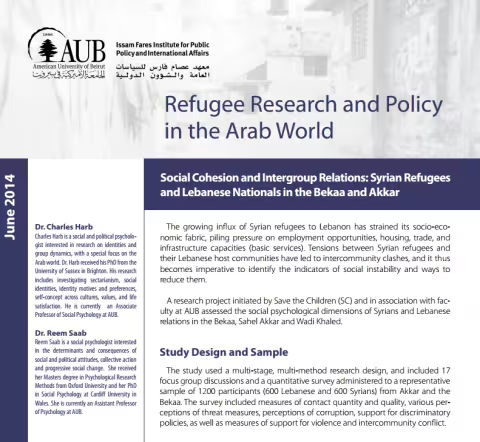
The growing influx of Syrian refugees to Lebanon has strained its socio-economic fabric, piling pressure on employment opportunities, housing, trade, and infrastructure capacities (basic services). Tensions between Syrian refugees and their Lebanese host communities have led to intercommunity clashes, and it thus becomes imperative to identify the indicators of social instability and ways to reduce them. A research project initiated by Save the Children (SC) and in association with faculty at AUB assessed the social psychological dimensions of Syrians and Lebanese relations in the Bekaa, Sahel...
National
Publishing Date

Policy Memo | June 2014
Social Cohesion and Intergroup Relations: Syrian Refugees and Lebanese Nationals in the Bekaa and Akkar by Charles Harb and Reem Saab
The growing influx of Syrian refugees to Lebanon has strained its socio-economic fabric, piling pressure on employment opportunities, housing, trade, and infrastructure capacities (basic services). Tensions between Syrian refugees and their Lebanese host communities have led to intercommunity clashes, and it thus becomes imperative to identify the indicators of social instability and ways to reduce them. A research project initiated by...

National
Publishing Date

Summary Brief | May 2014
National Case Studies on Health Policy-making in the Middle East: The Case of the National Social Security Fund Voluntary Health Insurance System in Lebanon by Fadi El-Jardali, Lama Bou Karroum, Hana Addam El-Ghali
Public policy making is complex and suffers from limited uptake of research evidence, particularly in the Eastern Mediterranean Region (EMR). In-depth case studies examining the health policymaking process would contribute to strengthening health systems, informing future policymaking and pushing for the use of technical evidence in this process through...