“More than 60% of Syrian refugees households comprise a person with disabilities and 1/5 Syrian refugees has a disability in Lebanon and Jordan”, shows a large study conducted by Humanity & Inclusion (HI) and iMMAP.
About the Zero Project: For a World without Barriers
The Zero Project was initiated by the Essl Foundation in 2010. It has been run in partnership with the World Future Council (WFC) since 2011 and the European Foundation Centre (EFC) since 2013. The mission of the Zero Project is to work for a world without barriers, according to the principles and Articles of the UN CRPD.
This report presents qualitative data collected by ICTJ on how individuals in Greater Beirut talk about the Lebanon wars and the need for truth, justice, and an end to violence in their country.
This report compiles information on hundreds of incidents of serious human rights violations that occurred in Lebanon from 1975 to 2008, including mass killings, enforced disappearances, assassinations, forced displacement, and the shelling of civilian areas.
Disability & Vulnerability Focal Point (DVFP) have been developed based on the observation that one of the greatest difficulties following a crisis is not only to identify and to access to vulnerable people including people with disabilities, but also to accompany them wit
28 refugee households were surveyed, which represented a total of 501 refugees, 48% male and 52% female, which is approximately 11% of the Syrian refugee population in North Bekaa.
Disability & Vulnerability Focal Point (DVFP) have been developed based on the observation that one of the greatest difficulties following a crisis is not only to identify and to access to vulnerable people including people with disabilities, but also to accompany them wit
The overall objective of the assessment was to identify emergency WASH needs and gaps of most vulnerable Syrian refugees and host families in five geographical areas, 4 collective centres and Bab al-Tebbaneh, Tripoli in North Lebanon.
-This report is issued by the Lebanese Physical Handicapped Union, September 2011.
Objective of the report:
This report aims at finding empowering mechanisms for applying inclusion of disability in the general directorate of occupational and technical education.
Content of the report:
- Introduction.
- Objective of the report.
- The actual status and challenges.
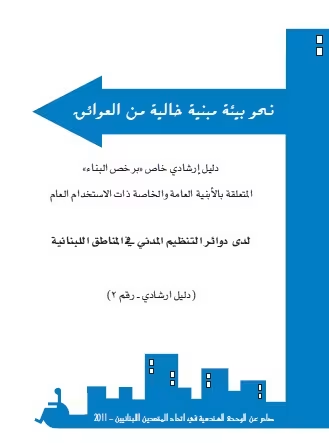
Special guidelines for “Building Licenses” pertaining to public and private buildings of the urban planning centers across Lebanon
Guidelines no. 2
- This guideline is issued by The Lebanese Physical Handicapped Union, arranged by engineer Bashar Abdel Samad, in October 2011.
Objective of the guideline:
Support the application of the decree concerning the accessible environment for people with disability.
Raise awareness on inclusion of people with disability.
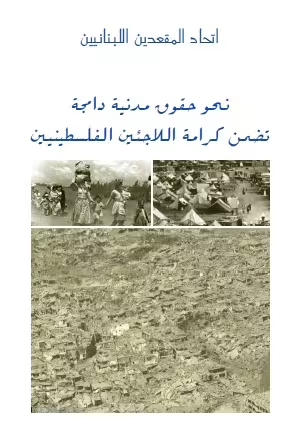
This report is issued by the Lebanese Physical Handicapped Union in July 2011.
Objective of the report:
Awareness of society on inclusion in civil laws encompassing the rights of Palestinian refugees in Lebanon
Content of the report:
-Introduction
Legislative Reality
- Prohibition of refugees to the workplace
- The demanded documents to obtain occupation
- Banning from the benefits of health and social services
- Outlawing refugees from possessing a residence
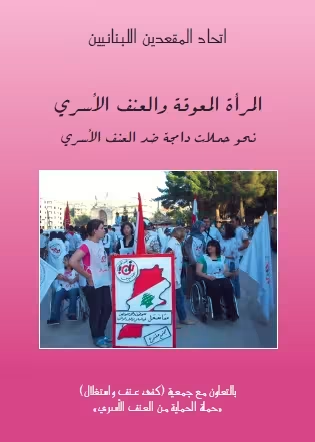
This report is issued by the Lebanese Physical Handicapped Union in 2011.
Objective of this report:
Awareness on repudiating and avoiding domestic violence against women with disability
Special guidelines for “Building Licenses” pertaining to public and private buildings of the urban planning centers across Lebanon
Guidelines no. 2
- This guideline is issued by The Lebanese Physical Handicapped Union, arranged by engineer Bashar Abdel Samad, in October 2011.
Objective of the guideline:
Support the application of the decree concerning the accessible environment for people with disability.
Raise awareness on inclusion of people with disability.
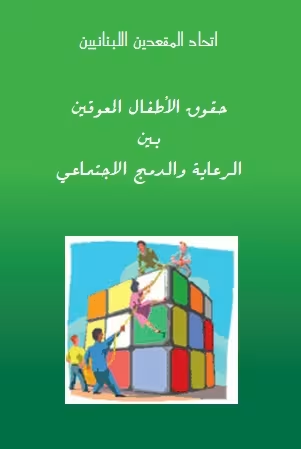
This study is issued by the Lebanese Physical Handicapped Union in 2011.
Objective of the report:
Launch discussion around social inclusion of children with disability in Lebanon and promote the inclusion criteria in accordance with related general policies in Lebanon.
This report will provide a description of the assessment conducted by IMC’s Mental Health and Psychosocial team in the region of Wadi Khaled following the displacement of Syrians into the northern villages between the Lebanese-Syrian borders as a result of the internal conflic
UNHCR, coordinating the operations in the North along side with the HRC (High Relief Commission) and DRC as its main implementing partner, requested from DRC to conduct a first rapid assessment in the Bekaa with the following objectives: a) To identify existing areas of displa