“More than 60% of Syrian refugees households comprise a person with disabilities and 1/5 Syrian refugees has a disability in Lebanon and Jordan”, shows a large study conducted by Humanity & Inclusion (HI) and iMMAP.
This report aims to provide statistical and analytical tools for the recovery community working in North Lebanon, specifically those working with the Nahr el-Bared displaced and returnee population. The information will allow for better assessment of current needs and gaps, which will eventually support the development of appropriate strategies of intervention on both the short and long term.
The July war 2006, lasted 34 days, and led to the displacement of 915,762 (almost 25% of the Lebanese population) persons, relocating into public and private schools all over the country. With the coming into force of the cease fire in August 14th 2006, there was a rapid return of the displaced to the south.
The concept of resilience offers a framework that facilitates cross-institutional and cross-disciplinary dialogue and pushes us to examine systems that influence complex situations.
About the Zero Project: For a World without Barriers
The Zero Project was initiated by the Essl Foundation in 2010. It has been run in partnership with the World Future Council (WFC) since 2011 and the European Foundation Centre (EFC) since 2013. The mission of the Zero Project is to work for a world without barriers, according to the principles and Articles of the UN CRPD.
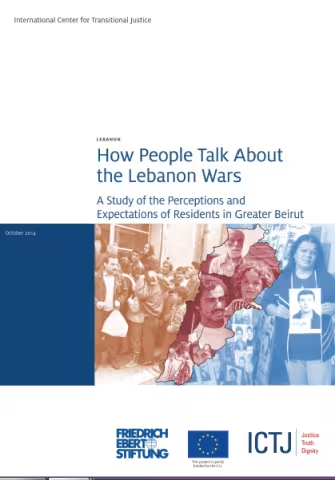
This report examines variations in wartime experiences and the attitudes of residents in Greater Beirut regarding measures to confront Lebanon’s legacy of political violence.
Shedding the lights on UNDP's recovery efforts in South Lebanon and the Southern Suburb of Beirut in the aftermath of the July 2006 aggression, the booklet tackles the recovery initiatives undertaken by UNDP from rubble removal activities to other quick impact initiatives.
Disability & Vulnerability Focal Point (DVFP) have been developed based on the observation that one of the greatest difficulties following a crisis is not only to identify and to access to vulnerable people including people with disabilities, but also to accompany them wit
28 refugee households were surveyed, which represented a total of 501 refugees, 48% male and 52% female, which is approximately 11% of the Syrian refugee population in North Bekaa.
Disability & Vulnerability Focal Point (DVFP) have been developed based on the observation that one of the greatest difficulties following a crisis is not only to identify and to access to vulnerable people including people with disabilities, but also to accompany them wit
The overall objective of the assessment was to identify emergency WASH needs and gaps of most vulnerable Syrian refugees and host families in five geographical areas, 4 collective centres and Bab al-Tebbaneh, Tripoli in North Lebanon.
-This report is issued by the Lebanese Physical Handicapped Union, September 2011.
Objective of the report:
This report aims at finding empowering mechanisms for applying inclusion of disability in the general directorate of occupational and technical education.
Content of the report:
- Introduction.
- Objective of the report.
- The actual status and challenges.
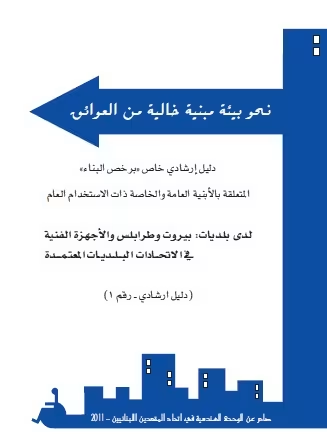
Special guidelines for “Building Licenses” pertaining to public and private buildings of the urban planning centers across Lebanon
Guidelines no. 2
- This guideline is issued by The Lebanese Physical Handicapped Union, arranged by engineer Bashar Abdel Samad, in October 2011.
Objective of the guideline:
Support the application of the decree concerning the accessible environment for people with disability.
Raise awareness on inclusion of people with disability.
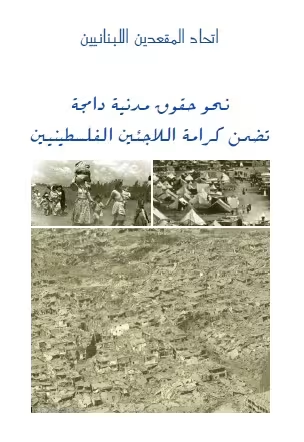
This report is issued by the Lebanese Physical Handicapped Union in July 2011.
Objective of the report:
Awareness of society on inclusion in civil laws encompassing the rights of Palestinian refugees in Lebanon
Content of the report:
-Introduction
Legislative Reality
- Prohibition of refugees to the workplace
- The demanded documents to obtain occupation
- Banning from the benefits of health and social services
- Outlawing refugees from possessing a residence