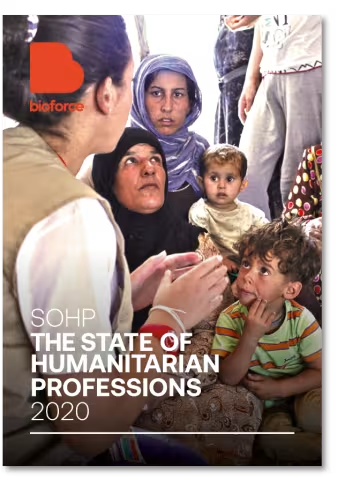
The State of Humanitarian Professions 2020 (SOHP) is the result of a year-long consultation with more than 1,500 humanitarian professionals. For the first time, this study gathers and analyses key figures on 24 humanitarian professions, as well as on recruitment practices and professional development in the sector. In addition, the SOHP study demonstrates the need to coordinate on the challenges of professionalising humanitarian teams, with 19 recommendations to be discovered in the final report.
This report aims to provide statistical and analytical tools for the recovery community working in North Lebanon, specifically those working with the Nahr el-Bared displaced and returnee population. The information will allow for better assessment of current needs and gaps, which will eventually support the development of appropriate strategies of intervention on both the short and long term.
Analyzing the Impact on the Personal and Professional Development
of Young Participants at Erasmus Plus/Youth in Action/Euromed projects through “Chabibeh Sporting Club” From 2008 till 2017
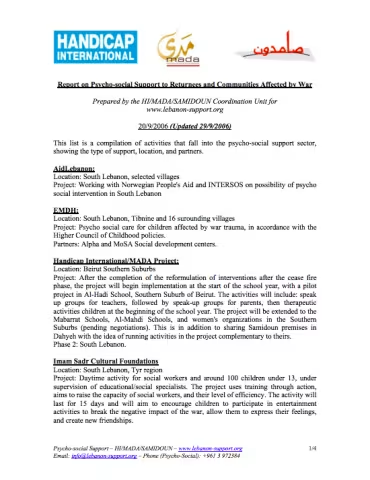
The July war 2006, lasted 34 days, and led to the displacement of 915,762 (almost 25% of the Lebanese population) persons, relocating into public and private schools all over the country. With the coming into force of the cease fire in August 14th 2006, there was a rapid return of the displaced to the south.
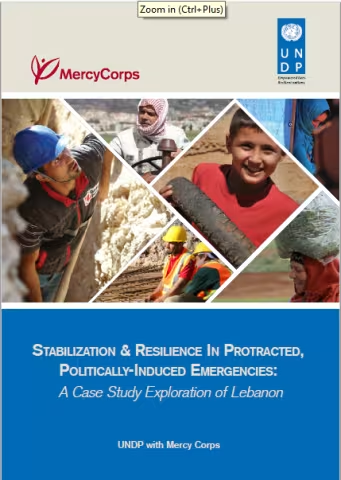
The concept of resilience offers a framework that facilitates cross-institutional and cross-disciplinary dialogue and pushes us to examine systems that influence complex situations.
The objective of the report is to identify the psychosocial impact and needs of humanitarian actors working with refugees in Syria, Lebanon, Jordan, Egypt, North Iraq and Palestine.
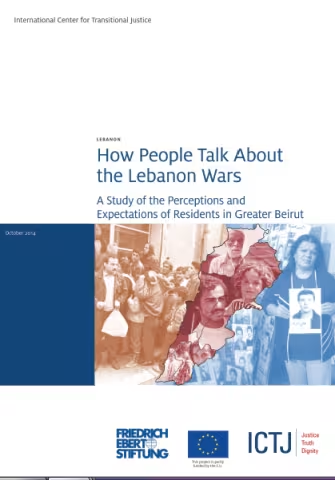
This report examines variations in wartime experiences and the attitudes of residents in Greater Beirut regarding measures to confront Lebanon’s legacy of political violence.
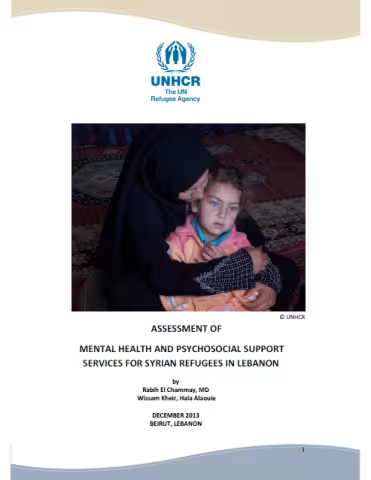
Syria's third year of civil war has caused a rapid acceleration in influx of the refugees to Lebanon with the intensification of clashes in recent months. In fall 2013 more than 2000 Syrian refugees are fleeing to Lebanon on daily basis. The mental health needs of Syrian refugees in Lebanon have not received thorough assessment. Information about the nature, the quality, and coverage of these services for the Syrian refugees is lacking.
Methodology
The Syrian refugee assessment for Mental Health and Psychosocial Support (MHPSS) took place in August and September 2013. The assessment had two...
Shedding the lights on UNDP's recovery efforts in South Lebanon and the Southern Suburb of Beirut in the aftermath of the July 2006 aggression, the booklet tackles the recovery initiatives undertaken by UNDP from rubble removal activities to other quick impact initiatives.
The brief of this qualitative exploratory study was to conduct targeted interviews with female employers of migrant domestic workers, psychiatrists, lawyers and institutional stakeholders in Lebanon.
This report will provide a description of the assessment conducted by IMC’s Mental Health and Psychosocial team in the region of Wadi Khaled following the displacement of Syrians into the northern villages between the Lebanese-Syrian borders as a result of the internal conflic
Working Paper Series #3 | July 2010
Describing the Lebanese Youth: A National and Psycho-Social SurveyCharles Harb
The present research investigates socio-demographic, socio-cultural and social-psychological profiles of a representative sample of Lebanese youth. The study thus provides a first assessment of youth in Lebanon, with a clear hope to replicate this research in other parts of the Arab world. This report does not aim to provide a comprehensive model testing between levels of analyses, but rather focuses on a more descriptive profiling of such variables in a way that may be useful to...
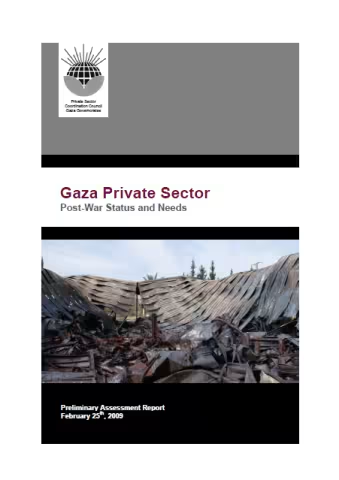
Israeli forces conducted a major combined military operation in the Gaza Strip for a period of 22 days (December 27, 2008 – January 18, 2009), where “Israeli forces used aerial bombing, tank shelling and armored bulldozers to eliminate the productive capacity of some of Gaza's
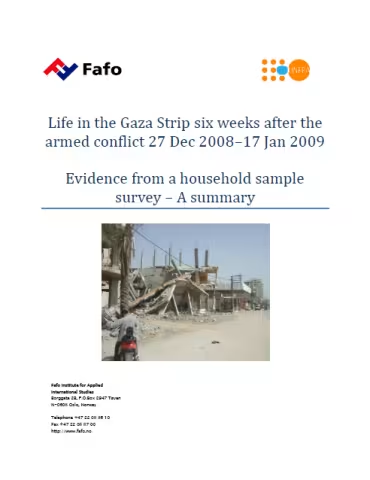
This multi-topic household sample survey was implemented to collect data to document the living conditions in the Gaza Strip in the wake of Israel’s assault on 27 December and the ensuing armed conflict.
Following the Nahr EL Bared War, LPDC launched in 2008 a workshop mapping the recovery and development initiatives in the camp's area. They followed up in 2009 with another workshop reviewing the development projects that took place in the NBC area.
This report highlights the post war status of private sector businesses represented in the Palestinian Federation of Industries (PFI) in the Gaza Strip.