Analyzing the Impact on the Personal and Professional Development
of Young Participants at Erasmus Plus/Youth in Action/Euromed projects through “Chabibeh Sporting Club” From 2008 till 2017
The July war 2006, lasted 34 days, and led to the displacement of 915,762 (almost 25% of the Lebanese population) persons, relocating into public and private schools all over the country. With the coming into force of the cease fire in August 14th 2006, there was a rapid return of the displaced to the south.
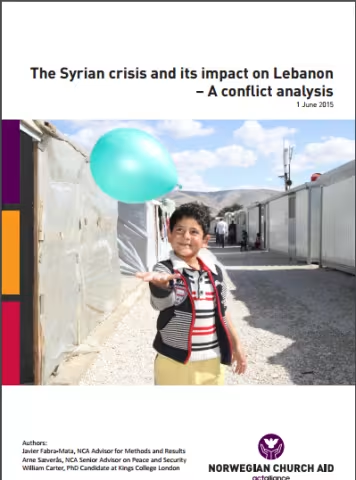
The present report analyses the impact of the Syrian conflict and refugee crisis on Lebanon and Lebanese host communities. This brief analysis presents the main conflict issues and trends, and the network of interaction between local and national level conflict dynamics.
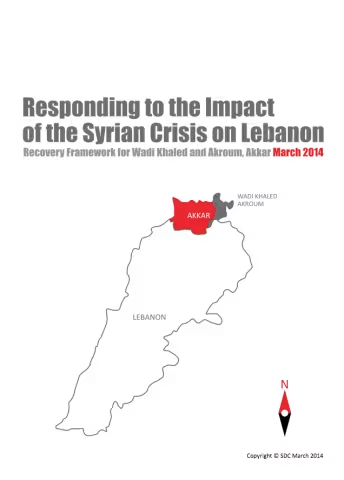
The Swiss Agency for Development and Cooperation (SDC) is pleased to share with you the report:
“Responding to the Impact of the Syrian Crisis on Lebanon: Recovery Framework for Wadi Khaled and Akroum, Akkar”, March 2014.
SDC facilitated a process to shed light on the impact of the Syria crisis at the national level but also on the local level. The formulation of a recovery framework for Wadi Khaled and Akroum is a process that can be replicated for other affected regions of Lebanon.
The findings and recommendations are based on consultations (between October 2013 and January 2014) with...
The private sector has long been a major contributor to humanitarian action. At the community level, businesses frequently use their materials and resources to aid people affected by crises. As local markets recover and supply chains are repaired, crisis-affected people are once again able to access basic goods and, in some cases, resume livelihoods. Large national, regional and multinational firms are also closely involved in supporting humanitarian objectives, whether indirectly, by resuming operations in crisis affected areas, or directly, by providing cash and in kind donations of goods or...
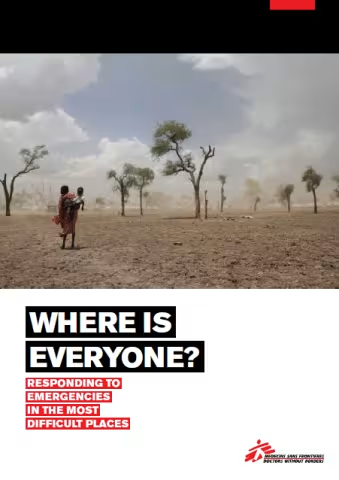
The humanitarian aid system is growing and expanding, and so surely its capacity to meet these challenges should also be growing.
Yet despite the enormous resources, in the more complex, less high-profile and difficult contexts, MSF teams in the field have seen that humanitarian responses to displacement emergencies have not occurred in a timely and effective way. This is especially the case in conflict areas.
These observations have prompted MSF to conduct this review, to better understand how the humanitarian system is responding to acute displacement emergencies. The review is based on...
This paper highlights the specificity of the refugee crisis in the unstable Lebanese landscape and calls for the reconfiguring of current relief mechanisms by enabling decentrali
التراث الثقافي غير المادي في لبنان على ضوء التجربة العالميّة في البحث الذي أعدّه لمرصد التراث الحديث تحت عنوان "التراث الثقافي غير المادي في لبنان على ضوء التجربة العالميّة" ذكر الدكتور شربل نصّار أن التراث الثقافي غير المادي يعدّ "مفهوماً مبهماً نظراً لتعدد التعاريف المنسوبة إليه." من خلال هذا البحث يشرح نصّار هذا المفهوم ويسلّط الضوء على الواقع القانوني والتشريعي الذي يحكمه في لبنان مقارنة بعدّة تجارب عالمية.
Briefing papers on the preservation of cultural heritageInstitutions and individuals from the Middle East and North Africa experience many shortcomings in legislation, policies and current practices impeding the sustainable preservation of cultural heritage. In order to obtain a systematic overview and a sound basis for engaging in lobby and advocacy work for improved governance of the cultural sector, the Modern Heritage Observatory contracted local lawyers and researchers to analyze and assess current regulations, policies and practices concerning the preservation of cultural heritage in...
The continuing unrest in Syria is resulting in a growing influx of Syrian refugees to Lebanon. The United Nations High Commissioner for Refugees has registered over 57,000 Syrian refugees in Lebanon (September 7, 2012) while many refugees are awaiting registration.
This report constitutes the final publication of the outcomes of the program "Development in Lebanon: Poverty Eradication, Gender Equity and Youth Participation; the Role of NGOs Civil Society and Other Actors".
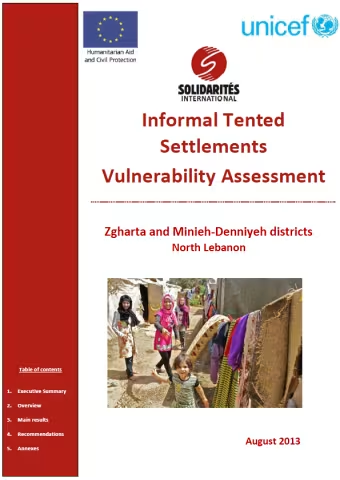
This report is the result of 4 months of field data collection from April to August 2013 carried out in the Informal Tented Settlements (ITS) of the two districts of Zgharta and Minieh-Dennieh by SOLIDARITÉS INTERNATIONAL’s (SI) outreach workers.
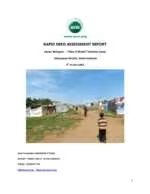
The purpose of the needs assessment conducted in the Bekaa area is to identify the needs of Syrian refugees (SR), in terms of food, non food items (NFIs), shelter, water and education.
Swiss Solidar undertook a multi-sectoral needs assessment in August 2013 to assess the humanitarian needs of Syrian refugees residing in Nabatieh and Jezzine Districts in Southern Lebanon.
This operational guidance note is anchored on the principles of universal health care for all persons of concern fleeing the ongoing conflict in Syria and in need of international protection in Lebanon.
Since March 2011 and the continuously escalating crisis in Syria, Lebanon (along with Jordan, Iraq and Turkey) has been a refuge area for Syrian families fleeing the instability and violence in their country.
Disability & Vulnerability Focal Point (DVFP) have been developed based on the observation that one of the greatest difficulties following a crisis is not only to identify and to access to vulnerable people including people with disabilities, but also to accompany them wit