This policy brief was developed as a deliverable in the project “Fair Game: Theatre of the Oppressed for Youth Empowerment” funded by the European Union. It tackles the topic of bullying in schools and offers recommendations drawn from the field experience in Lebanon that focused on the methodology of Legislative Theatre to raise awareness on bullying in schools and advocate for better policies.
In light of recent proposals for legislation againsts sexual harassment (SH) in Lebanon, this policy brief explores the subject of SH in public, institu
This Policy Brief is based on research that explored the process of establishing and implementing Law 293, and on a policy dialogue that took place at the Institute on March 8, 2017 t
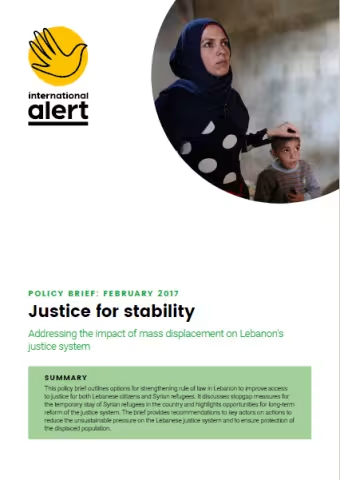
This policy brief outlines options for strengthening rule of law in Lebanon to improve access to justice for both Lebanese citizens and Syrian refugees.
The Building a Better Response project, together with the UN Office for the Coordination of Humanitarian Affairs (OCHA) and the International Humanitarian City, launched the Building a Better Response (BBR) e-learning course in Arabic with a panel discussion in Dubai on the role of local non-governmental organizations (NGOs) in humanitarian response. The event came in advance of the World Humanitarian Summit, set to take place in Istanbul in May 2016, where much of the conversation is expected to focus on placing local actors at the center of humanitarian response.
Our work cannot be as...
The United Nations Secretary-General has called for the first ever World Humanitarian Summit: to reaffirm our commitment to humanity and chart a course for change. The Secretary-General’s Agenda for Humanity calls on global leaders to commit to five core responsibilities in the name of our shared humanity:
Global leadership to prevent and end conflict
Uphold the norms that safeguard humanity
Leave no one behind
Change people's lives – from delivering aid to ending need
Invest in humanity
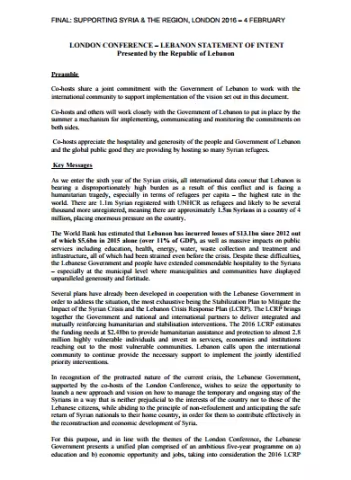
LONDON CONFERENCE – LEBANON STATEMENT OF INTENT Presented by the Republic of Lebanon: Supporting Syria & The Region
Summary: The Government of Lebanon affirms that the success of the Conference in London will depend on how international partners respond to this vision and support Lebanon to uphold the central pillars of providing humanitarian assistance, education for all, and the expansion of economic opportunities and jobs. The Government urges that the international community provide multi-annual funding of $4.9bn to cover this year’s Lebanon Crisis Response Plan and plans set out in this...
The 2015 Global Humanitarian Assistance (GHA) Report highlights that in 2013, 147 countries received humanitarian assistance, with countries from the Arab region, particularly those affected by the Syrian crisis, being the highest beneficiaries of aid.
The population shift from Syria, as a result of the Syrian Crisis, is causing enormous pressure on host communities and exacerbating instability factors.
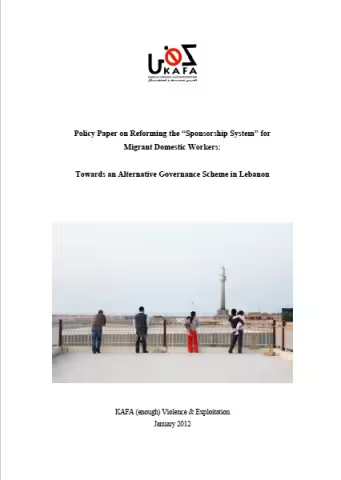
In recent years, the “sponsorship system” (kafala) in Lebanon and in other countries in the region has been identified as a core problem leading to the exploitation and abuse of migrant domestic workers.