This policy brief was developed as a deliverable in the project “Fair Game: Theatre of the Oppressed for Youth Empowerment” funded by the European Union. It tackles the topic of bullying in schools and offers recommendations drawn from the field experience in Lebanon that focused on the methodology of Legislative Theatre to raise awareness on bullying in schools and advocate for better policies.
This project aims to (1) bring statistical transparency to youth’s opinions, attitudes, feelings, and perceptions about social, cultural, political, and familial freedom of speech barriers within our society, and find what activities facilitate youth’s freedom of speech; (2) create discussion and widespread accountability by engaging the online and offline community, institutional stakeholders, and youth though an advocacy Call to Action based on our research findings, and (3) provide evidence that creative civic spaces are an integral part of our community and change negative attitudes...
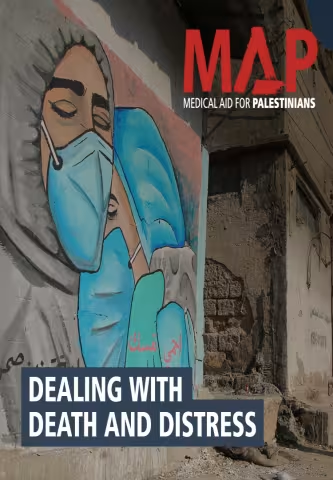
Based on interviews conducted with doctors, nurses and other frontline staff across West Bank, East Jerusalem and Gaza, the paper exposes how the stresses and strains of protracted COVID-19 response have compounded existing challenges of working in a health system already rendered fragile, fragmented and resource-deprived by perpetual occupation and blockade, to cause a deepening wellbeing crisis among the Palestinian healthcare workforce.
We Rise through Art is a handbook produced under the project with the same title in response to Beirut's explosion, highlighting activities and tools that can be adopted by trainers, coaches and facilitators with pre-adolescents and children under arts, sports and recreation.
We Play for Peace is a handbook produced under the project with the same title highlighting activities and tools that can be adopted by trainers, coaches and facilitators with pre-adolescents and children under arts, sports and recreation.
The LCRP Business Continuity Plan for COVID-19 reviews ongoing impact on LCRP operations and outlines risks and critical interventions needed to ensure life-saving access to services and protection for the most vulnerable displaced persons from Syria and vulnerable Lebanese during COVID-19 situation.
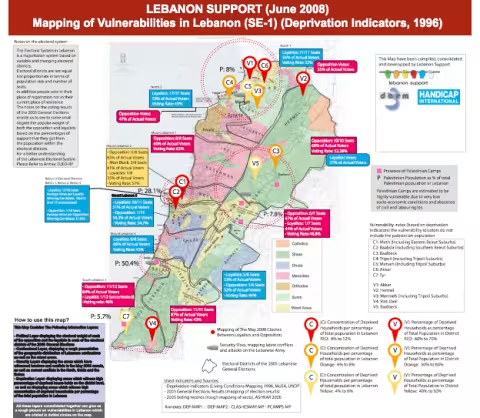
This package includes 3 maps pertaining to Lebanon's 2009 elections: - "confessional-distrib": showing the confessional geographic distribution of Lebanon's population - "election-results": showing the election results in West Bekaa/Rashaya and Metn areas. - "results&voters": showing the sectarian representation of parliamentary seats across Lebanon, the percentage of voters per electoral district, election results, and deputy representation per number of voters
Maps of businesses open in Nahr El Bared's adjacent area including food production businesses, construction and hardware industries, beauty and entertainment enterprises, and health, education and communication businesses.
In light of recent proposals for legislation againsts sexual harassment (SH) in Lebanon, this policy brief explores the subject of SH in public, institu
This Policy Brief is based on research that explored the process of establishing and implementing Law 293, and on a policy dialogue that took place at the Institute on March 8, 2017 t
This policy brief outlines options for strengthening rule of law in Lebanon to improve access to justice for both Lebanese citizens and Syrian refugees.
Based on the findings of participatory protection research that Oxfam undertook with refugees in Lebanon between late 2016 and early 2017, this paper explores refugees’ own definitions and conceptions of safety, and highlights refugee perspectives on how the international comm
The 2015 Global Humanitarian Assistance (GHA) Report highlights that in 2013, 147 countries received humanitarian assistance, with countries from the Arab region, particularly those affected by the Syrian crisis, being the highest beneficiaries of aid.