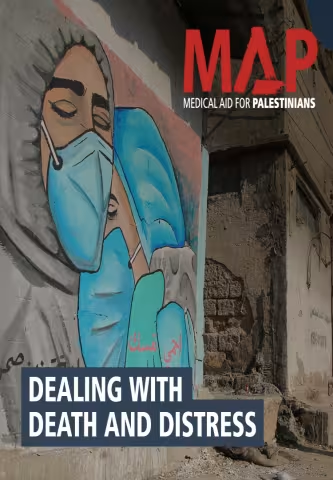
Based on interviews conducted with doctors, nurses and other frontline staff across West Bank, East Jerusalem and Gaza, the paper exposes how the stresses and strains of protracted COVID-19 response have compounded existing challenges of working in a health system already rendered fragile, fragmented and resource-deprived by perpetual occupation and blockade, to cause a deepening wellbeing crisis among the Palestinian healthcare workforce.
The LCRP Business Continuity Plan for COVID-19 reviews ongoing impact on LCRP operations and outlines risks and critical interventions needed to ensure life-saving access to services and protection for the most vulnerable displaced persons from Syria and vulnerable Lebanese during COVID-19 situation.
Information on the health service in Lebanon including availability of access and availability of drugs and treatment. Information on treatment of mental health issues such as anxiety, depression, post traumatic syndrome, including psychiatric treatment.
This essay proposes to re-orient feminist debates on epistemology towards the care-security nexus as a pathway that can plausibly provide an integral understanding of a human-centred and eco-minded security.
Using time-diary data from 25 countries, the authors demonstrate that there is a negative relationship between real GDP per capita and the female-male difference in total work time per day -- the sum of work for pay and work at home.
In the coming decades, the world’s rapid urbanization will be one of the greatest challenges to ensuring human welfare and a viable global environment.
This paper provides a brief overview of what is known about effective strategies for involving men in violence prevention efforts from the perspective of men who are recipients of anti-violence programs as well as from the men who provide them.
We analyze intra-family support among Palestinians living in Lebanon, using detailed household survey data from the refugee camps and Palestinian communities in Lebanon and latent class analysis technique. The study uncovers five latent classes of familial exchange.