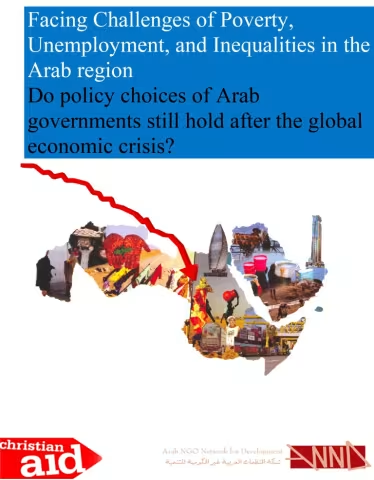
This paper was produced by ANND and Christian Aid and contains five main sections: “Executive Summary: a crisis of multiple dimensions; the threat of explosive vulnerabilities and increasing insecurities”, “Vulnerability to poverty: the key challenges faced by the Arab region”
Israeli forces conducted a major combined military operation in the Gaza Strip for a period of 22 days (December 27, 2008 – January 18, 2009), where “Israeli forces used aerial bombing, tank shelling and armored bulldozers to eliminate the productive capacity of some of Gaza's
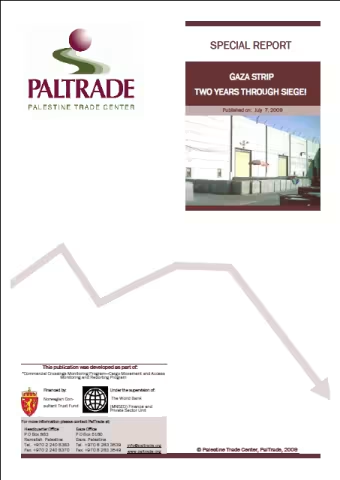
June 14, 2009 marks the second year of closure of the Gaza Strip for movement of both people and goods. The large majority of these movements are classified under the humanitarian functions with only limited quantities of exports mainly cash crops.
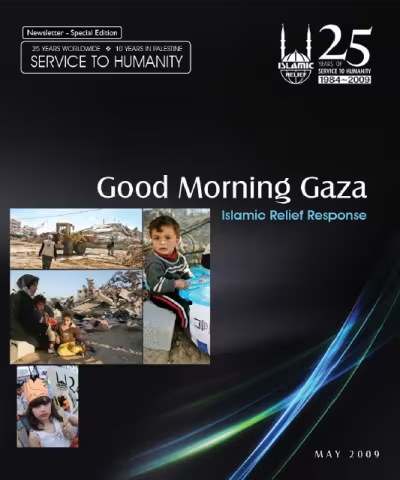
Months after the war, the Gaza Strip remains a disaster zone. Families are in despair, as hundresds of them had their homes totally destroyed and do not have proper shelter to endure Gaza's conditions.
IFI Research and Policy Memo #2 | January 2009
Governments Should Practice 'Water Demand Management' to Rescue Region's Water ResourcesHamed Assaf
Surging populations and increasing living standards in the Middle East are exacerbating the region’s water problem as countries begin to expect more of scarce and poorly managed water, warned Dr. Hamed Assaf, a professor of water resources engineering at the American University of Beirut. High water demand, negligence of water quality, and over-pumping are more serious threats to the region’s water supply than are the potential impacts of climate...
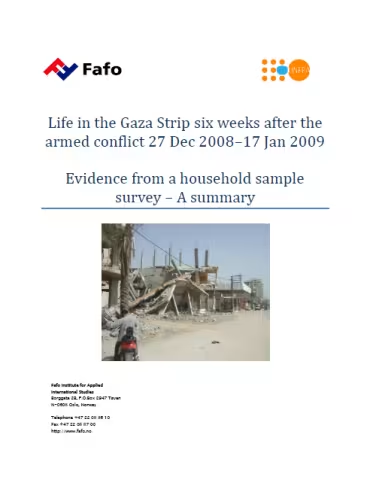
This multi-topic household sample survey was implemented to collect data to document the living conditions in the Gaza Strip in the wake of Israel’s assault on 27 December and the ensuing armed conflict.
Following the Nahr EL Bared War, LPDC launched in 2008 a workshop mapping the recovery and development initiatives in the camp's area. They followed up in 2009 with another workshop reviewing the development projects that took place in the NBC area.
2009 مذكرات للباحثين وصناع القرار #2 | كانون الثاني
على الحكومات أن تمارس "إدارة الطلب على المياه" كي تنقذ الموارد المائية للمنطقة من التغير المناخيحامد عساف
حذر البروفيسور حامد عساف من تفاقم مشكلة المياه في الشرق الاوسط يوماً بعد يوم، في ظل الزيادات السكانية وازدياد المتطلبات والمستوى المعيشي، مما يعني أنه على دول المنطقة توقع المزيد من الشح وتبعات سوء الإدارة في مواردها المائيةّ
وجاء كلام عساف، الدكتور برتبة بروفيسور في هندسة الموارد المائية في الجامعة الاميركية في بيروت، خلال محاضرته التي نظمها معهد عصام فارس للسياسات العامة والشؤون الدولية
The report assesses the progress made in the achievement of the Millennium Development Goals (MDGs) based on new national data which was formulated after the first MDGR that was published in 2003.
The fourth National Human Development Report, “Toward a Citizen’s State”, addresses citizenship in Lebanon through three principle perspectives: citizenship and sectarian state, socio-economic citizenship and citizenship and culture and education.
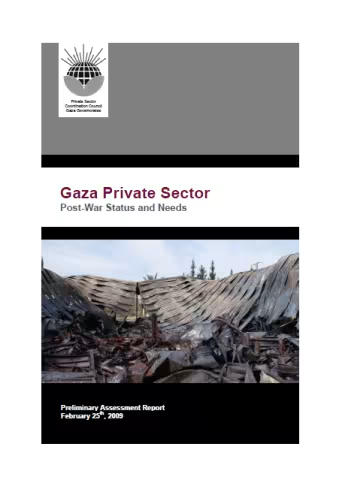
This report highlights the post war status of private sector businesses represented in the Palestinian Federation of Industries (PFI) in the Gaza Strip.
Parliamentary elections of 2009 and the year 2008 in review. The evenings of tuesday and Wednesday, April 7/8 marked the last day to register as a candidate for the Lebanese Parliamentary Elections scheduled on Sunday June 7, 2009.
Review of marginalisation of people with disabilities in Lebanon, Syria and Jordan. Using a social exclusion conceptual framework, this paper identifies several causes of marginalization of people with disabilities in the context of the MENA region.
This paper examines the impact of a rise in the Value Added Tax (VAT) on poverty and inequality in Lebanon. It develops an empirical model based on consumer demand theory and uses only household survey data on expenditures and spatial price indexes.
Research and Policy Memo #2 | January 2009
Public Sector Can Reduce Push Factors that Drive Youth Emigration Jad Chaaban
Young men and women prefer to leave Lebanon either temporarily or permanently to work abroad, leading to a decline in the country’s human capital and welfare. While the factors that attract youth abroad cannot be altered, the onus rests on public institutions in Lebanon to reduce the internal “push” factors that drive youth away.
“The Lebanese population’s age pyramid shows a shrinking trend in the 20-35 age categories,” said Jad Chaaban, a leading economist and researcher...
The aim of the “Socio-Economic Assessment in Nahr el-Bared surrounding areas” report is to provide an assessment of the pre and post conflict conditions of households located in the vicinity of Nahr el Bared camp for a variety of livelihood aspects including: housing, health,